
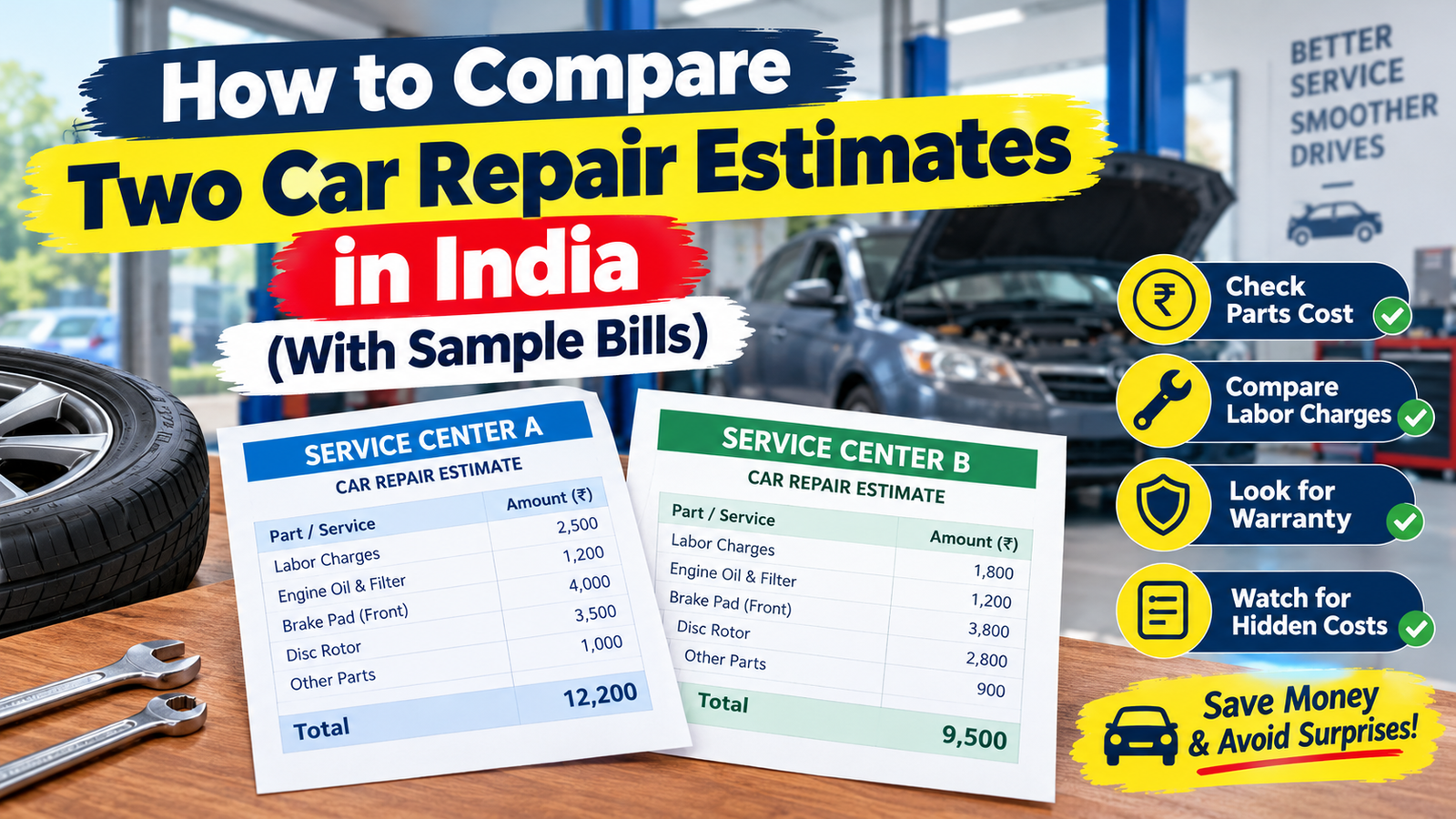
Your car goes into the garage and the estimate comes back at ₹17,000. A second garage says it can do the same job for ₹10,000. Which one do you trust?
Most people simply pick the lower number, and that is exactly where costly mistakes begin. A lower total can hide cheaper parts, missing jobs, vague labour charges or tax that has been left out. A higher total can include genuine quality, a proper warranty and a transparent bill.
If you want to compare car repair quotes the right way, you need to look past the final figure and break each estimate into its building blocks: parts, labour, extra charges, tax and warranty. In this guide, we will walk through two realistic sample bills step by step, so you can use the same method for any repair, from a simple service to a major job. For a deeper reference, you can also read our page on how to Compare Car Repair Estimates in India.
Why Comparing Car Repair Quotes Matters
Car repair is one of those expenses where you rarely know what a fair price looks like. Most owners are not mechanics, so they depend on whatever the garage tells them. That gap in knowledge is why two garages can quote very different amounts for what sounds like the same job.
The good news is that you don’t need to be a mechanic to compare estimates. You only need to make sure both quotes are measured on the same basis. Once you do that, the picture becomes much clearer, and you can decide whether a price difference is genuine savings or just a difference in what is being offered.
What a Proper Repair Estimate Should Contain
Before comparing two estimates, check that each one has the basics. A good estimate should list:
- Your car’s make, model, registration number and odometer reading
- Every part to be replaced, with name, brand and price
- Labour charges, split by job
- Any consumables or workshop charges, explained
- GST or tax details
- Warranty terms on parts and labour
- Expected delivery date
If an estimate is missing most of these, you cannot compare it fairly with anything. Ask the garage to rewrite it before you decide.
The Two Sample Bills
Let’s say a hatchback needs a front brake job, an engine oil service and a wheel alignment. Two garages give you the following estimates.
Garage A (Authorised Service Centre)
| Item | Amount (₹) |
|---|---|
| Front brake pads (OEM) | 3,200 |
| Front brake discs, pair (OEM) | 5,600 |
| Brake fluid | 450 |
| Engine oil + oil filter | 2,600 |
| Parts subtotal | 11,850 |
| Labour (brake job 1,200 + oil service 500 + alignment 800) | 2,500 |
| GST 18% on parts | 2,133 |
| GST 18% on labour | 450 |
| Total | 16,933 |
Garage B (Local Multi-brand Garage)
| Item | Amount (₹) |
|---|---|
| Brake pads (aftermarket) | 1,800 |
| Brake discs, pair (aftermarket) | 3,400 |
| Brake fluid | 300 |
| Engine oil + oil filter | 2,200 |
| Parts subtotal | 7,700 |
| Labour (one lump sum, no breakup) | 1,800 |
| “Workshop/consumables” charge | 400 |
| GST | Not mentioned |
| Total (cash) | 9,900 |
At first glance, Garage B is almost ₹7,000 cheaper. But this is not yet an apples-to-apples comparison. Let’s go through it one step at a time.
Step 1: Compare Parts by Name, Brand and Type
This is where most of the price gap comes from. Garage A has used OEM parts, meaning original parts approved by the car maker. Garage B has used aftermarket parts, which are made by third-party companies.
There are broadly three kinds of parts you will come across:
- OEM parts: Made to the car manufacturer’s specification, with guaranteed fit and usually a warranty. They cost the most.
- OES or “OEM-equivalent” parts: Made by the same companies that supply the carmaker, but sold under their own brand. Quality is often very close to OEM at a lower price.
- Aftermarket parts: Made by independent brands. Some are excellent, others are average, and a few are poor.
Ask Garage B directly: “Which brand are these pads, and what is the warranty?” If the garage cannot or will not name the brand, treat that as a red flag. For safety parts such as brakes, tyres and steering components, “anything will do” is a risky attitude.
Also compare quantity and specification. For example, make sure both estimates mention the same engine oil grade (such as 5W-30 or 0W-20) and the same quantity. A cheaper quote may use a lower grade or a smaller quantity of oil.
Step 2: Ask for a Labour Breakup
Garage A lists a separate charge for every job. Garage B simply says ₹1,800 as a lump sum. That makes it impossible to know what each job costs, or whether every job will actually be done.
Ask Garage B to write down labour job by job. This helps you in two ways. First, you can compare each job’s rate with Garage A. Second, you can spot jobs that are quietly missing. In our example, Garage B’s lump sum does not clearly mention wheel alignment, which is part of Garage A’s quote.
Labour rates also vary by city, garage type and car model. Authorised centres generally charge more per hour than independent garages, partly because of trained technicians, specialised tools and overheads. A higher rate is not automatically a rip-off, but it should be visible and explained.
Step 3: Check Extra and “Hidden” Charges
Look closely at entries such as “workshop charges”, “consumables”, “miscellaneous” or “washing”. Some of these are legitimate. Cleaners, grease, small clips, bolts and rags do get used during a repair. But a charge of ₹400 with no explanation deserves a polite question.
Here are a few things you can ask:
- What exactly does this charge cover?
- Is it a fixed percentage of the bill or a flat amount?
- Would you be willing to remove it if I provide my own consumables?
Garages that are confident about their pricing will answer these questions without discomfort.
Step 4: Bring Tax to the Same Level Before Comparing
This is the step people forget most often. Authorised service centres normally quote with GST included, while many local garages quote a “cash” price that leaves tax out.
For reference, since 22 September 2025, car parts, tyres, batteries and engine oil attract 18% GST, and labour charges attract a separate 18% GST. The earlier 28% rate on most auto parts no longer applies.
So Garage B’s estimate, adjusted for GST, would look like this:
- Cash total: ₹9,900
- 18% GST: ₹1,782
- Total with GST: ₹11,682
Now the gap shrinks from ₹7,033 to ₹5,251, and most of that remaining difference is explained by the parts quality.
One note: some very small garages are not registered for GST, and not charging it can be perfectly legal for them. What matters for you is to bring both quotes to the same basis, either both with GST or both without, before you compare. If you may want to claim the expense or keep a proper record, ask for a GST invoice.
Step 5: Compare Warranty and Guarantee
A cheaper estimate is only cheaper if the work holds up. Ask each garage:
- What is the warranty on the parts (months or kilometres)?
- Is there any guarantee on the labour?
- If the same problem returns within a couple of weeks, will they redo the job free of charge?
- Is the warranty written on the bill or only verbal?
Authorised centres usually give written warranties, and manufacturer-backed parts often carry their own. Many local garages are good too, but get the promise written on the bill instead of relying on a verbal assurance. A warranty that exists only in conversation is very hard to claim later.
Step 6: Build One Final Comparison Table
Now put both quotes in the same format:
| Point | Garage A | Garage B |
|---|---|---|
| Parts type | OEM | Aftermarket (brand?) |
| Parts cost | ₹11,850 | ₹7,700 |
| Labour | ₹2,500 (itemised) | ₹1,800 (lump sum) |
| Extra charges | None | ₹400 |
| GST | Included, ₹2,583 | ₹1,782 (adjusted) |
| Total | ₹16,933 | ₹11,682 |
| Warranty | Written | To be confirmed |
This makes the decision far easier. If your car is new and still under warranty, OEM parts and an authorised centre make sense, because using non-approved work can complicate warranty claims. If the car is older and your budget is tight, Garage B is a reasonable option, as long as you get a reputed aftermarket brand named on the bill, a proper labour breakup and a written warranty.
How to Negotiate Without Souring the Relationship
Comparing quotes is not only about choosing one garage. It is also a useful way to negotiate. A few approaches work well:
- Share the other quote politely. Say, “Another garage has quoted this for the same parts. Can you match or come closer?” Many garages will adjust labour or extras.
- Ask for part options. Request a price with OEM parts and another with a good aftermarket alternative, so you can choose.
- Bundle jobs. If you are already getting one job done, ask for a discount on adding another, such as alignment or a wash.
- Don’t haggle on safety. Negotiate on labour, extras and optional items, but avoid squeezing the quality of brakes, tyres or steering parts.
Red Flags to Watch for in Any Estimate
- Vague entries like “brake work” or “engine repair” with no part names.
- An estimate given over the phone without inspecting the car.
- Pressure such as “Do it today, the offer ends tonight.”
- Replacing parts you don’t understand the need for. Ask to see the old part after replacement.
- A round-figure total with no itemised calculation behind it.
- Refusal to give anything in writing.
- A big jump between the estimate and the final bill, with no prior approval from you.
When the Cheapest Quote Is Not the Best Quote
Sometimes the lowest quote is genuinely the best, for example when two garages use the same brand of parts and one simply has lower overheads. But there are situations where a cheaper quote costs more in the long run:
- Safety-critical repairs: Brakes, suspension, steering and tyres. Poor quality here puts you at risk.
- Repeat repairs: If a cheap part fails in six months and you pay for labour again, the saving disappears.
- Warranty-sensitive cars: If your car is under manufacturer warranty or an extended warranty, unapproved parts or workshops can create complications.
- Complex electronics: Modern cars need proper diagnostic tools, which small garages may not have.
In these cases, pay for quality, and use the comparison method above to make sure you are not overpaying beyond that.
Quick Checklist When Asking for an Estimate
- Get the estimate in writing (WhatsApp is fine).
- Every part should be listed with its name, brand and price.
- Labour should be split job by job.
- Extra charges should be explained.
- The GST or tax status should be clear.
- Warranty and delivery date should be mentioned.
- Get at least two quotes, three if possible.
FAQs
Should I always choose the cheapest estimate?
No. The cheapest estimate is only the better deal if the parts quality, labour and warranty are comparable. Otherwise you may end up paying again later.
How do I compare quotes when the tax treatment is different?
Bring both totals to the same basis, either both with 18% GST added or both without. See Step 4 above for a worked example.
What if the final bill is higher than the estimate?
Before work starts, get it in writing that any extra work needs your approval first. This avoids surprise bills.
How many garages should I get quotes from?
Two or three. More than that creates confusion, and fewer makes comparison difficult.
Is it okay to ask for the old parts back?
Yes. Asking to see or keep the replaced parts is a normal request and one of the simplest ways to confirm the work was actually done.
Bottom Line
Instead of looking only at the total price, put parts, labour, extra charges, tax and warranty side by side in one table. Doing this alone will help you avoid most costly mistakes and give you the confidence to question anything that doesn’t add up. Next time an estimate lands in your hands, keep this checklist ready and compare car repair quotes the smart way.

Through CarJeevan,prashant bobde aims to make confusing automotive information easier to understand. The website focuses on practical questions that car owners face, such as how to compare garage quotations, understand parts and labour charges, review additional fees, and identify the right questions to ask before approving a repair.
CarJeevan also provides a free Car Repair Estimate Calculator and Garage Quote Comparator that helps users organise and compare two repair quotations using the information provided by the user.
The editorial approach focuses on clear explanations, practical examples, and transparent limitations. Where appropriate, articles refer to official information, manufacturer guidance, policy documents, and other reliable sources. Illustrative examples are identified as examples rather than presented as actual market prices.
CarJeevan does not claim to diagnose vehicle faults or independently verify every garage’s prices. Readers are encouraged to consult a qualified automotive professional for mechanical inspections and safety-related repair decisions.
The goal is simple: to help Indian car owners understand repair costs better, ask informed questions, and make decisions with greater clarity.
Website: https://carjeevan.com/