
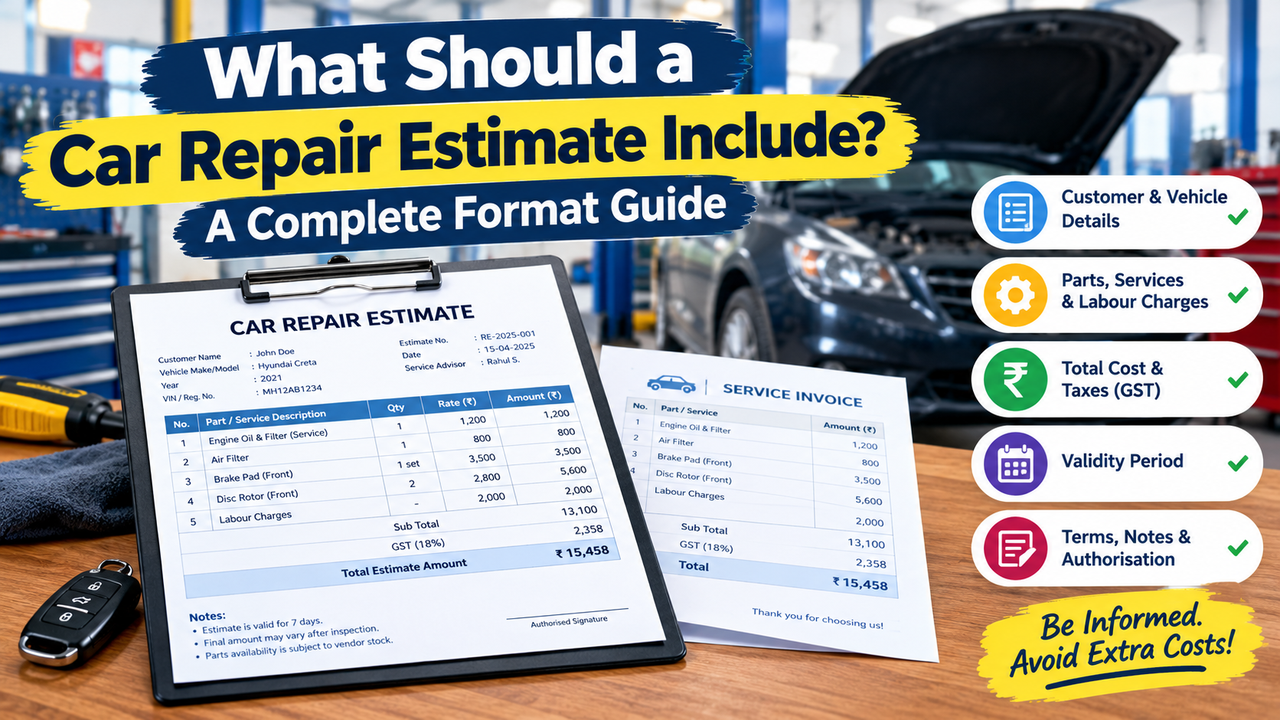
You hand over your keys, the service advisor taps a few buttons and says, “It will come to around ₹12,000.” No list, no breakdown, just a number. Sound familiar?
An estimate like that is not really an estimate. It is a guess, and it leaves you with no way to check what you are paying for. A proper car repair estimate format shows you exactly what will be fixed, which parts will be used, how much labour is being charged and what protection you get afterwards.
In this guide, we will go through every section a useful estimate should have, and how each one should look on paper. If you already have two quotes in hand, you can pair this guide with our article on how to compare two car repair estimates in India.
Why the Format of an Estimate Matters
A well-structured estimate protects both you and the garage. You know what you have agreed to, and the garage has a record of what you approved. If something goes wrong later, such as a part failing early or a bill that suddenly grows, the written estimate is your reference point.
A clear format also makes comparison possible. Two garages can only be compared fairly if both list parts, labour and tax in the same way. A vague estimate hides the very details that explain price differences.
Section 1: Vehicle and Customer Details
Every estimate should begin with the basics, because they tie the document to your specific car and visit. Look for:
- Your name and contact number
- Car make, model, variant and year
- Registration number and, ideally, the VIN or chassis number
- Odometer reading at drop-off
- Date and time of the estimate
- Fuel level, and any existing dents or damage noted at drop-off
The odometer reading matters for warranty claims, and the damage notes protect you from disputes about marks that were already on the car.
Section 2: A Clear Problem Description
Before any numbers, the estimate should state what is being fixed and why. “Front brakes squealing; pads worn below limit” is useful. “Brake work” is not.
Good estimates describe the complaint you reported and the garage’s diagnosis. If the garage found extra issues during inspection, they should appear separately and be marked as recommended or optional, not quietly added to the total.
Section 3: Parts List, Line by Line
This is the heart of the estimate, and where most confusion happens. Every part should have its own line with these details:
- Part name: specific, such as “front brake pad set”, not “brake parts”
- Brand and part number: so you can verify it later
- Type: OEM, OEM-equivalent or aftermarket
- Quantity and unit: for example 1 set, 2 pieces, 3.5 litres
- Unit price and line total
Here is how the parts section should look:
| Part | Brand / Type | Qty | Unit price (₹) | Total (₹) |
|---|---|---|---|---|
| Front brake pad set | Brand X, OEM-equivalent | 1 set | 2,400 | 2,400 |
| Engine oil 5W-30 synthetic | Brand Y | 3.5 L | 650 | 2,275 |
| Oil filter | Brand Y | 1 | 350 | 350 |
The type column deserves attention. OEM parts come from the carmaker’s approved supply, while aftermarket parts come from independent brands and vary in quality. The estimate should tell you which one you are getting, so the price makes sense.
Section 4: Quantity and Units Done Right
Quantity looks like a minor detail, but it is a common place for padding. Check that:
- Liquids are listed in litres or millilitres, not as “1 unit”
- Pairs and sets are stated clearly (a “pair” of discs versus a single disc)
- Quantities match what your car actually needs, which you can verify in the owner’s manual for items like engine oil
If the oil quantity on the estimate is 4 litres but your car’s engine takes 3.5, ask why. Sometimes there is a valid reason, but it should be explained.
Section 5: Labour Charges, Job by Job
Labour should never be a single lump sum. A good format lists each job separately with its charge, and where possible, the time or rate behind it:
| Job | Labour (₹) |
|---|---|
| Front brake pad replacement | 800 |
| Engine oil and filter change | 400 |
| Labour total | 1,200 |
Many garages work on a “flat rate” system, where each job has a fixed charge regardless of how long it takes. Others charge hourly. Either is fine, as long as the method is clear.
Separate listing also helps you see what is not included. If your problem needs a brake inspection and the estimate has no line for it, you can ask whether it is covered.
Section 6: Additional Charges, Clearly Explained
This is where unexplained amounts usually sneak in. Common legitimate extras include:
- Consumables: cleaners, grease, small clips and fasteners
- Disposal fees: for used oil or batteries
- Diagnostic or scanning charges: for electronic fault-finding
- Pickup and drop: if the garage collects your car
- Washing or detailing: if included
Each should be a separate line with an amount, and ideally a short note. A line saying “Workshop charges: ₹150 (cleaners, grease, fasteners)” is acceptable. A line saying “Misc: ₹1,500” is not. If you see vague entries, ask what they cover. You are entitled to an answer.
Section 7: Taxes Shown Separately
Tax should appear as its own lines, not buried inside prices. Since 22 September 2025, car parts, tyres, batteries and engine oil attract 18% GST, and labour charges attract a separate 18% GST. taxgardenshriramfinance
A clear estimate shows GST on goods and GST on labour separately, along with the garage’s GSTIN if it is registered. The estimate should also say whether the displayed prices are inclusive or exclusive of tax. Without that note, you can’t tell whether ₹5,000 means ₹5,000 or ₹5,900.
Section 8: Warranty Terms in Writing
Warranty is part of the price you are paying, so it belongs on the estimate. Look for:
- Parts warranty: the period in months or kilometres, and who provides it (manufacturer or garage)
- Labour warranty: whether the work itself is guaranteed, and for how long
- What is excluded: for example, damage caused by misuse or accidents
- How to claim: whom to contact and what documents to bring
A verbal promise such as “we’ll take care of it if anything happens” is hard to enforce. If the garage is confident in its work, it will have no problem writing the warranty on the estimate or invoice.
Section 9: Approval, Validity and Delivery Terms
The last section covers the terms that stop surprises later:
- Validity: how long the quoted prices hold, since parts prices can change
- Approval for extra work: a statement that any additional work will be done only after you approve it
- Estimated delivery date: and what happens if there is a delay
- Payment terms: advance required, if any, and accepted payment methods
- Old parts: whether replaced parts will be returned to you on request
The approval clause is especially important. It means a ₹7,000 estimate cannot quietly grow into a ₹11,000 invoice without your say.
Sample Estimate: Putting It All Together
Here is a compact example showing how the sections fit together for a brake pad replacement and oil service:
| Item | Detail | Amount (₹) |
|---|---|---|
| Front brake pad set | Brand X, OEM-equivalent, 1 set | 2,400 |
| Engine oil 5W-30 | Brand Y, 3.5 L at ₹650 | 2,275 |
| Oil filter | Brand Y, 1 pc | 350 |
| Consumables | Cleaner, grease, fasteners | 150 |
| Parts and consumables subtotal | 5,175 | |
| Labour: brake pads | Replacement, front axle | 800 |
| Labour: oil service | Oil and filter change | 400 |
| Labour subtotal | 1,200 | |
| GST at 18% on parts and consumables | 931.50 | |
| GST at 18% on labour | 216.00 | |
| Round-off | 0.50 | |
| Grand total | 7,523 | |
| Warranty | Pads: 6 months. Labour: 30 days | |
| Validity | 7 days. Extra work only with approval |
Notice how every rupee can be traced. If you ask “why is this ₹7,523?”, the document itself answers.
Common Mistakes in Estimates to Avoid
- No part names, just categories like “engine repair”
- Quantities missing, or listed as “1” for liquids
- Labour shown only as a lump sum
- “Miscellaneous” charges with no explanation
- Tax missing, or unclear whether prices include it
- No warranty details at all
- Estimates sent as a single total on a text message
If you spot more than one of these, ask the garage to reissue the estimate before you agree to anything.
Quick Checklist Before You Approve an Estimate
- Are your car details and odometer reading recorded?
- Is the problem described clearly?
- Does every part show name, brand, type, quantity and price?
- Is labour split job by job?
- Are extra charges explained?
- Is GST shown separately, and are prices clearly inclusive or exclusive?
- Is the warranty written down?
- Does the estimate mention validity and approval for extra work?
FAQs
Is a verbal estimate valid?
It is better than nothing, but hard to rely on. Always ask for a written or digital estimate, even if it is just a WhatsApp message with the full breakdown.
Can the final bill be higher than the estimate?
It can be, if extra problems are found. But the garage should get your approval before doing any additional work, and it should be written on the estimate that it will.
Should I pay for an estimate?
Basic estimates are usually free. Detailed diagnostics, such as scanner reports or teardown inspections, may carry a fee. Ask upfront, and check whether the fee is adjusted against the repair if you go ahead.
What if a garage refuses to itemise?
Treat it as a warning sign. A garage with fair pricing has no reason to hide the breakdown.
Final Thoughts
A good estimate is not about paperwork for its own sake. It is about knowing what you are paying for, who is responsible if something goes wrong, and whether the price is fair. Insist on a clear car repair estimate format with itemised parts, quantities, labour, extra charges, tax and warranty, and you will avoid most of the surprises that make car repairs stressful.

Through CarJeevan,prashant bobde aims to make confusing automotive information easier to understand. The website focuses on practical questions that car owners face, such as how to compare garage quotations, understand parts and labour charges, review additional fees, and identify the right questions to ask before approving a repair.
CarJeevan also provides a free Car Repair Estimate Calculator and Garage Quote Comparator that helps users organise and compare two repair quotations using the information provided by the user.
The editorial approach focuses on clear explanations, practical examples, and transparent limitations. Where appropriate, articles refer to official information, manufacturer guidance, policy documents, and other reliable sources. Illustrative examples are identified as examples rather than presented as actual market prices.
CarJeevan does not claim to diagnose vehicle faults or independently verify every garage’s prices. Readers are encouraged to consult a qualified automotive professional for mechanical inspections and safety-related repair decisions.
The goal is simple: to help Indian car owners understand repair costs better, ask informed questions, and make decisions with greater clarity.
Website: https://carjeevan.com/