
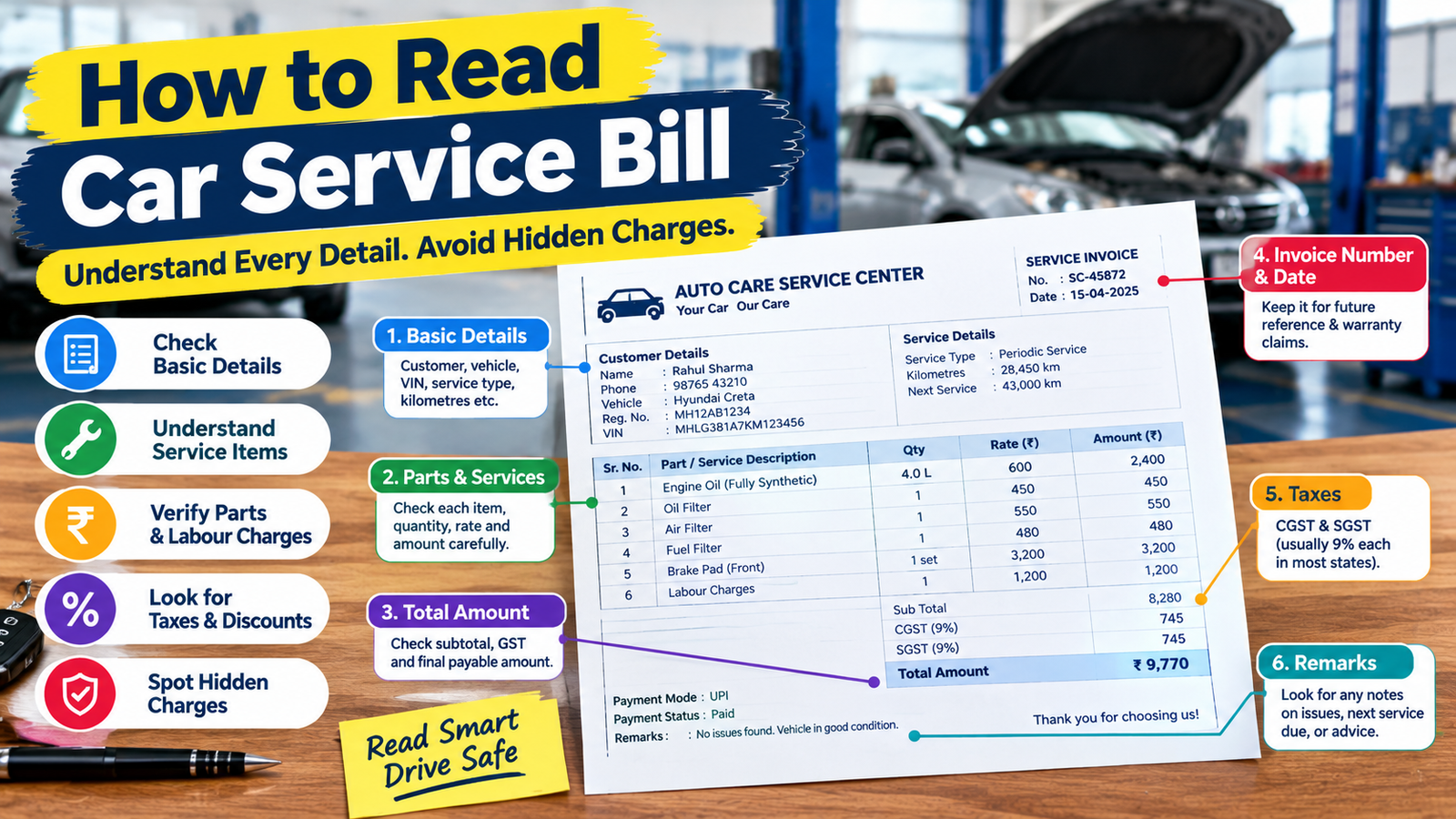
You collect your car after a service, the advisor hands you a printed invoice with a dozen lines, codes you don’t recognise and a total at the bottom. You pay, say thanks and drive away without really knowing what you just paid for.
Most car owners do exactly this. But a service invoice is not just a receipt. It is a record of what was done to your car, which parts went in, what you were charged for them and what protection you have afterwards. Knowing how to read a car service bill helps you catch errors, question unnecessary charges and keep proper records for warranty or resale.
In this guide, we will go through every section of a typical Indian car service invoice, using one worked example so the numbers are easy to follow. If you are still at the quote stage, read our guide on how to compare two car repair estimates in India first, and see what a car repair estimate should include to know what a good estimate looks like.
The Quick Anatomy of a Car Service Invoice
Almost every invoice, whether from an authorised service centre or an independent garage, follows the same structure from top to bottom:
- Garage and customer details
- Vehicle details and odometer reading
- Parts and materials
- Labour charges
- Additional charges
- Discounts
- Taxes
- Round-off and grand total
- Warranty, remarks and signature
Let’s take each one in turn.
Customer and Vehicle Details
The top of the invoice should carry the garage’s name, address, contact number and, if it is GST-registered, its GSTIN. Below that you will see an invoice number and date, plus your name and phone number.
Vehicle details matter more than people think. Check that these are correct:
- Registration number
- Make, model and variant
- Odometer reading at the time of service
- Job card number, if the garage uses one
The odometer reading is your proof of when a service was done. Manufacturers and buyers of used cars often look at service history, so a wrong reading can cause trouble later. A mismatch with your job card is also worth raising on the spot.
Parts and Materials
This is usually the biggest block. Each part should have its own row showing description, quantity, rate and amount, often with an HSN code (the goods classification code used under GST).
Here is a sample invoice for a 40,000 km periodic service on a hatchback. We will use it for the rest of this article.
| # | Description | Qty | Rate (₹) | Amount (₹) |
|---|---|---|---|---|
| 1 | Engine oil 5W-30 | 3.5 L | 600 | 2,100 |
| 2 | Oil filter | 1 | 350 | 350 |
| 3 | Air filter | 1 | 480 | 480 |
| 4 | Cabin (AC) filter | 1 | 520 | 520 |
| 5 | Brake fluid | 500 ml | 420 | 420 |
| Parts subtotal | 3,870 |
How to read it:
- Description: Should name the part specifically. “Filter” alone is not enough, since there are oil, air, fuel and cabin filters.
- Qty: Liquids should be in litres or millilitres. Cross-check against your owner’s manual. If your engine takes 3.5 litres and the bill says 4.5, ask why.
- Rate and amount: Quantity multiplied by rate should equal the amount. It sounds obvious, but arithmetic slips happen.
- HSN code: Different parts carry different codes, though many car parts fall under heading 8708. You don’t need to memorise these. Just check that a code is present on a GST invoice.
Labour Charges
Labour is the garage’s charge for the work itself. A clear invoice lists each job separately.
| # | Job | Amount (₹) |
|---|---|---|
| 1 | 40,000 km periodic service labour | 1,500 |
| 2 | Wheel alignment and balancing | 900 |
| 3 | Brake fluid replacement | 300 |
| Labour subtotal | 2,700 |
Labour is usually charged in one of two ways. Flat-rate means a fixed price per job set by the garage or manufacturer, regardless of how long it takes. Hourly means a rate per hour multiplied by time taken. Both are legitimate. What you should watch for is a single lump-sum line such as “Labour: ₹2,700” with no breakdown, because you can’t tell which jobs it covers.
Labour lines also carry a service accounting code, called a SAC, instead of an HSN. If you see “SAC” next to labour, that is normal.
Additional and “Hidden” Charges
Below parts and labour, you will often find smaller lines. Some are genuine, and some deserve a question. In our example there is one:
| Item | Amount (₹) |
|---|---|
| Consumables (cleaner, grease, fasteners) | 180 |
Here are the extra charges you are most likely to meet, and how to judge them:
- Consumables or shop supplies: Legitimate when small and explained. Be cautious if it is a large flat figure with no description.
- Disposal or environmental fee: Sometimes charged for used oil or old batteries. Reasonable if modest.
- Diagnostic or scanning charges: Fair for electronic fault-finding, but should be mentioned before the work, not discovered on the bill.
- Pickup and drop: Valid if you used the service. Check you actually did.
- Washing or interior cleaning: Often complimentary at authorised centres. If it appears as a charge you didn’t ask for, question it.
- Add-ons: Anti-rust coating, engine decarbonising, AC disinfection and similar extras. These should always be agreed in advance.
A simple rule: any amount you can’t explain in one sentence is worth asking about.
Discounts
Discounts can appear in several forms: a percentage off labour, a festive offer, a loyalty reward, a coupon, or a free item such as a wash. The important question is where the discount is applied.
In our example, the garage gives a 10% discount on labour:
- Labour subtotal: ₹2,700
- Discount at 10%: ₹270
- Labour after discount: ₹2,430
A discount applied before tax reduces the amount on which GST is calculated, so you save slightly more than the headline figure. A discount applied after tax only reduces the final payable amount. Look at the order of lines on the invoice to see which has been used. Also confirm that any discount promised verbally actually appears on the bill.
Taxes
This is the section that confuses most people, but it follows a simple pattern. Since 22 September 2025, car parts, tyres, batteries and engine oil attract 18% GST, and labour charges attract a separate 18% GST. taxgardenshriramfinance
Using our example:
| Component | Taxable value (₹) | GST at 18% (₹) |
|---|---|---|
| Parts and consumables (3,870 + 180) | 4,050.00 | 729.00 |
| Labour after discount (2,700 − 270) | 2,430.00 | 437.40 |
| Total taxable value | 6,480.00 | 1,166.40 |
On the invoice, you will usually see the 18% split into two halves:
- CGST 9% and SGST 9%: When the garage and the place of supply are in the same state. Each half is ₹583.20 in our example.
- IGST 18%: When the sale crosses state lines, which is rare for ordinary car servicing.
Either way, the total tax is the same. If the invoice shows a different overall percentage on parts without explanation, ask the garage to clarify.
Also remember that very small garages may not be GST-registered, in which case you may see no tax at all. That is not automatically a problem, but it affects how you compare it with another garage’s bill.
Round-off and Grand Total
Now we put it together:
| Line | Amount (₹) |
|---|---|
| Parts and consumables | 4,050.00 |
| Labour (after discount) | 2,430.00 |
| Taxable value | 6,480.00 |
| CGST 9% | 583.20 |
| SGST 9% | 583.20 |
| Total with tax | 7,646.40 |
| Round-off | −0.40 |
| Grand total payable | 7,646.00 |
The round-off is just the garage rounding to the nearest rupee. It should be small, under ₹1. If you see a large round-off, that is a red flag.
A quick check you can do yourself: add parts and labour, subtract the discount, multiply by 1.18, and compare with the grand total. If the numbers are far apart, something is off.
Warranty, Remarks and Signature
The bottom of the invoice often holds the most useful information. Look for:
- Warranty terms: On parts and on labour, in months or kilometres
- Next service due: Date or odometer reading
- Technician remarks: Issues spotted but not fixed, such as “rear pads at 30%”
- Old parts returned or not
- Signatures: Yours and the garage’s
Keep this invoice safe. It is the proof you will need for warranty claims, insurance and resale value.
Check the Invoice Against the Estimate
Before you pay, do one more thing: compare the invoice to the estimate or job card you approved. Check that:
- Every part and job on the invoice was in the estimate or was approved separately
- The prices match
- Nothing new has appeared without your permission
- Jobs you paid for were actually completed
If the final bill is higher, the garage should be able to show where the difference comes from and that you approved it.
Red Flags to Watch for on Any Invoice
- Vague descriptions such as “engine work” or “general service”
- Quantities that don’t match your car’s needs
- Labour shown as a single lump sum
- Large “miscellaneous” or “workshop” charges
- Missing GSTIN on a bill that charges GST
- Arithmetic that doesn’t add up
- Discounts promised but not shown
- Charges for add-ons you never agreed to
Quick Checklist Before You Pay
- Are your car details and odometer reading correct?
- Does each part show its name, quantity, rate and amount?
- Is labour listed job by job?
- Are extra charges small and explained?
- Is the discount shown, and applied before tax?
- Is GST at the right rate and split correctly?
- Does the grand total match your own quick calculation?
- Is the warranty written on the invoice?
- Does it match the estimate you approved?
FAQs
Can I ask for a GST invoice?
Yes. If the garage is GST-registered, you are entitled to a proper tax invoice, which you may need for business use or records.
What if I find an error after paying?
Contact the garage with the invoice and job card as soon as possible. Most genuine mistakes get corrected, and a clear paper trail helps.
Should I keep old invoices?
Yes. Service history improves resale value and is often needed for warranty claims.
Is it normal for labour to be taxed too?
Yes. Labour is a service, and it attracts GST separately from parts.
Final Thoughts
A car service invoice looks complicated, but it only has a few moving parts: what was used, what was done, what extras were added, what was discounted and how much tax applies. Once you know how each part is calculated, you can read any bill with confidence and spot problems before you pay. Next time you collect your car, spend two minutes with the invoice. It is the cheapest way to avoid an expensive mistake.

Through CarJeevan,prashant bobde aims to make confusing automotive information easier to understand. The website focuses on practical questions that car owners face, such as how to compare garage quotations, understand parts and labour charges, review additional fees, and identify the right questions to ask before approving a repair.
CarJeevan also provides a free Car Repair Estimate Calculator and Garage Quote Comparator that helps users organise and compare two repair quotations using the information provided by the user.
The editorial approach focuses on clear explanations, practical examples, and transparent limitations. Where appropriate, articles refer to official information, manufacturer guidance, policy documents, and other reliable sources. Illustrative examples are identified as examples rather than presented as actual market prices.
CarJeevan does not claim to diagnose vehicle faults or independently verify every garage’s prices. Readers are encouraged to consult a qualified automotive professional for mechanical inspections and safety-related repair decisions.
The goal is simple: to help Indian car owners understand repair costs better, ask informed questions, and make decisions with greater clarity.
Website: https://carjeevan.com/