
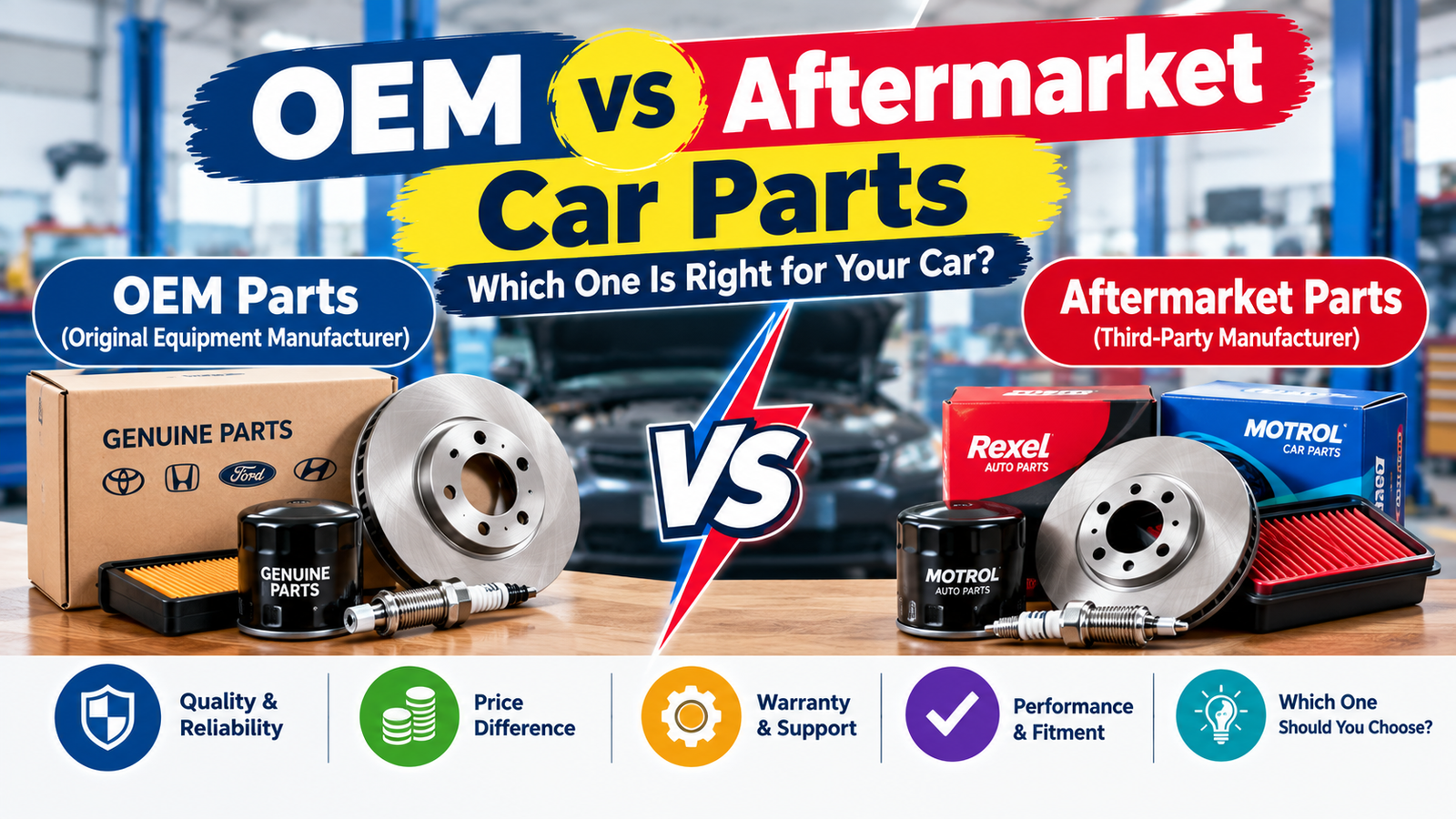
Your mechanic calls and says, “The brake pads need replacing. I can fit original ones for ₹3,200 or a local brand for ₹1,800. Which one do you want?”
It sounds like a simple question, but the answer isn’t obvious. The cheaper option might be perfectly fine, or it might wear out in half the time. The expensive one might be worth every rupee, or it might be more than your older car really needs.
That is the heart of the OEM vs aftermarket car parts debate. In this guide, we’ll explain what each term means, how they differ in compatibility, quality, warranty and price, and how to decide which one suits your car and your budget. If you are already holding two quotes with different part types, our guide on how to compare two car repair estimates in India will help you line them up fairly.
What Do OEM and Aftermarket Actually Mean?
Before comparing, let’s get the terms straight, because garages and parts shops use them loosely.
OEM (Original Equipment Manufacturer) parts are the same parts your car was built with. They are made to the carmaker’s specification and sold in the carmaker’s packaging, usually through authorised dealers and service centres. In India, these are often sold as “genuine parts” with the manufacturer’s branding.
OES (Original Equipment Supplier) parts are made by the same company that supplies the carmaker, but sold under the supplier’s own brand. The part is often nearly identical to the OEM version, just without the carmaker’s logo on the box. These are often called “OEM-equivalent” parts.
Aftermarket parts are made by independent companies and sold separately from the carmaker. They are designed to fit and work like the original, but they are not tied to the carmaker’s specification. Quality ranges widely, from excellent to very poor.
So the real picture is not just “original versus cheap”. It is a spectrum: OEM at one end, premium aftermarket and OES in the middle, and budget or unbranded parts at the other end.
OEM vs Aftermarket at a Glance
| Factor | OEM / Genuine | Aftermarket |
|---|---|---|
| Fit and compatibility | Made for your exact model | Usually fits, but varies by brand |
| Quality consistency | Very consistent | Ranges from excellent to poor |
| Warranty | Typically backed by carmaker or dealer | Depends on brand and seller |
| Price | Higher | Often lower |
| Availability | Authorised dealers, sometimes slower for older models | Widely available, many options |
| Choice | One option per part | Multiple brands and price levels |
Now let’s look at each factor in detail.
Compatibility: Will It Actually Fit?
This is where OEM parts have a clear edge. Because they are made to the carmaker’s own drawings, they fit your specific model, variant and year without guesswork. There are no surprises with mounting points, connector shapes or tolerances.
Good aftermarket parts also fit well. Reputed brands invest in reverse-engineering and testing, and many supply parts to carmakers too. But compatibility can slip in a few areas:
- Variant differences: A part for one engine variant may not suit another version of the same model.
- Electronics: Sensors, modules and lighting units can be fussy. A part that physically fits may still trigger warning lights or not communicate properly with the car’s computer.
- Cheap copies: Budget parts sometimes have slightly off dimensions, which makes fitting harder and wear faster.
A practical tip: always give your mechanic your car’s exact model, variant, year and, if possible, the VIN or part number. Matching the original part number is the simplest way to avoid fitment problems with any type of part.
Quality: Is OEM Always Better?
Not always, and this is where many people get misled. OEM parts offer consistent quality, because the carmaker sets standards and the supplier has to meet them every time. You know roughly what you are getting.
Aftermarket quality is less predictable, but it is not automatically lower. Some aftermarket brands match or exceed the original in specific areas. For example, a performance-oriented brake pad might offer better stopping power or last longer than the standard fitment, though it may make more noise or dust. Other aftermarket parts are made from cheaper materials and wear out quickly.
The real difference is consistency. With OEM, quality is a safe bet. With aftermarket, quality depends on the brand, so choosing the brand matters far more than choosing the category.
How to judge an aftermarket brand:
- Is it a known name with a track record in your market?
- Does it supply to carmakers (OES)? That is a strong sign of quality.
- Does the part come with a proper warranty and a GST invoice?
- Do independent mechanics you trust fit and recommend it?
If a garage cannot tell you the brand of a part, treat that as a red flag. A part without a name is a part without accountability.
Warranty: What Protection Do You Get?
Warranty is often the deciding factor, so it deserves a careful look.
OEM parts usually carry a warranty from the carmaker or dealer, often 6 to 12 months or a set distance for many parts, though terms vary by part and manufacturer. Claims are handled through authorised service centres, which makes the process straightforward.
Aftermarket parts may also carry a warranty, but it varies widely by brand. Reputed brands offer clear warranty terms, while budget or unbranded parts may offer little or nothing in writing.
There is a second warranty issue to understand: your car’s own manufacturer warranty. If your car is new and still under warranty, using non-approved parts or workshops can complicate a claim, especially if the aftermarket part is blamed for a failure. The exact terms differ between manufacturers, so check your warranty booklet or ask the service centre before choosing. If your car is out of warranty, this concern mostly disappears.
Whichever you choose, get the part warranty written on the estimate or invoice. A verbal promise is very hard to enforce later. For more on what a proper estimate should show, see our guide on what a car repair estimate should include.
Price: How Big Is the Gap?
Price is why aftermarket parts exist. They are typically cheaper than OEM, and the gap can range from a modest saving to a large one depending on the part and brand.
Here is an illustrative example for a common hatchback front brake job. These figures are samples to show the pattern, not exact market prices:
| Part | OEM / Genuine (₹) | Quality aftermarket (₹) | Budget aftermarket (₹) |
|---|---|---|---|
| Front brake pads (set) | 3,200 | 2,200 | 1,400 |
| Oil filter | 450 | 350 | 200 |
| Air filter | 650 | 480 | 300 |
| Headlight bulb pair | 900 | 600 | 350 |
Notice that quality aftermarket usually sits between the two extremes. Budget aftermarket is cheapest, but that is where the risk of poor quality is highest.
Tax is the same regardless of part type. Since 22 September 2025, car parts, tyres, batteries and engine oil attract 18% GST, so the percentage gap stays the same after tax, though the rupee gap grows slightly. taxgarden
Also consider cost over time. A cheap part that needs replacing twice as often may cost more in the end, especially if labour is charged each time. For parts that are expensive to fit, such as clutch kits or timing belts, paying for quality up front often saves money.
Which Parts Should You Choose OEM For?
Not every part carries the same risk or importance. A sensible approach is to spend more where failure is costly or dangerous, and save where the part is simple or cosmetic.
| Part category | Suggested approach | Why |
|---|---|---|
| Brakes, steering, suspension | OEM or reputed OES | Safety critical |
| Airbags and safety systems | OEM only | Safety critical, precise specification |
| Engine and transmission internals | OEM or top-tier OES | Costly failures, tight tolerances |
| Electronic sensors and modules | OEM preferred | Compatibility with the car’s computer |
| Filters, wipers, bulbs | Quality aftermarket is fine | Simple parts, easy to replace |
| Batteries and tyres | Reputed brands, OEM not essential | Many good independent brands |
| Cosmetic parts, mats, accessories | Aftermarket is fine | Low risk |
| Body panels and mirrors | Depends on fit and finish | Check fit before painting |
This is a general guide, not a rule. Your car’s age, your budget and how long you plan to keep it all matter.
How to Avoid Counterfeit Parts
Counterfeit parts, which are fake copies sold as genuine, are a real problem in some parts markets, and they affect both OEM and branded aftermarket categories. Here is how to reduce the risk:
- Buy from authorised dealers or trusted retailers. An unusually low price from an unknown seller is a warning sign.
- Check the packaging. Look for clean printing, correct part numbers, batch codes and any authentication labels or QR codes.
- Verify the part number. Match it against the manufacturer’s catalogue or your owner’s manual.
- Ask for a GST invoice. A proper invoice shows the seller is accountable.
- Inspect the part itself. Poor finishing, uneven weight or misspelled branding can indicate a fake.
- Ask your mechanic. Experienced mechanics often spot fakes quickly.
Common Mistakes People Make
- Assuming “aftermarket” always means low quality
- Assuming “OEM” is always necessary, even for a ten-year-old car
- Choosing purely on price without checking the brand
- Not asking about warranty before agreeing
- Letting the garage choose the part type without telling them
- Ignoring the car’s own warranty status
- Buying safety-critical parts from unverified sellers
A Simple Decision Checklist
- Is your car under manufacturer warranty? If yes, lean towards OEM or check with the service centre first.
- Is the part safety critical? If yes, choose OEM or a reputed OES brand.
- How long will you keep the car? Longer ownership favours quality parts.
- Is the aftermarket brand named, reputed and warranted?
- Is the warranty written on the invoice?
- Are you buying from a trustworthy source?
- Have you compared the price over time, not just today?
FAQs
Are aftermarket parts legal in India?
Yes. Aftermarket parts are widely sold and used. What matters is that they meet safety and quality standards, and that you buy from reliable sources.
Do aftermarket parts void my car’s warranty?
Not automatically, but they can complicate a claim if the part is linked to a failure. Check your warranty booklet or ask your service centre.
Are OEM parts the same as genuine parts?
In everyday use, yes. “Genuine” usually means parts sold by the carmaker through its own network.
Is OES better than aftermarket?
OES parts are usually made by the same supplier as the original, so they often match OEM quality at a lower price. They are a good middle option for many repairs.
Can I mix OEM and aftermarket parts in one repair?
Yes. Many owners use OEM for critical items and quality aftermarket for simple ones. Just make sure each part is listed clearly on the estimate.
Final Thoughts
There is no single winner in the OEM vs aftermarket debate. OEM parts give you consistency, perfect fit and simple warranty claims, at a higher price. Aftermarket parts give you choice and savings, as long as you pick reputed brands and buy from trustworthy sellers.
The smart approach is to match the part to the job: spend on what keeps you safe and what is expensive to redo, and save on what is simple and low risk. Ask for the brand, ask for the warranty, and get it all in writing. Do that, and you will make confident choices every time your mechanic asks, “Original or local?”

Through CarJeevan,prashant bobde aims to make confusing automotive information easier to understand. The website focuses on practical questions that car owners face, such as how to compare garage quotations, understand parts and labour charges, review additional fees, and identify the right questions to ask before approving a repair.
CarJeevan also provides a free Car Repair Estimate Calculator and Garage Quote Comparator that helps users organise and compare two repair quotations using the information provided by the user.
The editorial approach focuses on clear explanations, practical examples, and transparent limitations. Where appropriate, articles refer to official information, manufacturer guidance, policy documents, and other reliable sources. Illustrative examples are identified as examples rather than presented as actual market prices.
CarJeevan does not claim to diagnose vehicle faults or independently verify every garage’s prices. Readers are encouraged to consult a qualified automotive professional for mechanical inspections and safety-related repair decisions.
The goal is simple: to help Indian car owners understand repair costs better, ask informed questions, and make decisions with greater clarity.
Website: https://carjeevan.com/