
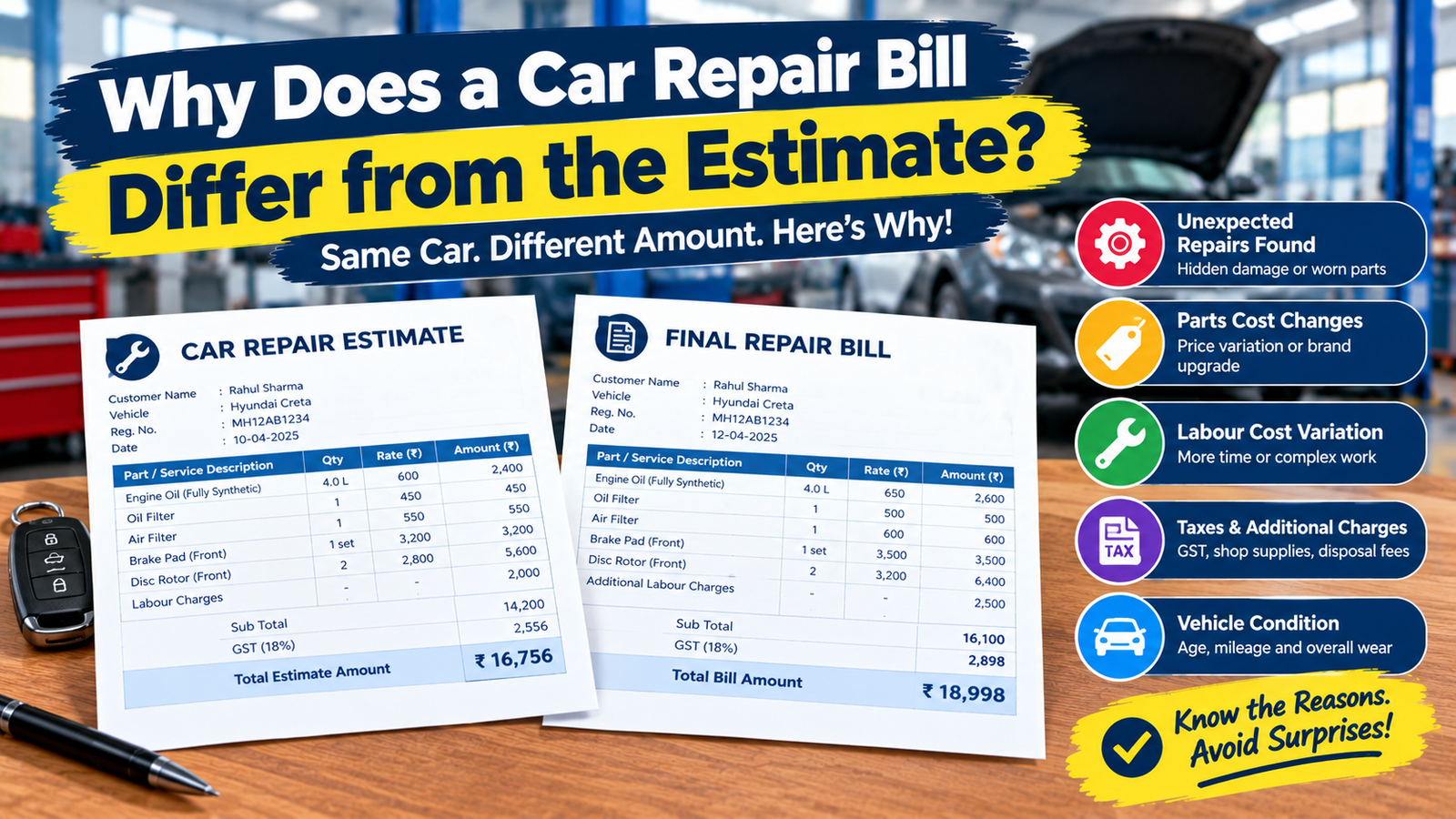
You were told ₹7,300. You collect the car and the invoice says ₹14,000. Nobody called you, nobody explained, and the advisor just says, “A few extra things came up.”
Almost every car owner has felt that sinking moment at the billing counter. Sometimes the extra amount is completely genuine, and sometimes it is not. The real problem is that, without knowing how bills grow, you can’t tell the difference.
In this guide, we’ll look at the most common reasons for the car repair estimate vs final bill gap, walk through a worked example with real numbers, and explain how to stop surprises before they happen. If you are still choosing a garage, start with our guide on how to compare two car repair estimates in India.
An Estimate Is Not a Fixed Price
Let’s get one thing straight first. In most cases, an estimate is the garage’s best prediction of the cost, based on what it can see at the time. It is not necessarily a fixed-price contract, unless the garage specifically agrees to a fixed or capped price in writing.
That doesn’t mean garages can charge whatever they like. A responsible garage explains changes and gets your approval before doing extra work. But it does mean some difference between estimate and bill is normal, especially when the job involves opening up the car.
The question to ask is not “Why isn’t it identical?” but “Is every extra rupee explained and approved?”
Reason 1: Extra Repairs Found During the Job
This is the most common reason, and often a genuine one. Many problems are only visible once parts are removed. A mechanic replacing brake pads might find that the discs are scored or below minimum thickness. A technician doing a timing belt job might notice a leaking water pump sitting right behind it.
Good garages explain these findings and give you the choice. Poor ones simply add them to the bill.
A useful way to judge these additions:
- Safety-related and unavoidable: worn discs, cracked belts, leaking brake lines. Reasonable to fix now.
- Preventive and sensible: replacing a water pump while the engine is already open, because the labour overlaps. Often saves money later.
- Optional or cosmetic: anti-rust coating, engine flush, interior treatment. These should always be agreed separately.
Reason 2: Additional or Changed Parts
The parts list on the final bill may differ from the estimate for several reasons:
- Extra parts needed: small items like gaskets, clips, bolts or fluids that weren’t listed at the start.
- Part substitution: the originally quoted part was unavailable, so a different brand or type was fitted. See our guide on OEM vs aftermarket car parts to understand how that changes price and warranty.
- Price changes: parts prices can move between the estimate and the purchase, especially if the estimate was given days earlier.
- Quantity differences: the estimate assumed 3 litres of oil, but the car took 3.5.
Substitutions deserve special attention. If you agreed to an aftermarket part and the bill shows an OEM part at a higher price, you should have been asked first.
Reason 3: Revised Labour Charges
Labour estimates are the hardest to get right, because the time a job takes depends on conditions inside the car. Labour can rise when:
- Bolts are rusted, seized or damaged and need extra effort to remove
- Related parts have to be removed to reach the faulty one
- The fault is harder to diagnose than expected
- A second job turns out to be needed
Flat-rate jobs, where the garage uses a fixed charge per job, are usually more stable. Hourly labour is more likely to drift. Either way, ask the garage to show which job each labour line belongs to, and why it changed. For a clear picture of how labour should be listed, see our guide on what a car repair estimate should include.
Reason 4: Tax and Small Extras Not Counted Upfront
Sometimes the gap is simply the estimate being incomplete. Verbal or rough estimates often quote the pre-tax price, or leave out small charges.
Tax alone makes a visible difference. Since 22 September 2025, car parts, tyres, batteries and engine oil attract 18% GST, and labour charges attract a separate 18% GST. If someone quotes you ₹10,000 before tax and you assume that is the final number, you are already ₹1,800 short. taxgardenshriramfinance
Other small items that appear at billing stage include consumables (cleaner, grease, fasteners), disposal fees for used oil or batteries, and diagnostic charges. These should be disclosed in advance, but they are commonly missed in quick estimates.
Reason 5: A Vague or Verbal Estimate
If the estimate was a phone call or a casual remark, the final bill can differ for a simple reason: nothing was ever pinned down. Statements like “around ₹8,000” or “should be about ten thousand” are not commitments, and they give you very little to point to later.
A written estimate with itemised parts and labour is your protection. Without it, there is no baseline to compare against.
Reason 6: Upselling and Unapproved Add-ons
Not every difference is innocent. Some garages treat the repair as a chance to add extras, such as fluid flushes, cleaning treatments or “recommended” replacements that aren’t actually needed. These are not always dishonest, but they should never be added without your clear agreement.
Red flags include urgent language (“this must be done today or it will fail”), refusal to show the old part, and extras that appear only on the final bill.
A Worked Example: From ₹7,346 to ₹14,036
Let’s make this concrete with a sample front-brake pad replacement and oil service. All figures are illustrative.
The original estimate
| Item | Amount (₹) |
|---|---|
| Front brake pad set | 2,400 |
| Engine oil 5W-30, 3.5 L | 2,275 |
| Oil filter | 350 |
| Parts subtotal | 5,025 |
| Labour: brake pad replacement | 800 |
| Labour: oil and filter change | 400 |
| Labour subtotal | 1,200 |
| Taxable value | 6,225 |
| GST at 18% | 1,120.50 |
| Estimate total | 7,346 (rounded) |
The final bill
| Item | Amount (₹) |
|---|---|
| Front brake pad set | 2,400 |
| Engine oil 5W-30, 3.5 L | 2,275 |
| Oil filter | 350 |
| Front brake discs, pair (new) | 4,200 |
| Brake fluid | 420 |
| Parts subtotal | 9,645 |
| Labour: brake pad replacement | 800 |
| Labour: oil and filter change | 400 |
| Labour: brake disc replacement (new) | 600 |
| Labour: brake fluid change (new) | 300 |
| Labour subtotal | 2,100 |
| Consumables (new) | 150 |
| Taxable value | 11,895 |
| GST at 18% | 2,141.10 |
| Final total | 14,036 (rounded) |
Where the ₹6,690 gap came from
| Reason for increase | Before tax (₹) | With 18% GST (₹) |
|---|---|---|
| Extra parts (discs and brake fluid) | 4,620 | 5,451.60 |
| Extra labour (disc and fluid jobs) | 900 | 1,062.00 |
| Consumables | 150 | 177.00 |
| Total increase | 5,670 | 6,690.60 |
Is this bill fair? It depends on one question: were the discs and fluid change approved before the work was done? If the mechanic called, showed that the discs were worn below the limit, and you agreed, this is a legitimate increase. If nobody called you, the amount may be reasonable but the process was wrong, and you have every right to raise it.
Which Changes Are Reasonable and Which Aren’t?
| Situation | Usually reasonable? |
|---|---|
| Worn discs found, owner called and approved | Yes |
| Extra labour due to a rusted bolt, explained | Yes |
| Tax missing from a verbal quote | Yes, but the garage should have said so |
| Part swapped to a costlier type without asking | No |
| Add-ons you never agreed to | No |
| Large “miscellaneous” charge with no explanation | No |
| Labour charged for a job not done | No |
| Bill higher with no prior call at all | Questionable, ask for details |
How to Prevent Billing Surprises Before They Happen
Most unpleasant surprises can be avoided with a few simple habits at the start:
- Get a written estimate. Even a WhatsApp message with itemised parts and labour will do.
- Ask whether the price includes GST. Make sure prices are marked inclusive or exclusive.
- Set an approval limit. Say clearly, “Please call me before doing anything beyond this estimate.” You can also say, “Call me if the total will go above 10 percent more.”
- Ask for photos or videos of any problem found. It takes a minute and makes decisions easier.
- Ask for old parts back. It confirms parts were actually replaced.
- Keep your phone reachable on the day, so approvals can be given quickly.
- Ask for an itemised final invoice. It helps you check against the estimate, as explained in our guide on how to read a car service bill.
What to Do If the Final Bill Is Higher Than Expected
If you are already at the counter and the number is higher than you expected, stay calm and work through these steps:
- Ask for a line-by-line explanation. Many differences can be explained in a few minutes.
- Compare against the estimate. Mark every item that wasn’t in the original.
- Ask whether you were consulted. If a call or message was made, ask to see the record.
- Request photos or the old parts for added items.
- Discuss the unapproved items politely. Many garages will reduce or remove charges if they failed to ask first.
- Escalate if needed. Speak to the service manager or owner. For authorised centres, the carmaker’s customer care is another route.
- Keep records. Save the estimate, invoice, messages and photos.
- Consider formal options. If the issue can’t be resolved, you may approach consumer protection channels, such as the National Consumer Helpline. This is general information rather than legal advice, so consider seeking professional guidance for serious disputes.
Keep the conversation factual and respectful. Most disagreements are settled faster with calm questions than with arguments.
Common Mistakes Car Owners Make
- Accepting a verbal estimate with no written record
- Assuming the quoted price includes tax
- Saying “just do whatever is needed” without any limit
- Not asking questions when extra work is proposed
- Not checking the final invoice against the estimate
- Paying quickly and raising problems later, when the evidence is gone
Quick Checklist
- Do you have a written, itemised estimate?
- Does it say whether GST is included?
- Have you set a limit for extra work?
- Were all additions approved before the work was done?
- Does every extra line have a clear explanation?
- Has the final invoice been checked against the estimate?
- Have you saved photos, messages and the invoice?
FAQs
Can a garage charge more than the estimate?
Often yes, if extra work is needed, but it should explain the increase and get your approval first. If the estimate was a fixed price agreed in writing, the position is different.
Is a 10 to 15 percent difference normal?
Small differences are common, especially from tax, consumables or minor extras. Anything larger should come with a clear reason and your prior approval.
Should I pay the full bill and complain later?
That depends on the situation. If the bill is mostly correct and only a small item is disputed, resolve it with the garage first. For large disputes, document everything and consider the escalation options above.
Can I refuse extra repairs?
Yes. You can approve only what you want. For safety-related items, ask the garage to explain the risk clearly, then decide.
What if the garage did the work without asking me?
Raise it politely and ask for a revised bill. Many garages will compromise, especially if you have a written estimate and records.
Final Thoughts
A repair bill that differs from the estimate is not automatically a scam, and it is not automatically fair either. The difference lies in whether the extra items were necessary, explained and approved. With a written estimate, a clear approval limit and a habit of checking the final invoice, you can spot genuine changes, push back on unfair ones and drive away knowing exactly what you paid for.

Through CarJeevan,prashant bobde aims to make confusing automotive information easier to understand. The website focuses on practical questions that car owners face, such as how to compare garage quotations, understand parts and labour charges, review additional fees, and identify the right questions to ask before approving a repair.
CarJeevan also provides a free Car Repair Estimate Calculator and Garage Quote Comparator that helps users organise and compare two repair quotations using the information provided by the user.
The editorial approach focuses on clear explanations, practical examples, and transparent limitations. Where appropriate, articles refer to official information, manufacturer guidance, policy documents, and other reliable sources. Illustrative examples are identified as examples rather than presented as actual market prices.
CarJeevan does not claim to diagnose vehicle faults or independently verify every garage’s prices. Readers are encouraged to consult a qualified automotive professional for mechanical inspections and safety-related repair decisions.
The goal is simple: to help Indian car owners understand repair costs better, ask informed questions, and make decisions with greater clarity.
Website: https://carjeevan.com/