
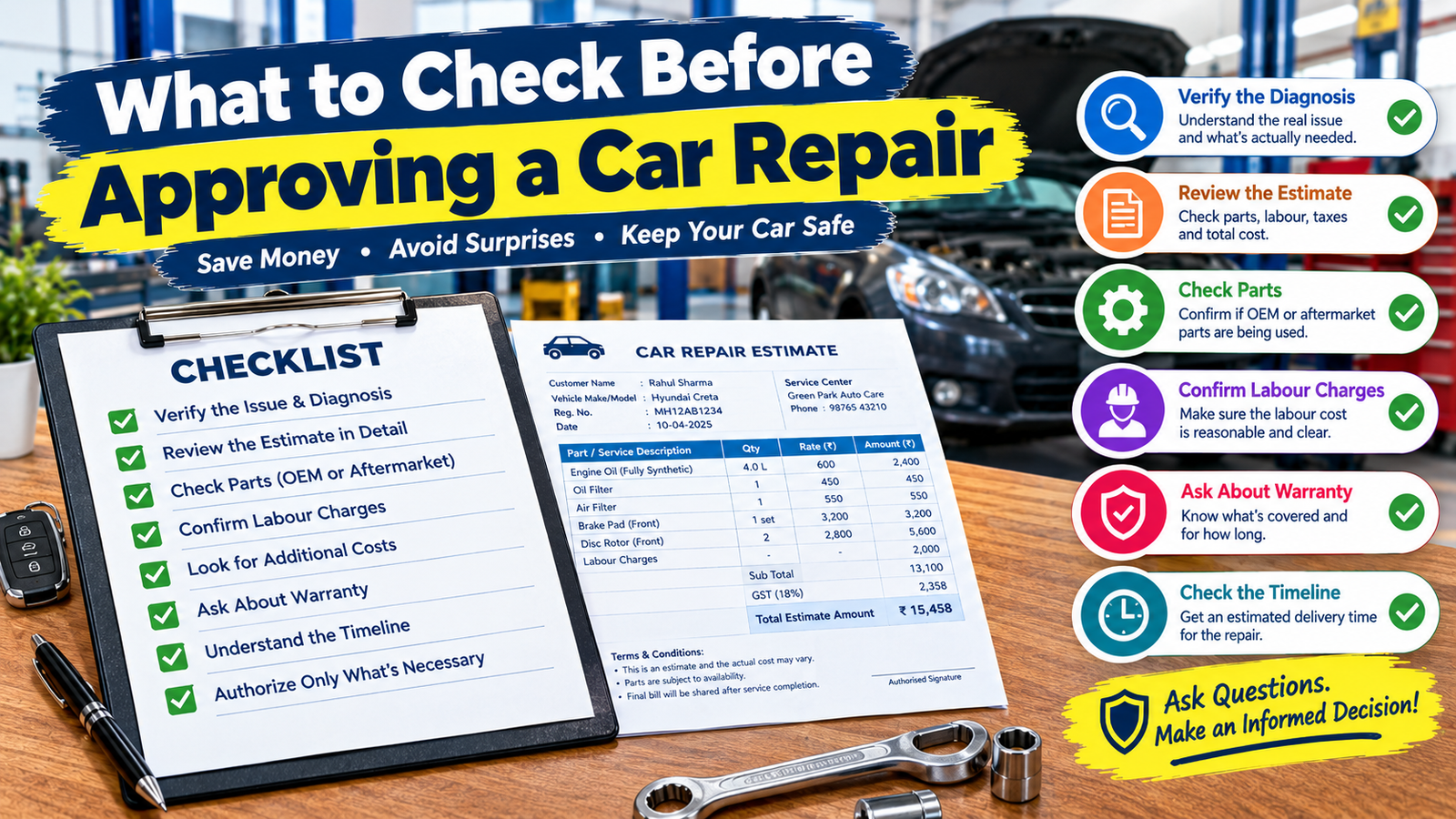
The mechanic walks over, wipes his hands on a cloth and says, “Madam/Sir, the problem is serious. We need to change this part, and it will take two days. Should I go ahead?”
Most of us say yes. We don’t know enough to say anything else, and we don’t want to look foolish by asking. But that single “yes” is the moment your money is decided. Once the work starts, it is very hard to undo.
The good news is that you don’t need technical knowledge to protect yourself. You only need the right questions. In this guide, we’ll share the most useful questions to ask your mechanic before repair, explain why each one matters, and finish with a printable checklist you can keep in your glovebox. If you already have more than one quote, read our guide on how to compare two car repair estimates in India alongside this one.
Why Asking Questions Is Not Rude
Many people feel that questioning a mechanic suggests they don’t trust him. In reality, good mechanics like informed customers. Clear questions reduce misunderstandings, avoid disputes at billing time and help the garage do exactly what you want.
You can keep the tone friendly. Instead of “Are you overcharging me?”, try “Can you walk me through what’s needed and why?” The second version gets you the same information without making anyone defensive.
Part 1: Questions About the Problem
Start by making sure you both agree on what is wrong.
1. What exactly is the problem, and how did you find it?
A good answer is specific: “The front pads are worn to 2 mm, and the discs have grooves.” A vague answer like “brake issue” is not enough. Ask how it was diagnosed, whether by inspection, a test drive or a scanner.
2. Can you show me?
This is the simplest and most powerful question. Ask the mechanic to show you the worn part, the leak or the crack. Many garages are happy to take a photo or short video, which you can keep as a record.
3. How urgent is it?
Not every problem needs fixing today. Ask: “Is this a safety issue, or can it wait a few weeks?” A trustworthy mechanic will separate “must do now” (brakes, steering, tyres) from “can wait” (minor seepage, cosmetic wear). Be careful if everything is described as urgent.
4. What happens if I don’t repair it now?
This helps you understand the real risk. A fair answer sounds like “The pads will damage the discs, and repair will cost more later.” A pressure answer sounds like “The car could fail any moment” with no explanation.
Part 2: Questions About the Repair Itself
Now clarify what the work will actually involve.
5. What exactly will you do?
Ask the mechanic to describe the steps in simple words. “Replace pads, clean calipers, check fluid” is clear. “General brake work” is not.
6. Is there a cheaper or simpler option?
Sometimes a part can be repaired, cleaned or resurfaced instead of replaced. Other times, replacement is the only sensible choice. Asking helps you see the options, even if you decide to go with the first one.
7. Is this repair related to anything else I should fix at the same time?
Some jobs overlap. If the engine is already open for a timing belt, replacing the water pump at the same time may cost only a little extra labour. Asking this can save you a second trip and a second labour bill.
8. Will this fix the problem completely, or might something else be wrong?
Some faults have more than one cause. A good mechanic will tell you honestly if more investigation might be needed, instead of promising a perfect result.
Part 3: Questions About Parts
Parts are where prices and quality vary the most, so ask clearly.
9. Which parts will you use, and which brand?
Every part should have a name and brand. If the garage can’t name the brand, treat that as a warning sign.
10. Are these OEM, OES or aftermarket parts?
Each type has different quality, warranty and price. Our guide on OEM vs aftermarket car parts explains the differences in detail, so you can choose what suits your car.
11. Can I have a choice of part types and prices?
Ask for at least two options where possible, for example an original part and a reputed aftermarket alternative. Then decide based on how safety-critical the part is and how long you plan to keep the car.
12. Are the parts new and sealed? May I see the packaging?
Checking the box helps you avoid used or counterfeit parts being passed off as new. Look for the part number, batch details and any authentication label.
13. Will you give back the old parts?
It is a standard request, and it confirms that replacement actually took place. Some parts, such as batteries, may be taken back by the supplier, but the garage should tell you that upfront.
Part 4: Questions About Cost
This is the area where surprises usually come from, so be thorough.
14. Can I get a written, itemised estimate?
Parts, quantity, labour and extra charges should each be listed separately. Even a WhatsApp message with the full breakdown works. For a full idea of what to look for, see our guide on what a car repair estimate should include.
15. Is GST included in this price?
Tax makes a big difference. Since 22 September 2025, car parts, tyres, batteries and engine oil attract 18% GST, and labour charges attract a separate 18% GST. A quote of ₹10,000 plus GST is ₹11,800 in practice. Always ask whether the figure is inclusive or exclusive. taxgardenshriramfinance
16. How is labour charged, flat rate or hourly?
Flat rates are more predictable. With hourly labour, ask for the estimated hours and the hourly rate, so you have something to compare against later.
17. Are there any other charges, such as consumables, diagnostics, pickup or disposal?
Ask for these to be listed, not left as a surprise at the end.
18. Is this a fixed price or an estimate that may change?
Many estimates are predictions rather than fixed prices. Ask directly, and if you want certainty, ask whether the garage can commit to a cap.
19. Will you call me before doing any extra work or going over the estimate?
This is the most important cost question of all. Say it clearly: “Please don’t do anything beyond this estimate without my approval.” You can also set a limit, such as “Call me if the total will go more than 10 percent higher.” This single sentence prevents most billing disputes, which we explain further in our guide on why a car repair bill differs from the estimate.
Part 5: Questions About Time
20. How long will the repair take?
Ask for a specific day, not “soon”. Also ask what could delay it, such as parts being unavailable.
21. Are the parts in stock, or do they need to be ordered?
If parts must be ordered, delivery time can add days. Ask for an honest estimate.
22. Will I get a courtesy car or pickup and drop?
If you rely on your car daily, these details matter. Ask whether they are free or charged.
Part 6: Questions About Warranty and Accountability
23. What warranty do you offer on the parts?
Ask for the period in months or kilometres, and who provides it, the manufacturer or the garage.
24. Is there a warranty on the labour?
A garage confident in its work should guarantee it for a reasonable period.
25. What is not covered?
Exclusions such as misuse, accidents or wear items should be explained now, not discovered later.
26. If the problem comes back, what happens?
Ask: “If the same issue returns in two weeks, will you fix it free of charge?” The answer tells you a lot about the garage.
27. Will the warranty be written on the invoice?
Verbal promises are hard to enforce. Get it in writing.
28. Will this repair affect my car’s manufacturer warranty?
If your car is still under warranty, check this before agreeing. The rules differ between manufacturers, so ask the service centre or check your warranty booklet.
Part 7: Questions About the Garage and the Mechanic
29. Who will actually be working on my car?
Is it a trained technician, and does the garage have experience with your car’s make and model?
30. Do you have the right tools or diagnostic equipment for this car?
Modern cars rely heavily on electronics. A garage without proper scanners may guess instead of diagnose.
31. Can I get a second opinion?
A good garage won’t mind. If the repair is large, getting a second quote is wise, and a reasonable garage will not pressure you to decide on the spot.
When to Slow Down
Some responses should make you pause before approving anything:
- The mechanic won’t put anything in writing
- Everything is described as urgent, with no explanation
- You are asked to pay the full amount upfront for a routine job
- The garage refuses to show the faulty part
- Parts are described only as “good quality” with no brand
- The mechanic gets irritated when you ask questions
- The estimate is a round number with no breakup
- A big repair is suggested for a small complaint
One of these signs may be a misunderstanding. Several together are a good reason to take your car elsewhere for a second opinion.
Printable Checklist: Before You Approve a Car Repair
You can copy this into a document, print it and keep it with your car papers.
The problem
- ☐ The mechanic explained exactly what is wrong
- ☐ I was shown the faulty part, or given a photo or video
- ☐ I know whether the repair is urgent or can wait
- ☐ I understand the risk of delaying it
The repair
- ☐ The steps of the repair were explained
- ☐ I was offered alternatives where available
- ☐ Related jobs that could be done together were discussed
The parts
- ☐ Every part is listed with its name and brand
- ☐ I know if each part is OEM, OES or aftermarket
- ☐ Parts will be new and sealed
- ☐ Old parts will be returned to me
The cost
- ☐ I have a written, itemised estimate
- ☐ I know whether GST is included
- ☐ Labour is listed job by job
- ☐ Extra charges are explained
- ☐ The garage will call me before any extra work
- ☐ I have set an approval limit for extra spending
The time
- ☐ I have a delivery date
- ☐ I know if any parts need to be ordered
The warranty
- ☐ Parts warranty is written down
- ☐ Labour warranty is written down
- ☐ Exclusions have been explained
- ☐ I know what happens if the problem returns
- ☐ I have checked the effect on my car’s own warranty
Final steps
- ☐ I compared at least one other quote for major repairs
- ☐ I saved the estimate, photos and messages
- ☐ I will check the final invoice against the estimate (see how to read a car service bill)
A Short Script You Can Use
If you feel awkward asking so many questions, here is a simple script you can adapt:
“Before I approve this, could you please send me an itemised estimate with the parts, brands, labour and GST? Please also show me the problem part. I’d like you to call me before doing anything beyond the estimate. And could you note the warranty on the invoice?”
It is polite, clear and covers the five most important points in a few seconds.
FAQs
Do I have to ask all these questions every time?
No. For a routine oil change, a few questions are enough. For a major repair, such as brakes, clutch, engine or suspension, it is worth going through most of them.
What if the mechanic doesn’t know the answer?
Ask him to find out before you approve. A good garage will check, and it is a better sign than a guess.
Is it okay to record the conversation or take notes?
Taking notes or asking for key points by message is perfectly reasonable. If you want to record, it is polite to ask first.
Should I always get a second opinion?
For small, routine jobs, it isn’t necessary. For expensive or unclear repairs, a second quote is a smart habit.
What if the garage refuses to answer?
Treat it as a warning sign. A garage with fair practices has nothing to hide, and you are free to go elsewhere.
Final Thoughts
You don’t need to be a mechanic to make good decisions about your car. You only need to ask clear, calm questions and keep the answers in writing. Find out what the problem is, what will be done, which parts will be used, what it will cost, how long it will take and what protection you have afterwards.
Keep the checklist handy, and the next time a mechanic asks, “Should I go ahead?”, you’ll have a confident, informed answer.

Through CarJeevan,prashant bobde aims to make confusing automotive information easier to understand. The website focuses on practical questions that car owners face, such as how to compare garage quotations, understand parts and labour charges, review additional fees, and identify the right questions to ask before approving a repair.
CarJeevan also provides a free Car Repair Estimate Calculator and Garage Quote Comparator that helps users organise and compare two repair quotations using the information provided by the user.
The editorial approach focuses on clear explanations, practical examples, and transparent limitations. Where appropriate, articles refer to official information, manufacturer guidance, policy documents, and other reliable sources. Illustrative examples are identified as examples rather than presented as actual market prices.
CarJeevan does not claim to diagnose vehicle faults or independently verify every garage’s prices. Readers are encouraged to consult a qualified automotive professional for mechanical inspections and safety-related repair decisions.
The goal is simple: to help Indian car owners understand repair costs better, ask informed questions, and make decisions with greater clarity.
Website: https://carjeevan.com/