
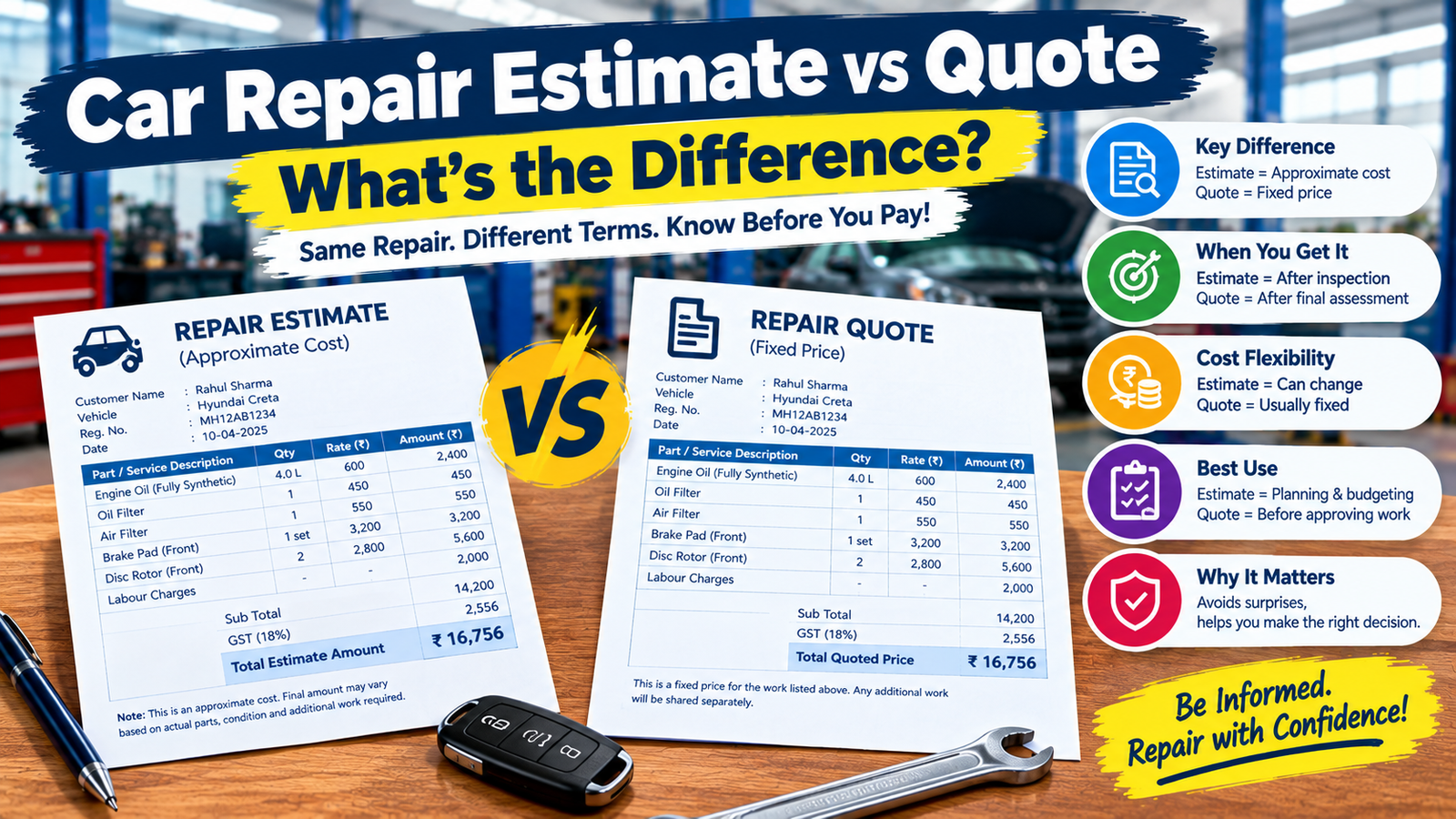
A garage says, “I’ll send you the quotation on WhatsApp.” The message arrives with the heading “Estimate”. Later, the bill has the word “Quote” on it, and the total is nowhere near either. Was the garage allowed to do that?
In everyday Indian garage talk, “estimate”, “quote”, “quotation” and “approx cost” are used almost interchangeably. But in principle they mean different things, and knowing the difference can save you from a nasty surprise at billing time.
This guide explains car repair estimate vs quote: what each one means, whether the price can change, what to check in a written quotation and which terms to understand before you say “go ahead”.
CarJeevan provides general information, not legal advice. For a serious dispute, consult a qualified professional or your local consumer forum.
Estimate vs Quote: The Quick Answer
| Point | Estimate | Quote |
|---|---|---|
| Meaning | A best guess of the likely cost | An offer to do defined work for a stated price |
| Is the price fixed? | Usually not | Usually yes, for the stated scope |
| Can the final bill change? | Yes, if more work or parts are needed | Only if the scope changes and you agree |
| When is it used? | When the fault isn’t fully known | When the work is clearly defined |
| Level of detail | Can be rough or detailed | Should be detailed and itemised |
| Best use | Early planning and comparing garages | Final decision and approval |
One important caution: the title on the paper does not settle the matter. A document called “Estimate” may contain a firm price, and a document called “Quote” may be full of “subject to” clauses. What counts is the wording and what you agreed to.
What Is a Car Repair Estimate?
An estimate is the garage’s informed guess. It’s often an educated guess because a mechanic can rarely know exactly what is wrong until the car has been pulled apart, so the figure is based on what is most likely to be the problem. nt
That is why garages often give estimates first. A noise from the front end, an AC that doesn’t cool or a gearbox that jerks can have several causes, and nobody can price the job accurately until it is inspected.
An estimate can be verbal or written, but a written one is far better. It should still list parts, labour and extras, as we explain in our guide on what a car repair estimate should include.
What Is a Quote (Quotation)?
A quote is a more definite offer. It is an offer to do a job for a specified price, and if you are given a fixed quote, the provider should complete the work within that cost unless you agree to a variation. consumerprotection
Consumer guidance from New Zealand’s motoring association says an accepted quote becomes the basis of the contract between you and the workshop, and that it should be in writing with a detailed parts and labour breakdown. aa
A good quote should state:
- exactly what work is covered
- the price for that work
- what is not covered
- how long the price is valid
- how any extra work will be handled
How This Works in India
We should be honest here. The guidance quoted above comes from consumer bodies in other countries, because we could not find a single, widely published rule that defines “estimate” and “quote” specifically for car repairs in India. Garages often use the words loosely.
So the practical approach is this: don’t rely on the label. Rely on the written wording, your approval and your records. A document that clearly states a fixed price for a defined scope, which you accept, is much stronger than a vague phone remark. If a dispute reaches a consumer forum, those papers are your evidence.
Can the Price Change in Both?
Estimate: yes, it can. The final amount may be higher, and occasionally lower, depending on what the mechanic finds. New Zealand’s consumer protection site says the final price should generally stay within 10 to 15 percent of an estimate. That is not an Indian rule, so treat it as a sensible benchmark rather than a guarantee. A better habit is to agree your own limit in writing, such as “call me if the total will go more than 10 percent above this”. consumerprotection
Quote: usually not, for the same scope. But watch out for:
- Scope changes. If a new problem appears, extra work is outside the original quote and needs your approval.
- Exclusions. The quote may leave out items such as consumables, diagnostics or taxes.
- Escape clauses. Phrases like “subject to inspection”, “final bill on actuals” or “non-binding” turn a quote back into an estimate.
- Validity. A quote or estimate can carry an expiry date, after which it no longer applies. Parts prices move, so an old quote may not hold. nibusinessinfo
Tax can also change the number you pay. Check whether prices include or exclude GST. Car parts, tyres, batteries and engine oil attract 18% GST, and labour charges attract a separate 18% GST. A quote of ₹10,000 plus GST is ₹11,800 in reality. taxgardenshriramfinance
Worked Example: One Brake Job, Two Documents
These numbers are illustrative, not market rates. Say you need a front brake job and two garages respond.
| Point | Garage A: “Estimate” | Garage B: “Quote” |
|---|---|---|
| Scope | Front brake pads, “and other work if needed” | Front brake pads, both sides, with cleaning and caliper check |
| Price | ₹8,500 approx. | ₹9,200 fixed for the listed work |
| Taxes | Not stated | 18% GST included |
| Validity | Not stated | 7 days |
| Extra work | “Will be charged on actuals” | Only with your written approval |
| Warranty | Not mentioned | 6 months on pads, 30 days on labour |
During the job, the mechanic finds that the discs are worn.
- At Garage A, the bill can rise to ₹12,800 because “actuals” were never defined. Unless you asked for a limit, you have little to point to.
- At Garage B, the discs are outside the quote, so the garage must come back to you, explain the need and agree on the extra cost before doing it.
Garage A’s number looked lower, but Garage B’s document protects you better. For why bills grow in practice, read our guide on why a car repair bill differs from the estimate.
What to Check in a Written Quotation
Before you accept, go through the document line by line.
- Garage details. Name, address, phone and GSTIN if registered.
- Your car. Make, model, registration number and odometer reading.
- Date and validity. When it was issued and until when the price holds.
- Scope of work. What exactly will be done, and what is excluded.
- Parts. Name, brand, type (OEM, OES or aftermarket), quantity and price. Our guide on OEM vs aftermarket car parts explains why this matters.
- Labour. Listed job by job, not as a lump sum. See car labour charges in India for how labour is calculated.
- Extra charges. Consumables, diagnostics, pickup and disposal, each explained.
- Tax. GST shown separately, with a clear note on whether prices are inclusive or exclusive.
- Total and price type. Whether it is fixed, approximate or subject to change.
- Warranty. Period and coverage for parts and labour, in writing.
- Delivery date. And what happens if it slips.
- Signatures. Yours and the garage’s. A South African motor workshop association advises that all parties sign the quote before repair work begins. citizen
Our car repair estimate template has all these fields in a printable format.
Phrases That Should Make You Ask Questions
| Phrase on the paper | What to ask |
|---|---|
| “Approximate” or “approx.” | What could push it higher, and by how much? |
| “Subject to inspection” | Can you inspect first and send a firm quote? |
| “Final bill on actuals” | Will you call me before going above this figure? |
| “Excluding extra work” | What extra work is likely on this car? |
| “Price valid on request” | Can you put a validity date on it? |
| “Non-binding” | Is any part of this price fixed? |
| “Misc. / workshop charges” | What exactly does this cover? |
Terms to Understand Before You Approve a Repair
Once you say yes, you are agreeing to the garage’s terms, so understand these first:
- Price type. Is it a fixed price, an estimate or a “not to exceed” amount?
- Approval for extra work. The same South African guidance says the mechanic should contact the owner about any additional work and note the time of the contact. Ask for the same here, by call or WhatsApp. motoring
- Your spending limit. Consumer guidance from the Northern Territory in Australia suggests giving the trader a limit on what you are prepared to pay based on their estimate. This lets you agree a fixed price once the full extent is known, or stop the work. nt
- Diagnosis or teardown fees. If you decline the repair after inspection, will you owe anything?
- Advance payment. How much, when and whether it is refundable.
- Delay and storage. What happens if the car stays in the garage longer than planned.
- Replaced parts. Whether old parts will be returned to you.
- Warranty and exclusions. What is covered, for how long and how to claim.
- Complaint route. Who to speak to if you are unhappy.
For more, see our checklist of questions to ask your mechanic before repair.
How to Compare an Estimate with a Quote
If one garage gives an estimate and another a quote, bring them onto the same basis before you compare:
- Add GST to both, or remove it from both.
- Check that the scope of work is the same.
- Check that parts types and brands match.
- Add likely extras to the estimate, such as discs or consumables, to see the realistic total.
- Compare warranty and validity.
You can enter each line into our Car Repair Calculator, add GST and discounts, and view two quotations side by side. It checks arithmetic and shows where the quotes differ, which makes it easier to ask better questions. It does not use a live price database, so it cannot tell you whether a price is fair or inspect your car. For brakes, steering and other safety-critical work, rely on a qualified mechanic as well.
Common Mistakes
- Treating a rough estimate as a fixed price
- Believing a document is binding only because it says “quote”
- Accepting a verbal price with nothing in writing
- Not checking whether GST is included
- Skipping the scope and exclusions
- Ignoring the validity date
- Saying “do whatever is needed” without a spending limit
- Not keeping messages, photos and signed copies
Quick Checklist Before You Approve
- Is it an estimate or a quote, and does the wording agree?
- Is the scope of work clearly written?
- Are parts, labour and extras itemised?
- Is GST shown and clearly included or excluded?
- Is there a validity date?
- Is there a rule for extra work and your approval?
- Have you set a spending limit?
- Is the warranty written down?
- Have both sides signed or confirmed in writing?
- Have you saved a copy?
FAQs
Is a car repair estimate legally binding?
Generally an estimate is a non-binding approximation, but the exact position depends on the wording and the circumstances. If it matters, take professional advice.
Is a quote always fixed?
Not always. A quote with clauses like “subject to inspection” or “non-binding” may behave like an estimate. Read the wording.
Can a garage charge more than its quote?
Usually only for extra work outside the original scope, and it should explain and get your approval first.
Which should I ask for, an estimate or a quote?
Ask for an estimate to understand the likely cost, then ask for a written quote once the problem is confirmed and before you approve the repair.
What if the final bill is much higher than the estimate?
Ask for a line-by-line explanation, check whether you approved the extras and keep records. Our guide on how to read a car service bill helps you check the invoice.
Does a written quote protect me better?
Yes. A detailed, signed document gives you a clear record of scope, price and warranty
Final Thoughts
An estimate tells you roughly what to expect, and a quote tells you what the garage is committing to. In practice, garages mix the two words, so look past the heading. Ask whether the price is fixed, what is included, how extra work will be handled and what protection you have afterwards, and get the answers in writing. Then use the Car Repair Calculator to line up your documents, and approve the repair with confidence.

Through CarJeevan,prashant bobde aims to make confusing automotive information easier to understand. The website focuses on practical questions that car owners face, such as how to compare garage quotations, understand parts and labour charges, review additional fees, and identify the right questions to ask before approving a repair.
CarJeevan also provides a free Car Repair Estimate Calculator and Garage Quote Comparator that helps users organise and compare two repair quotations using the information provided by the user.
The editorial approach focuses on clear explanations, practical examples, and transparent limitations. Where appropriate, articles refer to official information, manufacturer guidance, policy documents, and other reliable sources. Illustrative examples are identified as examples rather than presented as actual market prices.
CarJeevan does not claim to diagnose vehicle faults or independently verify every garage’s prices. Readers are encouraged to consult a qualified automotive professional for mechanical inspections and safety-related repair decisions.
The goal is simple: to help Indian car owners understand repair costs better, ask informed questions, and make decisions with greater clarity.
Website: https://carjeevan.com/