
Last reviewed and prices checked: 5 November 2026. This is general information, not a diagnosis. If the light is flashing, or comes on with a red warning light, stop driving as soon as it is safe.
Introduction
The amber engine symbol lit up on the dashboard this morning. The car starts, idles and drives exactly as it did yesterday. You wonder whether to ignore it, and a friend says it is probably the fuel cap.
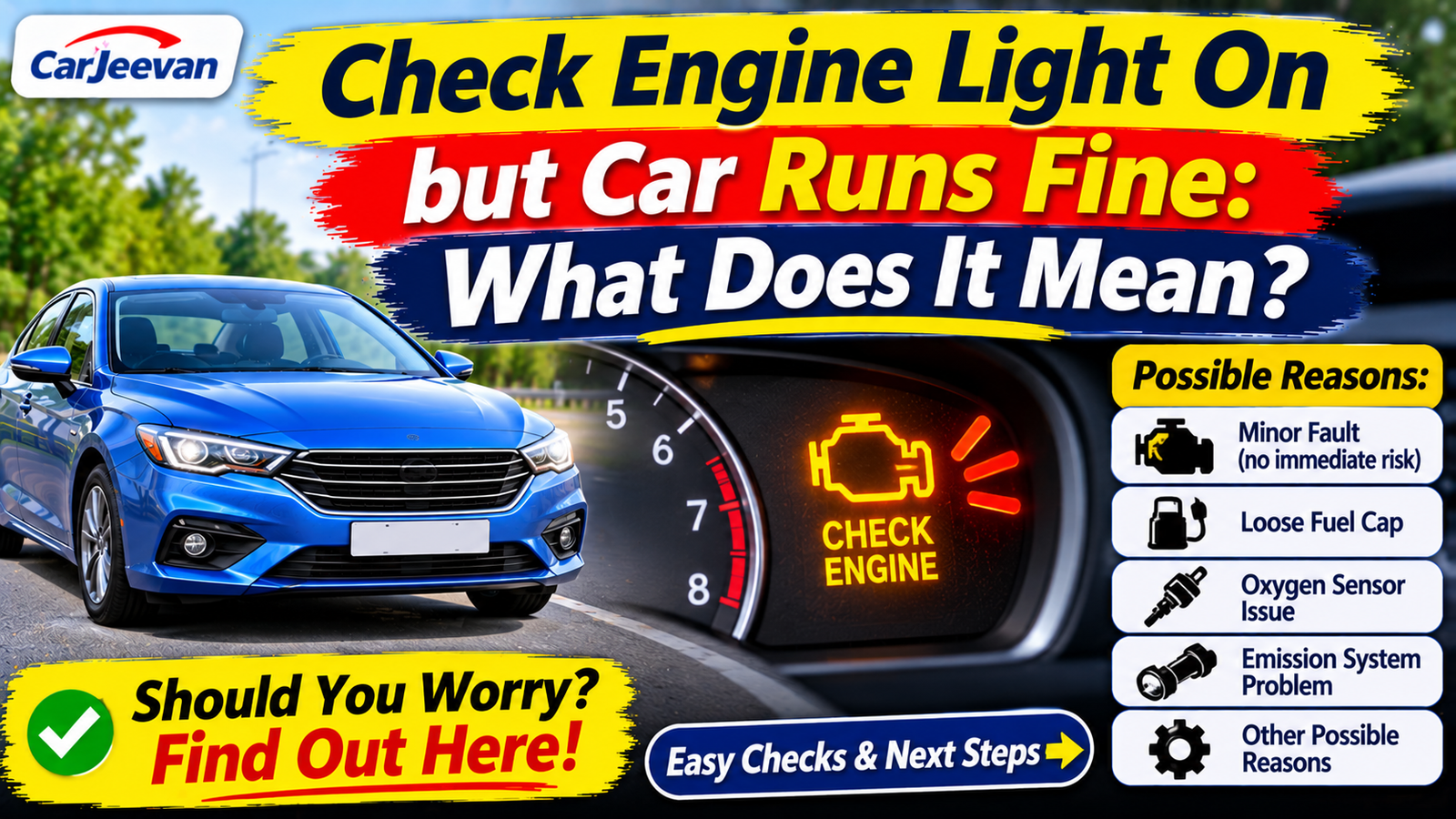
The check engine light is a fault flag, not a diagnosis. Your car’s computer has noticed a reading outside the expected range in the engine or emissions system, stored a trouble code and lit the lamp. The car can feel normal because the computer often compensates for the problem or the fault is small. How the light behaves tells you how urgent it is: a steady amber light usually means get it scanned within a few days, and a flashing light means stop driving as soon as it is safe, because an active misfire can damage the catalytic converter.
This guide explains what steady, flashing and intermittent lights mean, why the light can be on while the car feels fine, what you can safely do first, what common codes point to, indicative repair costs in India, and how to compare two quotes. We did not test any car for this article. Safety guidance and causes come from a battery maker’s India guide and workshop sources, prices from the Indian guide’s published ranges, and the worked example is hypothetical.
Check Engine Light On but Car Runs Fine – Quick Overview
| Light behaviour | What it usually means | What to do |
|---|---|---|
| Steady amber | A fault is stored. The car is generally driveable, but the issue needs diagnosis. | Check the fuel cap, note how the car drives, and get a scan within a few days. |
| Flashing | An active misfire, which can send unburnt fuel into the catalytic converter. | Stop driving as soon as it is safe and call for help. Do not restart to see if it clears. |
| On, then off | An intermittent fault. The code usually stays stored. | Get the car scanned even though the light is off. |
| On with a red warning light | More than one system may be affected. | Stop safely. The red light takes priority. |
Why the Light Can Be On While the Car Feels Fine
Amaron explains that the light is tied to the engine, emissions system and related components. It does not cover brakes, suspension, steering or body systems, which have their own warning lights. The computer lights the lamp when a sensor reading falls outside the acceptable range and it cannot correct it automatically. Many such faults, such as a loose fuel cap, a weak oxygen sensor or a small leak in the evaporative system, cause no change you can feel.
India’s onboard diagnostics rules explain why almost every modern car has this system. DieselNet’s summary says OBD-II has been required for all categories of new vehicles since 1 April 2013, and Autocar Professional says BS VI OBD requirements apply in two stages, from April 2020 and April 2023. The Central Motor Vehicles Rules say BS VI vehicles must be able to identify the likely area of a malfunction by means of fault codes stored in computer memory. Your owner’s manual shows what the warning symbol looks like on your car, and a spanner-style symbol may be a service reminder instead.
What to Do First
Amaron suggests this order, and the first step is the only one you need to do yourself:
- Check the fuel cap. A loose, cracked or missing cap lets fuel vapour escape, which the evaporative system detects as a leak. Remove it, refit it until it clicks, and drive normally for a day or two. If the light goes off, the cap was the cause.
- Note how the car drives. Rough idling, hesitation, loss of power, unusual smells or higher fuel use all help a technician.
- Check for other warning lights. A red light, or oil, temperature or battery lights together with the check engine light, mean you should stop and get help.
- Think about the last fill-up. Amaron notes that a light that appears soon after refuelling at an unfamiliar station is worth mentioning to the technician.
- Get the codes read. A scan within a few days tells you which system is involved.
Do not disconnect the battery to clear the light. Amaron says this erases stored codes and learned settings, and the light returns if the fault is still there.
Steady vs Flashing: When to Stop
Workshop sources agree that a flashing light signals an active misfire, in which unburnt fuel reaches the exhaust and can overheat and damage the catalytic converter, a costly part. If the light is flashing, reduce speed and load, pull over when it is safe, and arrange for help. A steady light with a normally running car is generally safe to drive to a workshop within a few days, but the same sources and Amaron say not to leave it for weeks, because a small fault can lead to a bigger one.
Common Causes
Amaron lists these as common in India, with its own ranges for repair cost. The severity labels are its own.
- Loose or faulty fuel cap. The commonest and cheapest cause. It often has no drivability symptoms.
- Oxygen sensor. It helps the computer set the fuel mixture. A failing one can raise fuel use and, over time, harm the catalytic converter.
- Catalytic converter. It degrades over time and can be hurt by unresolved sensor faults or misfires.
- Spark plugs or ignition coils. They cause misfires, and a flashing light points here.
- Mass airflow (MAF) sensor. Dusty conditions can clog it, and it is sometimes cleaned instead of replaced.
- EGR valve carbon build-up. More common in stop-go city traffic, according to Amaron.
- Evaporative (EVAP) system leak. Often a cap, a hose or a purge valve.
- Thermostat. One that sticks open can set a warm-up code, and one that sticks closed can cause overheating, which is urgent.
What a Code Does and Does Not Tell You
A scanner shows a code such as P0420. The code points to a system or circuit. It does not always name the failed part, and Amaron says accurate diagnosis needs a technician who reads live sensor data and inspects the car, not just the code.
| Code (example) | What it points to | A caution |
|---|---|---|
| P0442 or P0455 | An evaporative system leak, often the fuel cap | Check the cap first, then hoses and the purge valve |
| P0420 | Catalyst efficiency below threshold | Workshop sources say not to replace the converter on this code without testing, because a failing oxygen sensor can produce the same code |
| P0300 | A random misfire | Plugs, coils or fuel delivery. A flashing light makes this urgent |
| P0171 | A lean mixture | An oxygen sensor, an air leak or a fuel fault |
| P0335 | The crankshaft position sensor circuit | Could be the sensor or its wiring |
Indicative Check Engine Light Repair Prices in India
| Cause | Published figure | Source (checked 5 Nov 2026) | What to know |
|---|---|---|---|
| OBD scan only | ₹0 (self) to ₹500 at a workshop | Amaron (27 June 2026) | Many providers scan for free, per Amaron. |
| Basic OBD scanner to buy | ₹1,500–₹3,000 | Amaron’s warning lights guide (see source list) | Reading codes is not diagnosis. |
| Loose fuel cap | ₹0–₹500 | Amaron | Tighten or replace. |
| Oxygen sensor replacement | ₹2,000–₹8,000 | Amaron | Wide range. Ask for the part brand. |
| Spark plugs | ₹500–₹4,000 | Amaron | Depends on the engine. |
| Ignition coil | ₹2,000–₹8,000 per coil | Amaron | Per coil. |
| MAF sensor cleaning; replacement | ₹200–₹500; ₹3,000–₹10,000 | Amaron | Cleaning is sometimes enough. |
| EGR valve cleaning; replacement | ₹500–₹2,000; ₹3,000–₹8,000 | Amaron | Cleaning is sometimes enough. |
| Catalytic converter replacement | ₹8,000–₹30,000+ | Amaron | Often the costliest line. |
| EVAP system repair | ₹500–₹5,000 | Amaron | Depends on the component. |
| Thermostat replacement | ₹800–₹3,000 | Amaron | See our overheating guide once live. |
| Authorised-centre prices | Not verified | – | Amaron says authorised centres charge 20–40% more, but shows no data, so we do not repeat it. |
How far to trust this table. Four limits apply. Every figure comes from one source, a battery maker that also sells a diagnostic service. Prices vary by car, city and part type. Cleaning and replacement are priced separately, so ask which is being quoted. And we found no authorised-centre price list.
What a Workshop Should Do
Amaron says a professional technician uses live data monitoring alongside codes and a physical inspection to confirm the fault, instead of replacing parts based on codes alone. For a quote, that means asking what the codes were, what the live data and inspection showed, and which finding supports each part. The code should lead to a test, and the test to a part. A quote that goes straight from a code to an expensive part deserves questions.
Resetting the Light, and the PUC Test
The light can be cleared with a scanner after the fault is repaired. Clearing it without fixing the fault makes it return, and Amaron advises against disconnecting the battery. Amaron also says a persistent emissions-related fault can cause a car to fail a PUC check in states where stricter testing applies. Test methods and state practice vary, so check with your PUC centre.
How to Compare Two Quotes
Two quotes are only comparable if they rest on the same findings. Check these in order:
- Codes and findings. Which codes were read, and what did the tests show?
- Scope. Which parts are replaced, and why does each one follow from a finding?
- Cleaning or replacement. Which is quoted, for sensors and valves?
- Parts. Brand, part number, and new or reconditioned. See our guide to OEM and aftermarket parts.
- Labour. Hours, and itemised or lump sum.
- Tax. Bring both quotes to the same basis, as in our guide on how to compare two car repair estimates.
- Warranty. On parts and on labour, and whether it is written.
Illustrative example: two quotes for the same P0420 code. These figures are invented to show the method. They are not market prices, and neither quote is recommended.
| Line | Quote A (hypothetical) | Quote B (hypothetical) |
|---|---|---|
| Scan and live-data check of the oxygen sensors | ₹600, findings written | None shown |
| Upstream oxygen sensor | ₹4,500 (brand and part number stated) | – |
| Catalytic converter | – | ₹16,000 |
| Labour | Included above | ₹2,000 |
| Total before tax | ₹5,100 | ₹18,000 |
| GST at 18% | ₹918 | ₹3,240 |
| Total as quoted | ₹6,018 | ₹21,240 |
Quote B is ₹15,222 higher. The point is not the price. Quote A tests the sensors first, which is what workshop sources advise for this code, while Quote B names a converter with no test shown. Quote B may still be right for another car, such as one with an engine fault that has damaged the converter. Ask which result supports each line.
How CarJeevan Helps Compare Two Repair Quotes
CarJeevan’s Car Repair Estimate Calculator & Quote Comparator is a free tool for organising two garage quotations side by side. For each quotation you enter the repair items with quantity, parts cost per item and labour, plus other charges, discounts and tax or fees. You can also tick whether a quotation states the part brand or number, explains the warranty, lists labour separately and requires your approval for additional work. The tool then shows the totals and the differences between the two. Its privacy note says the calculations run in your browser.
It has limits. It has no live price database, does not read fault codes or diagnose a car, cannot tell you which repair your car needs or whether a garage is overcharging, and does not guarantee savings. Its output is only as accurate as what you enter. Enter taxes exactly as the quotation shows them, and do not count them twice.
For a check engine light job, enter the scan, each part and the labour as separate rows. A part that appears in one quote and not the other is then easy to spot, and it is a question to ask, not a verdict.
Have two garage quotations for your check engine light repair? Use the CarJeevan comparison tool to organise and compare the parts, labour and other charges entered in both estimates.
Questions to Ask Before Approving the Repair
For general questions, see our list of questions to ask your mechanic before approving any repair. For a check engine light, add these:
- Which codes did you read, and can I see them?
- What did the live data and inspection show?
- Which finding supports each part on the quote?
- Is cleaning an option before replacement, for the MAF sensor or EGR valve?
- If the code is P0420, did you test the oxygen sensors before quoting a converter?
- Will you clear the light only after the repair, and check that it stays off?
- Is the warranty written, on both parts and labour?
Prevention: Small Habits That Help
Amaron suggests servicing on schedule, using fuel from reputable stations, closing the fuel cap firmly after every refuel, keeping the air filter clean, and not ignoring early signs such as rough idling or a drop in fuel economy. Our annual car maintenance cost guide shows how routine servicing fits into a yearly budget.
Check Engine Light On but Car Runs Fine – Frequently Asked Questions
Is it safe to drive with the check engine light on?
If the light is steady amber and the car drives normally, it is generally safe to drive to a workshop within a few days. If it is flashing, or comes on with a red warning light, stop as soon as it is safe.
What does a flashing check engine light mean?
An active misfire, in which unburnt fuel can reach the catalytic converter and damage it. Reduce speed and load, pull over when it is safe, and get help.
Can a loose fuel cap turn the light on?
Yes. A loose, cracked or missing cap lets fuel vapour escape, which the evaporative system detects as a leak. Refit it until it clicks and drive for a day or two. If the light stays on, get the car scanned.
How much does it cost to find out why the light is on?
Amaron lists ₹0 for a self-scan to ₹500 at a workshop for a scan only, and says many providers scan for free. Repairs range from ₹0 for a fuel cap to ₹30,000 or more for a catalytic converter.
Can I reset the light myself?
A scanner can clear it after the fault is repaired. Clearing it without a fix makes it return, and disconnecting the battery erases stored codes and learned settings.
Conclusion
A check engine light on a car that runs fine is a prompt to find out why, not a reason to panic or ignore it. Check the fuel cap, note how the car drives, and get the codes read within a few days. If the light is flashing or comes on with a red warning light, stop as soon as it is safe.
A good workshop reads the codes, tests, and ties each part to a finding. When you hold two quotes, the CarJeevan tool can line them up row by row, while the diagnosis belongs with a qualified technician.
This article is general information, not a diagnosis or professional advice. Prices are estimates checked on 5 November 2026 and may change. Have a qualified technician inspect your car if a warning light is on.

Through CarJeevan,prashant bobde aims to make confusing automotive information easier to understand. The website focuses on practical questions that car owners face, such as how to compare garage quotations, understand parts and labour charges, review additional fees, and identify the right questions to ask before approving a repair.
CarJeevan also provides a free Car Repair Estimate Calculator and Garage Quote Comparator that helps users organise and compare two repair quotations using the information provided by the user.
The editorial approach focuses on clear explanations, practical examples, and transparent limitations. Where appropriate, articles refer to official information, manufacturer guidance, policy documents, and other reliable sources. Illustrative examples are identified as examples rather than presented as actual market prices.
CarJeevan does not claim to diagnose vehicle faults or independently verify every garage's prices. Readers are encouraged to consult a qualified automotive professional for mechanical inspections and safety-related repair decisions.
The goal is simple: to help Indian car owners understand repair costs better, ask informed questions, and make decisions with greater clarity.
Website: https://carjeevan.com/