
Last reviewed and prices checked: 5 November 2026. This is general information, not a diagnosis. Have a qualified auto-electrician test your car before you replace parts.
Introduction
The car started fine yesterday. This morning there is only a weak click, or nothing at all. You jump-start it, drive to work, and the next morning it is dead again. A workshop suggests a new battery, and another suggests a new alternator.
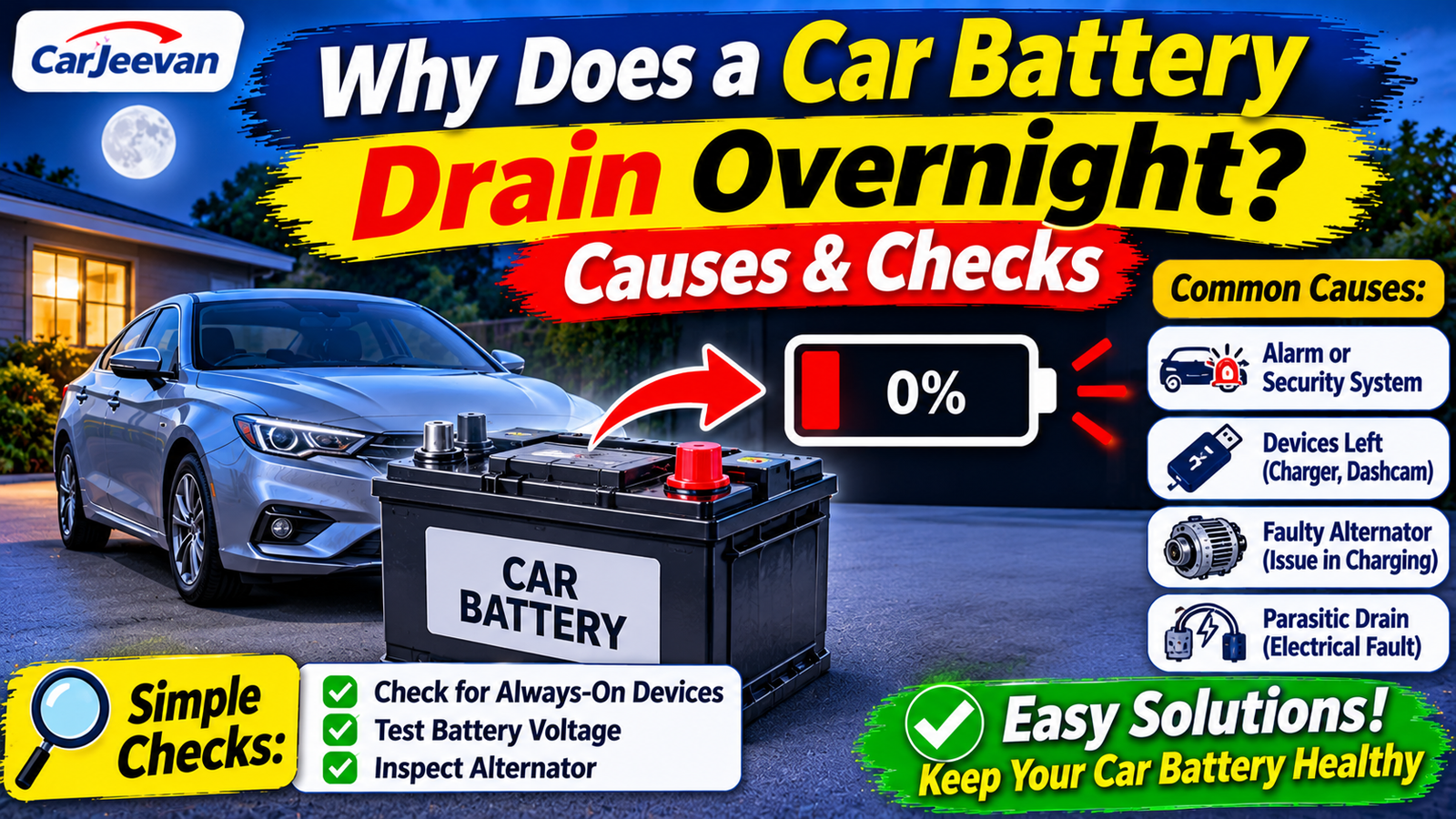
A battery that drains overnight usually points to one of three things: something is drawing power while the car is off (a parasitic drain), the alternator is not recharging the battery properly while you drive, or the battery itself is weak or old. Simple causes, such as an interior light left on or a door not fully shut, come first. Then come aftermarket accessories, especially dashcams in parking mode, followed by a stuck relay, a module that does not go to sleep, corroded terminals or a failing alternator. The right fix depends on which one it is, so the safe move is to get the battery, the charging system and the drain tested, instead of replacing the battery and hoping.
This guide explains what a parasitic drain is, the common causes, checks you can do safely, the tests a workshop should run, indicative costs in India, and how to compare two quotes. We did not test any car for this article. Causes come from a motoring club, motoring sites and a seller’s page, prices from one seller’s published estimates, and the worked example is hypothetical.
Why Does a Car Battery Drain Overnight? – Quick Overview
| Likely cause | Typical sign | Who should check it |
|---|---|---|
| Interior, boot or glovebox light left on, or a door not fully shut | A light glows inside after locking | You, with a quick look |
| Aftermarket accessory (dashcam, tracker, amplifier, charger in the 12 V socket) | The problem started after fitting it | You, then a workshop |
| Stuck relay or a module that does not sleep | Drain with no obvious cause | A workshop, with a parasitic draw test |
| Alternator not charging, or leaking current | Battery warning light, dim lights, repeated flat battery | A workshop, with a charging system test |
| Old or weak battery | Slow cranking, dies after a day or two parked | A workshop, with a battery load test |
| Loose or corroded terminals | Weak starting, crust on terminals | A workshop |
Indicative Cost of Testing and Fixing a Battery Drain in India
| Item | Published figure | Source (checked 5 Nov 2026) | What to know |
|---|---|---|---|
| Battery health test | ₹200–₹400 | Ride N Repair (April 2026) | A seller’s blog. Opened. |
| Parasitic drain diagnostic | ₹500–₹1,200 | Ride N Repair | Same caveat. |
| Terminal cleaning | ₹150–₹400 | Ride N Repair | Same caveat. |
| Door or dome light switch | ₹250–₹800 per switch | Ride N Repair | Same caveat. |
| Relay replacement | ₹200–₹900 | Ride N Repair | Identifying the right relay needs a workshop. |
| Dashcam hardwire kit with low-voltage cut-off | ₹800–₹2,000 installed | Ride N Repair | Same caveat. |
| Alternator repair | ₹2,500–₹6,500 | Ride N Repair | Same caveat. |
| Alternator replacement | ₹7,500–₹22,000 | Ride N Repair | OEM or reconditioned makes a large difference. |
| Doorstep jump-start | ₹449–₹700 | Ride N Repair | Same caveat. |
| Battery replacement | ₹4,500–₹10,500 on the same page | See our battery replacement cost guide | The guide has the model-wise ranges, exchange and warranty details. |
| Authorised-centre prices | Not verified | – | No published price list found. |
How far to trust this table. Four limits apply. Every figure comes from one seller’s page. Prices vary by car, city and part type. We found no authorised-centre prices. And a test that finds the cause is worth more than a part replaced without one.
What Is a Parasitic Drain, and How Much Is Normal?
A parasitic drain is any electrical load that keeps drawing current after the car is switched off and locked. Some drain is normal: the clock, the alarm and memory in the control units need power. Most sources put a normal standby draw at roughly 20–50 milliamps once the car’s modules have gone to sleep, which can take tens of minutes after locking. One source says anything under 100 milliamps is acceptable, so there is no single figure, and your carmaker’s specification governs.
The arithmetic is simple. Battery capacity in amp-hours, divided by the draw in amps, gives the hours to empty. This table is an illustration for a 45 Ah battery, not a measurement. A battery loses the ability to start the engine well before it is empty, so the real time is shorter.
| Draw | Calculation | Hours to empty | About |
|---|---|---|---|
| 50 mA (typical normal) | 45 ÷ 0.05 | 900 | 37.5 days |
| 200 mA | 45 ÷ 0.2 | 225 | 9.4 days |
| 600 mA (a poorly wired accessory) | 45 ÷ 0.6 | 75 | 3.1 days |
So a normal draw can still flatten a battery in weeks if the car is parked for a long time, and a draw a few times higher can do it in days. A small drain in a daily-driven car is topped up by the alternator, which is why the problem often shows only when the car sits.
Common Causes
Lights, doors and the boot
AAA, the American motoring club, lists interior lights left on and plugged-in accessories in the 12 V outlet among the “silent” battery drains. A door or boot that is not fully shut can keep a light on. Look through the windows after locking the car, as one seller’s page advises.
Aftermarket accessories
AAA says factory-fitted stereos and alarms usually do not cause trouble, but aftermarket ones installed incorrectly can drain the battery heavily. The seller’s page points to dashcams in parking mode, aftermarket alarms, amplifiers, LED strips, GPS trackers and Bluetooth modules. If the trouble began after fitting something new, mention that to the workshop first.
A stuck relay or a module that stays awake
A relay stuck closed can keep a circuit energised after the ignition is off, and a control unit that never goes to sleep can draw continuously. These are workshop jobs, and finding them can be slow. Indian owners on Team-BHP describe cases where a new battery drained within 24 hours and two workshops needed more than one attempt to find the cause. That is an owner’s experience, not a statistic, but it shows why intermittent drains need patience.
The alternator
The alternator recharges the battery while the engine runs. If it undercharges, every drive leaves the battery a little emptier. A fault inside it, such as a leaking diode, can also draw current when the engine is off. Both are plausible causes, which is why a charging system test comes before replacing the battery or the alternator. The seller’s page puts alternator repair at ₹2,500–₹6,500 and replacement at ₹7,500–₹22,000.
An old or weak battery
A tired battery cannot hold a charge, so even a normal draw can leave it flat. The seller’s page says batteries last 2.5 to 4 years in Indian heat, and Amaron’s guidance, quoted in our battery replacement cost guide, says to test before replacing because loose terminals, a drained battery and charging faults can look like a failed battery.
Loose or corroded terminals
Crust or a loose clamp reduces how well the battery charges and delivers current. Ask the workshop to inspect and clean them. The seller’s page prices terminal cleaning at ₹150–₹400.
Short trips, long parking and heat
Short trips may not recharge the battery fully, and a car left parked for days gives a normal draw time to flatten it. The seller says heat shortens battery life in India.
Checks You Can Do Safely
These need no tools. Do not disconnect the battery or probe wiring yourself unless your owner’s manual says to, since modern cars can lose settings or trigger alarms.
- After locking the car, look through the windows for any glowing light, and check that all doors, the boot and the bonnet are fully closed.
- Unplug anything in the 12 V socket, and switch off or unplug dashcams, trackers and other add-ons before leaving the car.
- Note when the problem began, and whether it followed new accessories, a service or an electrical repair.
- Check the battery’s age. The seller’s page says many batteries carry a date sticker or code, often in MM/YY format. Our battery guide covers how to read the label.
- Look for visible crust on the terminals or a bulging case, and tell the workshop if you see either.
- Drive for a longer stretch than usual, and notice whether the battery warning light comes on.
If the car will not start, jump-start it according to your owner’s manual, or call roadside help. The seller’s page notes doorstep jump-starts from ₹449.
What a Workshop Should Test, and in What Order
The order below is a reasonable one that follows the three questions above. The wording is ours, based on the sources, and a workshop may do it differently.
- The battery. A load test, not just a voltage reading, because a weak battery can show a normal voltage.
- The charging system. Whether the alternator is charging within the expected range, and whether any warning light is on.
- The terminals and connections. Whether they are clean and tight.
- The standby draw. A parasitic draw test after the car’s modules have gone to sleep. AutoTrader UK notes that a mechanic can diagnose a parasitic drain this way.
- Isolating the circuit. Narrowing down which circuit or accessory is responsible, and checking relays or modules on it.
A quote that jumps to a new battery or alternator without any of these results deserves questions.
When to Replace the Battery, and When to Look for a Drain
Replace the battery if it fails a load test or is old and weak. But a new battery in a car with a drain will go flat too, so do not stop at the battery if the problem returns. Our battery replacement cost guide explains what a replacement quote should include, including price basis (with or without old-battery exchange) and the split between free-replacement and pro-rata warranty.
How to Compare Two Quotes for a Drained Battery
Two quotes are only comparable if they rest on the same findings. Check these in order:
- Tests done. Battery load test, charging test, drain test, and what each showed.
- Scope. Which parts or fixes follow from which result.
- Parts. Brand, part number, and new or reconditioned.
- Labour. Hours, and itemised or lump sum.
- Tax. Bring both quotes to the same basis, as in our guide on how to compare two car repair estimates.
- Warranty. On parts and on labour, and whether it is written.
Illustrative example: two quotes for a car that dies after two days parked. These figures are invented to show the method. They are not market prices, and neither quote is recommended.
| Line | Quote A (hypothetical) | Quote B (hypothetical) |
|---|---|---|
| Battery health test | ₹300, battery found healthy | None shown |
| Drain diagnostic | ₹900, aftermarket dashcam found drawing continuously | None shown |
| Dashcam low-voltage cut-off kit | ₹1,500 | – |
| New battery | – | ₹6,500 |
| Alternator replacement | – | ₹9,000 |
| Total before tax | ₹2,700 | ₹15,500 |
| GST at 18% | ₹486 | ₹2,790 |
| Total as quoted | ₹3,186 | ₹18,290 |
Quote B is ₹15,104 higher, but the price is not the point. Quote A is tied to test results, and Quote B lists two big parts with no test shown. Quote B could still be right for another car, such as one where the battery fails a load test. Ask which result supports each line, and ask whether the drain has been ruled out.
How CarJeevan Helps Compare Two Repair Quotes
CarJeevan’s Car Repair Estimate Calculator & Quote Comparator is a free tool for organising two garage quotations side by side. For each quotation you enter the repair items with quantity, parts cost per item and labour, plus other charges, discounts and tax or fees. You can also tick whether a quotation states the part brand or number, explains the warranty, lists labour separately and requires your approval for additional work. The tool then shows the totals and the differences between the two. Its privacy note says the calculations run in your browser.
It has limits. It has no live price database, does not test batteries or find drains, cannot tell you which repair your car needs or whether a garage is overcharging, and does not guarantee savings. Its output is only as accurate as what you enter. Enter taxes exactly as the quotation shows them, and do not count them twice.
For a battery problem, enter each test, part and labour line as its own row. A line that appears in one quote and not the other is then easy to spot, and it is a question to ask, not a verdict.
Have two garage quotations for your battery problem? Use the CarJeevan comparison tool to organise and compare the parts, labour and other charges entered in both estimates.
Questions to Ask Before Approving the Repair
For general questions, see our list of questions to ask your mechanic before approving any repair. For a battery drain, add these:
- Did you load-test the battery, and what was the result?
- Did you test the charging system, and what did it read?
- Did you measure the standby draw after the car’s modules went to sleep, and what was it?
- Which circuit or accessory is responsible, and can you show me?
- Is a repair possible before replacing the alternator or a module?
- If you replace the battery, what is the price basis (with or without exchange) and the warranty split?
- Is the quote itemised and the warranty written?
Prevention: Small Habits That Help
Switch off lights and accessories before leaving the car, and have aftermarket accessories fitted properly. Drive for a longer stretch now and then, because short trips may not recharge the battery fully. If the car will sit for a long time, ask your workshop what is safe for your model. Our annual car maintenance cost guide shows how a battery fits into a yearly budget.
Why Does a Car Battery Drain Overnight? – Frequently Asked Questions
Why does my car battery die overnight?
The usual suspects are a parasitic drain (a light, accessory, relay or module drawing power), an alternator that is not charging, or a weak or old battery. Check for lights and open doors first, then get the battery, charging system and drain tested.
What is a parasitic drain?
It is any load that keeps drawing current after the car is off. A small standby draw is normal, commonly quoted as roughly 20–50 mA, but sources vary and your carmaker’s figure applies.
Can a dashcam drain a car battery overnight?
Yes, if it runs in parking mode on a permanent supply. A seller’s page says parking-mode dashcams can draw hundreds of milliamps, and a hardwire kit with a low-voltage cut-off is a common fix.
How can I tell whether it is the battery or the alternator?
A workshop can load-test the battery and test the charging system. If the battery is weak, it needs replacement. If the alternator is undercharging, replacing the battery alone will not fix the problem.
How much does it cost to find a battery drain?
One seller lists ₹500–₹1,200 for a parasitic drain diagnostic and ₹200–₹400 for a battery health test. Prices vary, so ask for the cost of testing before you agree to replace parts.
Conclusion
A car battery that drains overnight is almost always one of three things: a drain, a charging problem or a weak battery. Start with the simple checks, such as lights, doors and plugged-in accessories, and then ask for the battery, charging system and standby draw to be tested before any parts are replaced.
A good workshop shows its test results and ties each line of the quote to one of them. When you hold two quotes, the CarJeevan tool can line them up row by row, while decisions about your car’s electrical system belong with a qualified auto-electrician.
This article is general information, not a diagnosis or professional advice. Prices are estimates checked on 5 November 2026 and may change. Have a qualified auto-electrician test your car before you replace parts.

Through CarJeevan,prashant bobde aims to make confusing automotive information easier to understand. The website focuses on practical questions that car owners face, such as how to compare garage quotations, understand parts and labour charges, review additional fees, and identify the right questions to ask before approving a repair.
CarJeevan also provides a free Car Repair Estimate Calculator and Garage Quote Comparator that helps users organise and compare two repair quotations using the information provided by the user.
The editorial approach focuses on clear explanations, practical examples, and transparent limitations. Where appropriate, articles refer to official information, manufacturer guidance, policy documents, and other reliable sources. Illustrative examples are identified as examples rather than presented as actual market prices.
CarJeevan does not claim to diagnose vehicle faults or independently verify every garage's prices. Readers are encouraged to consult a qualified automotive professional for mechanical inspections and safety-related repair decisions.
The goal is simple: to help Indian car owners understand repair costs better, ask informed questions, and make decisions with greater clarity.
Website: https://carjeevan.com/