
Last reviewed and prices checked: 5 November 2026. This is general information, not a diagnosis. If the steering feels loose or the noise changes when you turn, stop driving and have the car inspected.
Introduction
There is a sharp clunk every time you cross a speed breaker. It started a few weeks ago, and it is getting louder. One mechanic says the shocks are gone, another says it is the bushes, and a third says it is just the stabiliser link.
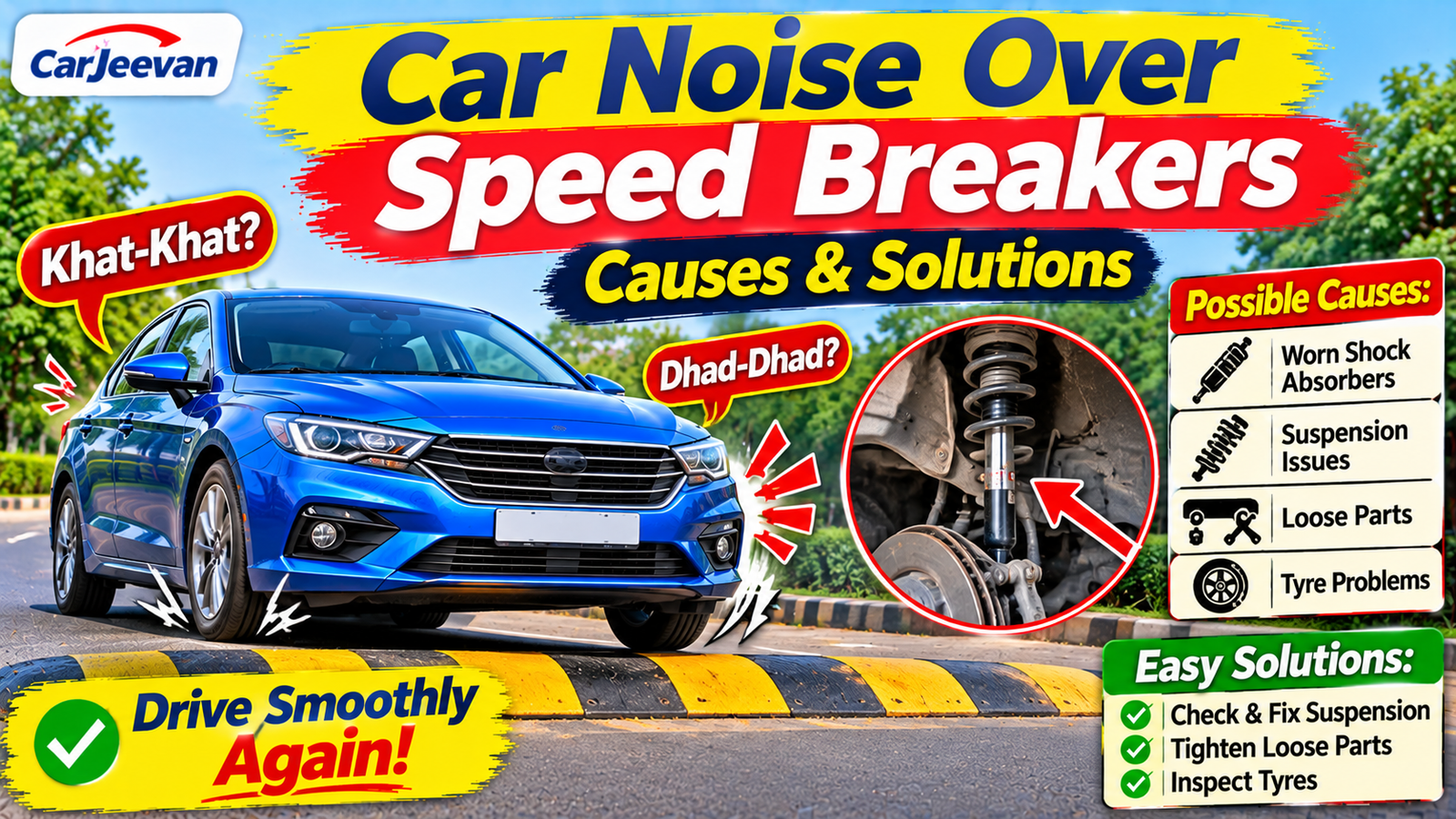
A clunk over speed breakers usually means that something in the suspension or steering has gone loose or worn, so metal or hardened rubber is moving more than it should when the wheel hits the bump. The usual suspects are stabiliser (anti-roll bar) links and bushes, strut mounts, control arm bushes, shock absorbers, and, more seriously, ball joints and tie rod ends. Sometimes the cause is something simple, such as a loose cover under the engine or a heavy object in the boot. The sound, where it comes from and when it happens narrow the field, and a few signs mean you should stop driving.
This guide explains what different sounds usually mean, why speed breakers expose the problem, the signs that make it urgent, what to tell the workshop and what it should check, indicative part and repair costs, and how to compare two quotes. We did not test any car for this article. Causes come from parts-maker guidance and workshop sources, the Indian context from a parts seller’s page, prices from Maruti Suzuki’s retail site and our own suspension guide, and the worked example is hypothetical.
Car Noise Over Speed Breakers – Quick Overview
This “noise decoder” lists likely causes. It is a guide to what to ask about, not a diagnosis.
| What you hear | When | Likely causes | Urgency |
|---|---|---|---|
| A sharp single clunk or knock | Over bumps, potholes and speed breakers, sometimes on hard braking | Stabiliser (anti-roll bar) links | Moderate: get it checked soon |
| A softer creak, squeak or hollow thud | Slow cornering, body roll, small repeated bumps | Stabiliser bushes, control arm bushes, bump stops | Low to moderate |
| A dull thud or knock from high in the wheel arch | Larger bumps, low speed, sometimes when turning the steering | Strut mounts or bearings, worn shock or strut | Moderate to high |
| A clunk with loose or wandering steering, or one that changes when turning | Bumps and turns | Ball joints, tie rod ends | High: stop driving and get it checked |
| A clunk from the rear only | Rear bumps | Rear links, shock mounts, trailing arm bushes, loose cargo, exhaust hangers | Low to moderate |
| A rattle with no change to steering | Rough roads | Loose underbody cover, heat shield or exhaust hanger | Low, but check it |
Why Speed Breakers Expose the Problem
A speed breaker makes the wheel move sharply up and down, so the suspension has to compress and rebound fast. Any joint, link or bush with slack then shifts and knocks. Workshop sources note that low-speed bumps tend to expose worn rubber bushes and mounts, because they compress easily at low speed, and that high-speed impacts may not produce the same sound because the forces differ. An Indian parts seller says poor roads, unmarked breakers and heat wear these parts faster in India, and that suspension noise can appear around 40,000–50,000 km on cars used mainly on city roads. That is a seller’s view, not a measured figure.
Common Causes and What Each Sounds Like
Stabiliser (anti-roll bar) links
The stabiliser bar reduces body roll, and the link is the short rod that connects it to the strut or arm. A parts seller’s guide to Indian conditions says a worn link produces a sharp, single clunk when the suspension is loaded, such as over a pothole or speed breaker, and sometimes under hard braking. The sound comes from the ball joint at the end of the link. Delphi, a parts maker, says it is not necessary to replace links in pairs, though a workshop may offer it.
Stabiliser bushes
The bushes are the rubber sleeves that hold the bar to the body. The same seller says a worn bush gives a softer creak, squeak or hollow thud, especially in slow cornering or on repeated small bumps.
Strut mounts and bearings
The strut mount joins the top of the strut to the body, and on the front it contains a bearing that lets the strut turn with the steering. Delphi says a worn mount can cause clunking over bumps or squeaking when manoeuvring at low speed, and that mounts on both sides tend to wear alike, so replacing them in pairs is advisable. Monroe, a shock-absorber maker, says new mounting kits should be fitted whenever struts are replaced.
Shock absorbers and struts
A worn or leaking shock can let the car bounce and knock. Workshop sources add that the shock is not always the source of the noise, since mounts, spring seats and loose hardware are often responsible, so ask what was found before replacing it.
Control arm bushes
Worn arm bushes allow movement that clunks on bumps, and sources link them to a single thud under braking or acceleration. Our guide to suspension repair cost covers parts and prices.
Ball joints and tie rod ends
These are the urgent ones. Delphi lists clunking over bumps or when turning, loose or wandering steering, uneven tyre wear and steering wheel vibration among symptoms of a worn ball joint, and warns that waiting until a joint fails is dangerous because the wheel could collapse, causing an immediate loss of control. It advises replacing a joint that shows excessive play and checking alignment afterwards. Other sources say a clunk that comes with loose steering should be checked immediately.
Loose underbody parts and cargo
Some rattles are not suspension at all. Workshop sources list loose exhaust hangers, heat shields and brake hardware, and heavy items loose in the boot. These are usually cheaper to fix, but they still need checking.
When to Stop Driving
Stop driving, and have the car inspected before it moves again, if any of these appear with the clunk: the steering feels loose or wanders, the noise changes or gets worse when you turn the wheel, the car pulls to one side, the steering wheel vibrates, there is a new clunk after recent suspension work, or tyres show new uneven wear. If the car is drivable and none of these appear, get it checked soon and avoid rough roads and high speeds until it has been.
What to Tell the Workshop, and What It Should Check
Notes help a technician find the cause faster. Write down whether the noise is at the front or rear, how fast you were going, whether it happens over every bump or only big ones, whether it happens when turning or braking, whether it is worse cold or warm, and when it began, including any pothole hit or recent work.
At the workshop, the car should be inspected on a lift or with the wheels raised so each link, bush, mount, joint and shock can be checked for play, torn boots, leaks and loose bolts. Delphi’s guidance for ball joints says to inspect for excessive play, wear and damage, and to check wheel alignment afterwards. A quote that names large parts without any inspection findings deserves questions. Our guide to wheel alignment vs balancing cost explains the alignment step.
Indicative Part and Repair Costs in India
Maruti Suzuki retail MRP for small parts (parts only)
| Part | MRP, including taxes | What to know |
|---|---|---|
| Stabiliser bar mount (rubber) | ₹52, ₹65 and ₹85 for different part numbers | Per piece. Model-specific. |
| Stabiliser bush kit; front stabiliser mount bushing | ₹198 (kit listed for Alto and WagonR); ₹270 (imported part) | Per unit. |
| Front strut support (top mount) | ₹460 for one part number | Per piece. Model-specific. |
| Front strut bearing | ₹549 (imported part) | Per piece. |
| Steering tie rod | ₹515 for one part number | Per piece. Model-specific. |
| Front stabiliser bar | ₹852.50–₹3,227 for different part numbers | The bar itself is rarely the cause of a clunk. |
| Stabiliser link | Not verified | We could not match a link listing to a price. |
Source: Maruti Suzuki Genuine Parts listings (see the source list). These are retail MRPs for specific part numbers and models, seen as search-result text, and they exclude labour.
Repair figures from our suspension guide
Our suspension repair cost guide lists, from published seller and workshop pages, bushes at ₹500–₹2,500 each, ball joints at ₹1,500–₹4,000, tie rod ends at ₹1,200–₹3,500, and shock absorbers or struts at ₹3,500–₹6,000 a pair for small hatchbacks, with labour of ₹800–₹2,000 per axle. Those figures are seller and workshop estimates and include labour, so they are not like-for-like with the Maruti MRPs.
How far to trust these figures. Four limits apply. The Maruti MRPs are for specific parts and models. The workshop figures are one-city seller estimates. We found no authorised-centre price list. And the gap between a part that costs a few hundred rupees and a quote of thousands is mostly labour and the number of parts replaced, so ask what is being replaced and why.
How to Compare Two Quotes for a Suspension Noise
Two quotes are only comparable when they rest on the same findings. Check these in order:
- Inspection. What did the workshop find, and can you see it?
- Scope. Which parts are replaced, and why does each follow from a finding?
- Parts. Brand, part number, and new or reconditioned.
- Labour. Hours, and itemised or lump sum.
- Alignment. Included, separate or not mentioned.
- Tax. Bring both quotes to the same basis, as in our guide on how to compare two car repair estimates.
- Warranty. On parts and on labour, and whether it is written.
Illustrative example: two quotes for a clunk over speed breakers. These figures are invented to show the method. They are not market prices, and neither quote is recommended.
| Line | Quote A (hypothetical) | Quote B (hypothetical) |
|---|---|---|
| Inspection on a lift | ₹500, play found in the front stabiliser links and the bar bushes | None shown |
| Stabiliser links, pair | ₹1,600 | – |
| Stabiliser bush kit | ₹400 | – |
| Front struts, pair | – | ₹7,200 |
| Strut mounts and bump stop kits | – | ₹2,400 |
| Lower arms, pair | – | ₹4,400 |
| Labour | ₹900 | ₹3,500 |
| Wheel alignment | – | ₹1,000 |
| Total before tax | ₹3,400 | ₹18,500 |
| GST at 18% | ₹612 | ₹3,330 |
| Total as quoted | ₹4,012 | ₹21,830 |
Quote B is ₹17,818 higher, but the point is not the price. Quote A is tied to what was found, and Quote B lists several large parts with no findings shown. Quote B could still be right for a car with worn ball joints or leaking struts. Ask which finding supports each line, and ask to see the worn parts.
How CarJeevan Helps Compare Two Repair Quotes
CarJeevan’s Car Repair Estimate Calculator & Quote Comparator is a free tool for organising two garage quotations side by side. For each quotation you enter the repair items with quantity, parts cost per item and labour, plus other charges, discounts and tax or fees. You can also tick whether a quotation states the part brand or number, explains the warranty, lists labour separately and requires your approval for additional work. The tool then shows the totals and the differences between the two. Its privacy note says the calculations run in your browser.
It has limits. It has no live price database, does not inspect cars or find noises, cannot tell you which repair your car needs or whether a garage is overcharging, and does not guarantee savings. Its output is only as accurate as what you enter. Enter taxes exactly as the quotation shows them, and do not count them twice.
For a suspension noise, enter the inspection, each part, the labour and any alignment as separate rows. A part that appears in one quote and not the other is then easy to spot, and it is a question to ask, not a verdict.
Have two garage quotations for your suspension noise? Use the CarJeevan comparison tool to organise and compare the parts, labour and other charges entered in both estimates.
Questions to Ask Before Approving the Repair
For general questions, see our list of questions to ask your mechanic before approving any repair. For a clunk over speed breakers, add these:
- Which part is worn or loose, and how did you find it (play, torn boot, leak, loose bolt)?
- Can you show me the worn part on the car or after removal?
- Does the noise come from the front or the rear, and does that match what you found?
- Are ball joints and tie rod ends checked, and what did they show?
- Is replacing one part enough, or do you recommend pairs, and why?
- Is alignment needed after the repair, and is it in the quote?
- Is the warranty written, on both parts and labour?
Prevention: Small Habits That Help
Slow down for speed breakers and potholes, avoid overloading the car (Delphi says extreme overloading can affect link performance), and fix small noises early so they do not wear neighbouring parts. An Indian parts seller advises against unbranded suspension parts on safety grounds. Our annual car maintenance cost guide shows how repairs fit into a yearly budget.
Car Noise Over Speed Breakers – Frequently Asked Questions
Why does my car clunk over speed breakers?
Usually a worn or loose suspension or steering part: a stabiliser link, a bush, a strut mount, a shock, a ball joint or a tie rod end. Sometimes a loose underbody part or cargo. Note when and where the clunk happens, and get it inspected.
Is a stabiliser link clunk dangerous?
A worn link is not usually an immediate breakdown risk, but it affects stability in lane changes and cornering, so get it checked soon.
When is the noise dangerous?
When it comes with loose or wandering steering, changes when you turn, or follows recent suspension work. Delphi warns that a failed ball joint can cause the wheel to collapse, so stop driving and have the car inspected.
Can the noise be something other than suspension?
Yes. Loose exhaust hangers, heat shields, under-engine covers, brake hardware and loose items in the boot can all rattle. Ask the workshop to check them.
How much does it cost to fix a clunk over speed breakers?
It depends on the part. Maruti Suzuki lists some small mounts and bushes at under ₹600 MRP for specific part numbers, while a pair of struts or a ball joint costs thousands with labour. Get an inspection, then a written quote.
Conclusion
A clunk over speed breakers is the car telling you that something is loose or worn. The sound, the side it comes from and when it happens narrow the cause, and signs such as loose steering or a noise that changes when you turn mean you should stop driving. Many causes involve small, inexpensive parts, but labour and the number of parts replaced decide the bill.
Ask for an inspection, ask which finding supports each part, and compare complete quotations. When you hold two estimates, the CarJeevan tool can line them up row by row, while decisions about your suspension and steering belong with a qualified technician.
This article is general information, not a diagnosis or professional advice. Prices are estimates checked on 5 November 2026 and may change. Suspension and steering faults can be safety-critical, so have a qualified technician inspect your car.

Through CarJeevan,prashant bobde aims to make confusing automotive information easier to understand. The website focuses on practical questions that car owners face, such as how to compare garage quotations, understand parts and labour charges, review additional fees, and identify the right questions to ask before approving a repair.
CarJeevan also provides a free Car Repair Estimate Calculator and Garage Quote Comparator that helps users organise and compare two repair quotations using the information provided by the user.
The editorial approach focuses on clear explanations, practical examples, and transparent limitations. Where appropriate, articles refer to official information, manufacturer guidance, policy documents, and other reliable sources. Illustrative examples are identified as examples rather than presented as actual market prices.
CarJeevan does not claim to diagnose vehicle faults or independently verify every garage's prices. Readers are encouraged to consult a qualified automotive professional for mechanical inspections and safety-related repair decisions.
The goal is simple: to help Indian car owners understand repair costs better, ask informed questions, and make decisions with greater clarity.
Website: https://carjeevan.com/