
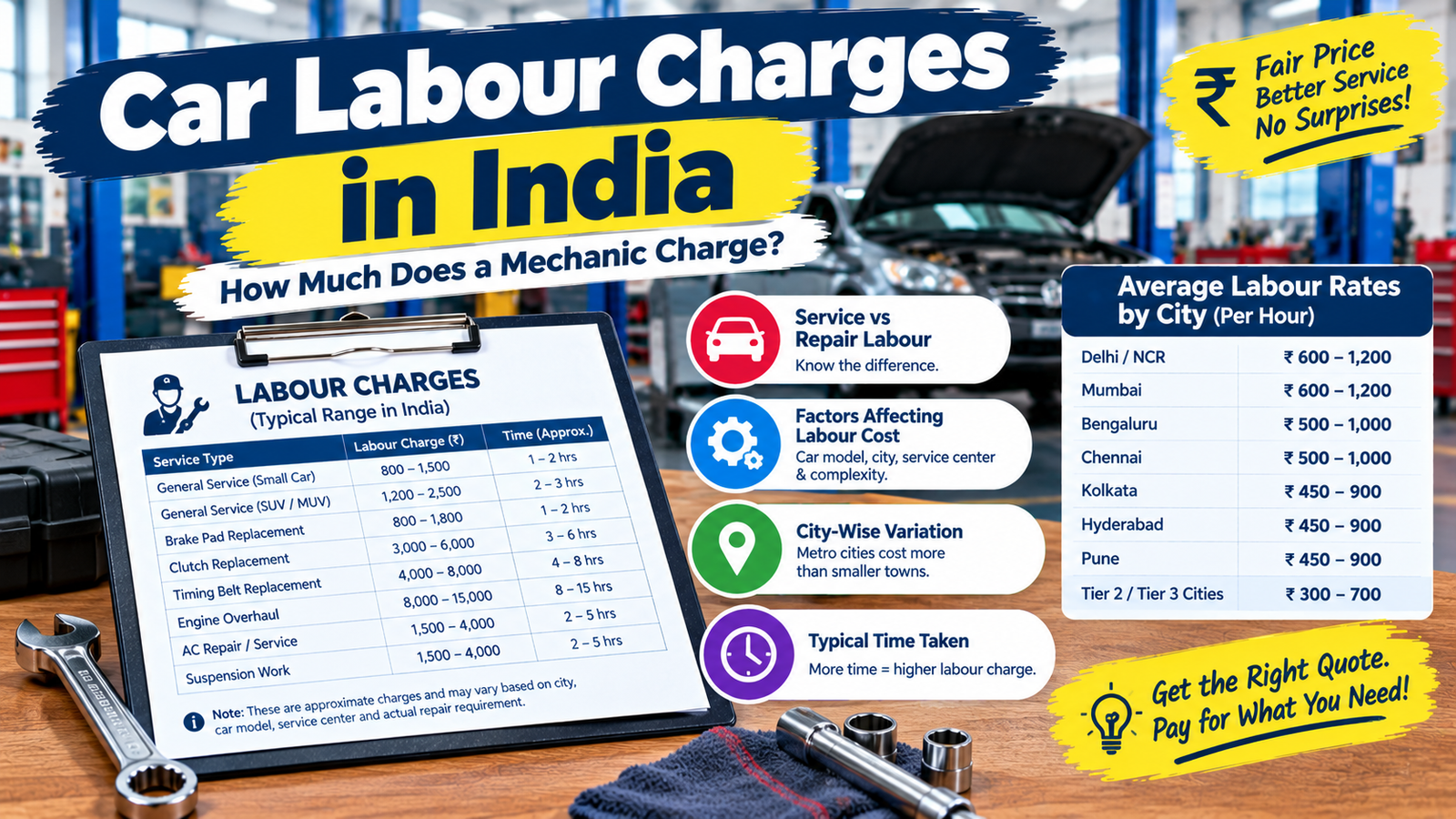
Two garages look at the same car and give you very different labour figures for the same job. One says ₹1,500, the other says ₹3,200. Neither will tell you why. Since the parts are often priced similarly, labour is where the gap shows up, and it is also the line people understand least.
In this guide, we explain how car labour charges are calculated, why they change from one garage to another, how brake, clutch and AC jobs differ, and how to check the labour breakdown on any quotation.
One point first. We do not give a fixed price list here, and you should be careful of any website that does. Labour rates depend on your city, your car, the type of garage and the exact job. All sample numbers in this article are illustrative and are meant to show the method, not to tell you what a job should cost.
How Car Labour Charges Are Calculated
Most workshops use one of two methods.
1. Flat-rate (fixed per job). The garage has a standard time for each job, and the charge is that time multiplied by the workshop’s hourly rate. Most shops take this standard time from a flat-rate guide that shows the average time an experienced technician needs for a given repair. That time is then multiplied by the shop’s hourly labour rate to reach the total. The charge stays the same even if the mechanic finishes faster or takes longer. aaaaaa
2. Hourly (actual time). You pay for the time the technician actually spends. This is more common for diagnosis, electrical faults and unusual repairs where nobody can predict the time.
A simple example, with made-up numbers: if a job has a standard time of 2.5 hours and the workshop’s rate is ₹800 per hour, the labour line is 2.5 × ₹800 = ₹2,000. Change either number and the labour changes, which is why the same job can look different across garages.
On top of this, labour charges also depend on local costs, whether the car is mainstream or luxury, the type of repair shop and the facility’s overheads. Add 18% GST on labour, and you see why two quotes can drift apart. Labour charges attract their own 18% GST. aaashriramfinance
What Affects Car Repair Labour Cost?
Here are the main factors, from the most to the least obvious.
| Factor | How it changes labour |
|---|---|
| City and area | Rent, wages and demand differ between metros and smaller towns |
| Car make and model | Premium and imported cars usually need more time, special tools and trained technicians |
| Engine and layout | A cramped engine bay or transverse engine can make simple jobs slower |
| Type of job | Anything that needs removing other components first takes longer |
| Garage type | Authorised centre, multi-brand workshop or neighbourhood garage |
| Condition of the car | Rusted bolts, damaged threads or previous poor repairs add time |
| Diagnosis | Finding an electrical or AC fault can take longer than fixing it |
| Overlapping jobs | Doing two jobs together can save repeated dismantling |
| Packages and plans | Prepaid service packages sometimes include labour discounts |
On that last point, a Maruti Suzuki maintenance plan was reported to offer at least 10% savings on labour. Whether such a plan helps you depends on your car and how often you service it, so read the terms before buying one. outlookbusiness
Authorised Service Centre vs Local Garage: Labour Differences
There is a common belief that the neighbourhood garage is always cheaper. It often is, but not always. Owners discussing this on Team-BHP have pointed out that neighbourhood garages are not automatically cheaper on parts and labour. The honest answer is “it depends”. team-bhp
| Point | Authorised service centre | Local or independent garage |
|---|---|---|
| Labour rates | Usually standardised and often higher | Varies widely, sometimes negotiable |
| Technicians | Trained on your brand | Experience varies, from excellent to average |
| Tools and diagnostics | Brand-specific equipment | Depends on the garage |
| Estimate format | Usually itemised | Sometimes a lump sum |
| Workmanship warranty | Often given in writing | Varies, so ask |
| Best for | New cars, warranty work, complex electronics | Older cars, routine jobs, budget repairs |
A higher labour rate at an authorised centre is not automatically unfair, and a low labour figure at a local garage is not automatically a bargain. What matters is the scope of work, the skill involved and the protection you get afterwards. If your car is still under warranty, check with the service centre before using an outside workshop. Our guide on OEM vs aftermarket car parts covers the parts side of the same decision.
Car Repair Labour Charges by Job
Instead of quoting prices that would be wrong in half the cities, here is what actually makes labour move up or down for three common jobs.
Brake pad and disc replacement
A pad change is usually one of the simpler jobs, but it is not always identical. The time depends on whether you are doing one axle or both, whether the discs also need replacing or resurfacing, and whether the calipers are seized. Published times vary a lot. One UK garage chain says a pad replacement takes roughly 30 to 90 minutes per axle depending on the vehicle and its condition, while some Indian service listings quote a few hours because they bundle in inspection and cleaning. That difference alone shows why you should ask exactly what the labour covers. dacemotorgroup
What to ask: Is this per axle or for the whole car? Does it include cleaning, caliper inspection and brake fluid top-up?
Clutch repair or replacement
Clutch work is usually labour-heavy because the gearbox often has to be separated from the engine. The charge depends on how easy it is to reach the clutch, whether the flywheel needs resurfacing or replacing, and whether the hydraulic system needs bleeding. One repair guide notes that on jobs like clutch replacement, labour can account for a large share of the total, sometimes more than the parts. That example comes from the UK, but the logic applies in India too. haynes
What to ask: Does labour include flywheel resurfacing, release bearing and bleeding? If I replace the clutch now, are there other parts worth replacing at the same time to avoid paying labour twice?
Car AC repair
AC jobs have the widest spread, because “AC not cooling” can mean many things. A gas top-up with a leak check is a small job. A leaking condenser, a faulty compressor or a blocked evaporator involves draining the system, dismantling parts of the dashboard or front end, vacuuming and recharging. Diagnosis can take longer than the fix.
What to ask: Is diagnosis charged separately? Does the labour include leak testing, vacuuming and gas refilling? Is the gas charged separately?
A quick summary
| Job | What pushes labour up | What to confirm on the estimate |
|---|---|---|
| Brake pads | Both axles, seized calipers, added cleaning | Per axle or whole car, what is included |
| Brake discs | Rust, resurfacing instead of replacement | Replace vs resurface, one or both sides |
| Clutch | Gearbox removal, flywheel work | Flywheel, bleeding and bearing included or not |
| AC repair | Leak search, component replacement, recharge | Diagnosis fee, gas cost, leak testing |
Sample Comparison: Same Clutch Job, Two Labour Quotes
Here is how a labour comparison looks when you go beyond the headline number. These figures are invented to demonstrate the method and are not market rates.
| Labour line | Garage A (authorised) | Garage B (local) |
|---|---|---|
| Clutch assembly replacement | ₹6,500 | ₹4,500 (lump sum) |
| Flywheel resurfacing | Included | Not mentioned |
| Hydraulic bleeding | Included | Not mentioned |
| “Workshop charges” | None | ₹300 |
| Labour before GST | ₹6,500 | ₹4,800 |
| GST at 18% | ₹1,170 | ₹864 |
| Labour with GST | ₹7,670 | ₹5,664 |
At first glance the gap is ₹2,006. But Garage B hasn’t said whether flywheel resurfacing and bleeding are covered. If they are billed later, the gap shrinks. If they are not needed, Garage A’s labour includes work you don’t require. Only a line-by-line breakdown tells you which.
How to Check the Labour Breakdown in an Estimate
A good estimate shows labour clearly. Look for the following.
- Job-wise lines. Each job should be listed separately, not as one lump sum. Our guide on what a car repair estimate should include shows how it should look.
- Scope of work. Check what is included in each line, such as cleaning, testing, bleeding or alignment.
- Method of charging. Ask whether it is flat-rate or hourly. For hourly work, ask for the rate and expected hours.
- Overlapping jobs. If two jobs involve the same dismantling, labour for the second should usually be lower.
- Extra charges. Items like “workshop”, “consumables” or “miscellaneous” should be explained in writing.
- Tax. Confirm whether GST on labour is included or added separately.
- Approval for extras. Ask the garage to call you before adding labour. Our article on why a car repair bill differs from the estimate explains why labour is the most common reason bills grow.
You can use our free Car Repair Estimate Calculator & Garage Quote Comparator to enter each labour line, add GST and discounts, and see two garage quotations side by side. It helps you check that the arithmetic adds up and shows exactly which lines differ, so you can ask better questions. It does not use a live price database, so it cannot tell you whether a garage is overcharging. For that, you still need to ask the garage questions, compare more than one quote and consult a qualified mechanic for safety-critical work.
For a printable format, see our car repair estimate template.
Questions to Ask About Labour
- Is labour flat-rate or hourly?
- What exactly does this labour line include?
- Is diagnosis charged separately?
- Does the quote cover both sides or axles, or only one?
- Are there related jobs that could be done together to save labour?
- Is there a warranty on the workmanship?
- Will you call me before any additional labour is added?
- Is GST on labour included in this price?
For more, read our guide on questions to ask your mechanic before repair.
Common Mistakes People Make About Labour
- Comparing only the total and ignoring what the labour covers
- Accepting a lump-sum labour line with no breakdown
- Assuming a local garage is always cheaper, or an authorised centre always overcharges
- Forgetting that GST applies to labour as well
- Not asking about overlapping jobs
- Paying separately for diagnosis without knowing in advance
- Comparing prices from another city or an old online post as if they apply to you
- Choosing the cheapest labour for safety-critical work such as brakes
Quick Checklist
- Is labour listed job by job?
- Is the scope of each job clear?
- Do you know whether it is flat-rate or hourly?
- Are overlapping jobs discussed?
- Are extra charges explained?
- Is GST on labour shown?
- Is workmanship warranty written down?
- Have you compared at least two quotations?
FAQs
How are car mechanic labour charges decided in India?
Mostly by a standard time for the job multiplied by the workshop’s hourly rate, or by a fixed price per job. The final figure depends on the city, the car, the garage type and the condition of the vehicle.
Why is car service labour so different between garages?
Overheads, technician skill, tools, workmanship warranty and the scope of work all differ. Two lines with the same name may not cover the same work.
Is labour charged separately from parts?
In an itemised estimate, yes. Parts, labour and extra charges should each appear on their own lines, with GST shown separately.
Is it okay to negotiate labour charges?
Often yes, especially at independent garages. Politely sharing another written quote can help. For safety-critical work, don’t compromise on quality to save a small amount.
Can I find a fixed rate list for car repair labour charges by job?
Not reliably. Rates vary by vehicle, repair and city, so use any list only as a rough reference and rely on written quotations for your car.
Does GST apply to labour?
Yes, labour charged by a GST-registered garage is taxed separately from parts. Very small unregistered garages may not charge it.
Final Thoughts
Labour is not a mystery number. It is time, skill and workshop cost put together, and it becomes much easier to judge once it is broken down job by job. Ask what each line covers, check the method of charging, compare at least two quotations on the same basis and keep everything in writing. Then use the Car Repair Estimate Calculator to line up your quotes and spot where they differ before you decide.

Through CarJeevan,prashant bobde aims to make confusing automotive information easier to understand. The website focuses on practical questions that car owners face, such as how to compare garage quotations, understand parts and labour charges, review additional fees, and identify the right questions to ask before approving a repair.
CarJeevan also provides a free Car Repair Estimate Calculator and Garage Quote Comparator that helps users organise and compare two repair quotations using the information provided by the user.
The editorial approach focuses on clear explanations, practical examples, and transparent limitations. Where appropriate, articles refer to official information, manufacturer guidance, policy documents, and other reliable sources. Illustrative examples are identified as examples rather than presented as actual market prices.
CarJeevan does not claim to diagnose vehicle faults or independently verify every garage’s prices. Readers are encouraged to consult a qualified automotive professional for mechanical inspections and safety-related repair decisions.
The goal is simple: to help Indian car owners understand repair costs better, ask informed questions, and make decisions with greater clarity.
Website: https://carjeevan.com/
1 thought on “Car Labour Charges in India: What Affects Repair Costs?”