
Last reviewed and prices checked: 5 November 2026. This is general information, not a diagnosis. If your temperature gauge reaches the red or you see steam, stop driving and get professional help.
Introduction
The needle creeps up at a signal in heavy traffic, then drops as soon as you reach an open stretch. The next day it does it again. You top up some water and hope for the best, but a workshop quote for the problem could be a few hundred rupees or tens of thousands, and nobody has said which.
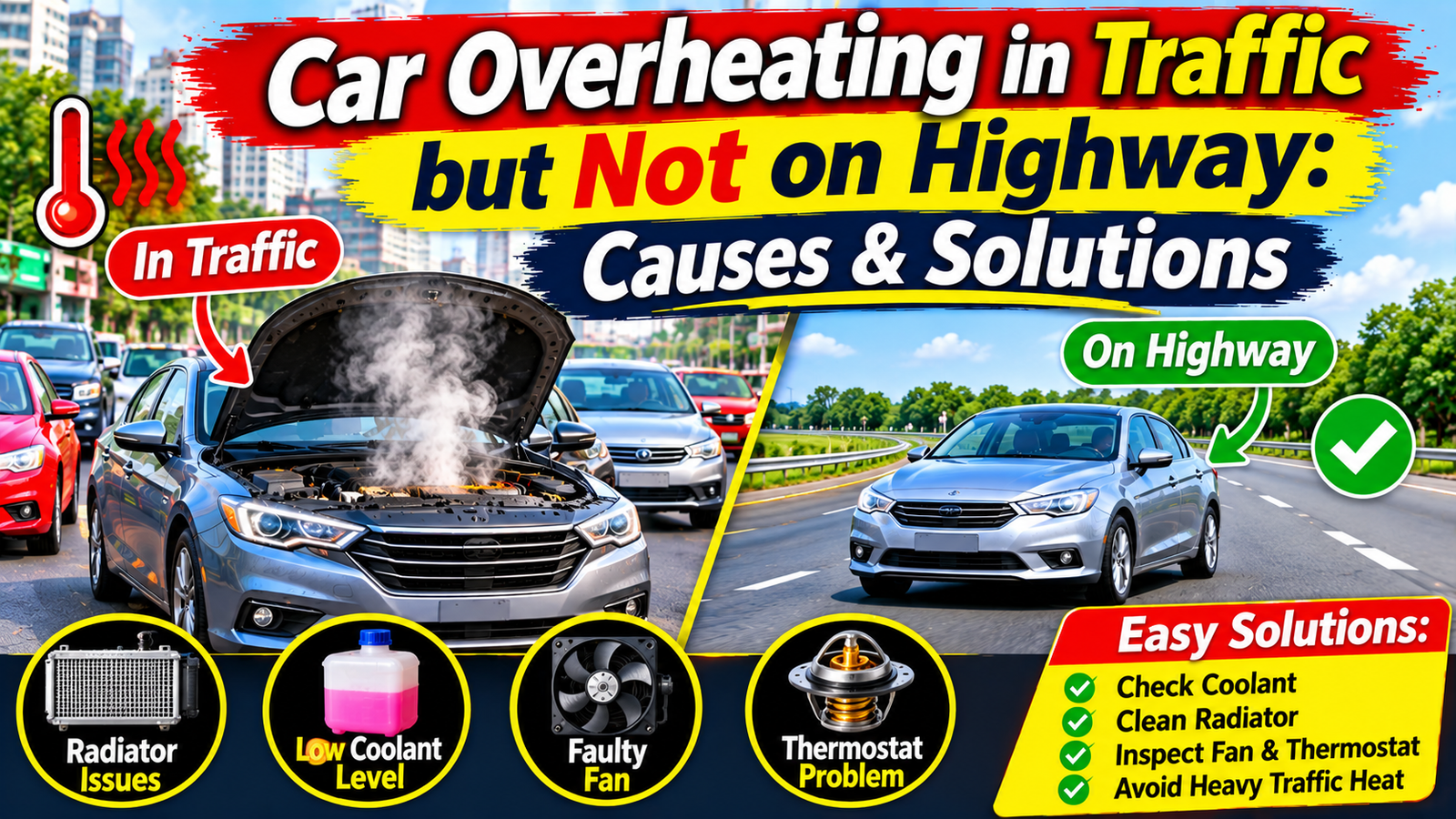
A car that overheats in traffic but not on the highway is usually short of airflow through the radiator at low speed. At speed, air is forced through the radiator. In traffic, the cooling fan has to move it. So a weak or non-working fan is a common suspect, but low coolant, a blocked radiator, a sticking thermostat, a weak water pump, a faulty radiator cap or even a false temperature reading can produce the same pattern. The safe response is to deal with the heat immediately, then have the system tested instead of guessing.
This guide explains why the pattern appears, what to do in the first minute, what a workshop should check and in what order, indicative repair costs in India, and how to compare two quotes. We did not test any car for this article. Safety steps come from carmaker guidance, causes from parts-maker and workshop sources, prices from published estimates, and the worked example is hypothetical.
Car Overheating in Traffic – Quick Overview
| Likely cause | Typical sign | Who should check it |
|---|---|---|
| Cooling fan, relay or fan sensor not working | Temperature rises at idle, falls at speed | A workshop, with a fan circuit test |
| Low coolant or a leak | Coolant level falls, puddles, sweet smell | A workshop, with a pressure test |
| Blocked or dirty radiator or condenser | Gets worse in heat and slow traffic | A workshop, with a temperature and flow check |
| Thermostat sticking | Gauge unstable, heater poor | A workshop |
| Weak water pump or loose belt | Overheating that gets worse over time, noise or leaks | A workshop |
| Faulty radiator cap or air in the system | Overheating even with coolant, coolant pushed out | A workshop, with a cap pressure test |
| False temperature reading | Gauge does not match reality | A workshop, with a sensor test |
Why It Happens in Traffic but Not on the Highway
Workshop sources give the same basic explanation. At highway speed, outside air moves through the grille and across the radiator fins. In slow traffic that natural airflow nearly disappears, so an electric or belt-driven fan has to pull the air through. If the fan is weak, damaged or not switching on, the temperature rises at a signal and falls when you speed up.
Three related points are worth knowing. First, the pattern points to airflow but does not prove the fan is at fault, because low coolant, a restricted radiator, a sticking thermostat or poor coolant circulation can look the same. Second, at idle the engine runs slowly, so the water pump circulates coolant more slowly too, which exposes a weak pump or low coolant that higher engine speed masks. Third, turning on the AC adds load: the AC condenser sits in front of the radiator, so the fan has to pull air through the condenser first. If you suspect the AC side, see our guide to car AC repair cost.
What to Do Right Now When the Needle Climbs
Maruti Suzuki’s guidance, from its car care page, says that if the high-temperature warning light comes on or the needle approaches the H mark, you should:
- Turn off the air conditioner.
- Take the car to a safe place and park.
- Let the engine idle for a few minutes until the warning light goes off or the needle returns to the normal range.
- If you see or hear steam escaping, switch the engine off immediately and do not open the bonnet until the hissing or steam has stopped.
- Never open the radiator cap while the engine is hot, because it can cause serious burns.
Hyundai’s owner’s manuals give a similar sequence. They say to pull over safely, turn the AC off, and, if there is no visible coolant loss or steam, leave the engine running and check that the cooling fan is working, and to turn the engine off if the fan is not running. If coolant is leaking out, stop the engine at once and call a service centre. Both say that the coolant cap must never be removed while the engine and radiator are hot, and Hyundai warns that suddenly adding coolant to an overheated engine can cause cracks, so any top-up should be slow and in small quantities, following the manual.
Do not keep driving with the gauge in the red. If the problem repeats, get the car checked before the next long drive. Your owner’s manual is the authority for your model.
Causes and What a Workshop Does About Each
This section explains the causes. It is not a repair guide, and cooling system work should be done by a qualified workshop.
Cooling fan, relay or sensor
If the fan does not start, runs slowly or spins weakly, airflow at idle is poor. The fault can be the fan motor, a fuse, a relay, a thermal switch or the fan control unit, which is why HELLA’s workshop page tells technicians to check the switch-on point, fuse, thermal switch and control unit as well as any mechanical damage.
Low coolant or a leak
Low coolant cuts the system’s ability to carry heat away. Coolant is lost through hoses, clamps, the radiator, the water pump, the reservoir or a gasket, so the answer is to find the leak. Maruti Suzuki advises not to restart the engine until a located leak is fixed, and says that if there is no leak you should add coolant slowly to the reservoir and never to the radiator. Topping up repeatedly without finding the leak only delays the problem.
Blocked radiator or condenser
Dirt, debris and corrosion can restrict airflow or coolant flow. HELLA lists checking that the radiator and any upstream components, such as the AC condenser, are free from contaminants, and checking whether the radiator itself is clogged using temperature and flow checks.
Thermostat
The thermostat controls coolant flow through the engine. If it sticks, the temperature can swing or climb. Denso notes that thermostat faults are often mistaken for other cooling problems and that diagnosis should combine several checks, not just a fault code.
Water pump and belt
The pump circulates coolant. HELLA’s checklist includes confirming the pump wheel sits firmly on its shaft, and Maruti Suzuki says to check the water pump belt for slippage or damage after an overheat. A loose or slipping belt can reduce pump flow.
Radiator cap, expansion tank and air in the system
The cap and expansion tank hold pressure. A MAHLE workshop tip lists air trapped in the cooling circuit, a defective fan and an incorrect temperature sensor among the causes of overheating with a defective expansion tank cap, and HELLA lists checking the pressure valves in the cap or tank with a test pump. A cap that cannot hold pressure lets coolant boil earlier.
A false temperature reading
Sometimes the gauge or sensor is wrong. HELLA’s first step is to ask whether the displayed temperature is realistic and, if necessary, to check the coolant temperature sensor and the instrument.
A serious engine fault
If overheating continues after the basic checks, or you see white smoke, coolant loss with no leak, or coolant in the oil, a head gasket or other internal fault may be involved. This needs a proper test, not a guess. Do not drive the car until it is checked.
What a Workshop Should Check, and in What Order
HELLA’s workshop page gives this order for an overheating engine, which is useful when you read a quote. Start with the coolant level, contaminants, antifreeze and leaks, and the belt tension. Then check, depending on symptoms:
- Whether the displayed temperature is realistic.
- Whether the radiator and condenser are free from contaminants.
- Whether the radiator fan works, including its switch-on point, fuse, thermal switch and control unit.
- Whether the thermostat opens.
- Whether the radiator is clogged, using temperatures at its inlet and outlet and a flow check.
- Whether the coolant pump is working.
- Whether the pressure valves in the cap or expansion tank work, using a test pump.
A quote that jumps straight to expensive parts without any of these checks deserves questions.
Indicative Cooling System Repair Prices in India
| Item | Published figure | Source (checked 5 Nov 2026) | What to know |
|---|---|---|---|
| Hose clamp tightening | ₹100–₹300 | CarWyapar (6 Aug 2026) | An editorial’s estimates, with no method stated. |
| Coolant top-up | ₹300–₹800 | CarWyapar | Same caveat. Find the leak first. |
| Radiator cap | ₹250–₹900 | CarWyapar | Same caveat. |
| Coolant hose replacement | ₹500–₹2,500 | CarWyapar | Same caveat. |
| Thermostat replacement | ₹1,500–₹5,000 | CarWyapar | Same caveat. |
| Radiator repair | ₹1,500–₹4,500 | CarWyapar | Same caveat. |
| New radiator | ₹4,000–₹18,000 | CarWyapar | Parts, plus labour of about ₹700–₹2,000. |
| Water pump replacement | ₹3,500–₹12,000 | CarWyapar | Parts and labour. |
| Head gasket repair | ₹15,000–₹60,000+ | CarWyapar | Much higher on premium cars. |
| Condenser or cooling fan motor | ₹2,500–₹4,500 (hatchback), ₹3,000–₹5,500 (sedan), ₹3,500–₹6,500 (SUV) | Ride N Repair blog (April 2026) | Search-result text only. A seller blog, so check what the quote includes. |
| Labour for these jobs | ₹500–₹3,500 for most, up to ₹25,000 for a head gasket | CarWyapar | Higher in big cities, per the same editorial. |
| Authorised-centre prices | Not verified | – | No published price list found. |
How far to trust this table. Four limits apply. These are editorial and seller estimates, not price lists, and no method is stated. Prices vary by car, city and part type. We found no authorised-centre prices, so the table says nothing about which kind of workshop is cheaper. And a very wide range, such as ₹4,000 to ₹18,000 for a radiator, means you should ask for the part brand and price in writing. Our guide to how car labour charges are calculated explains flat-rate and hourly charging.
How to Compare Two Overheating Repair Quotes
Two quotes are only comparable when they rest on the same findings. Check these in order:
- Diagnosis. What tests were done, and what did they show?
- Scope. Which parts are replaced, and why does each one follow from a finding?
- Parts. Brand, part number, and new or reconditioned.
- Coolant. The type specified in your owner’s manual, and the quantity.
- Labour. Hours, and itemised or lump sum.
- Tax. Bring both quotes to the same basis, as in our guide on how to compare two car repair estimates.
- Warranty. On parts and on labour, and whether it is written.
Illustrative example: two quotes for the same symptom. These figures are invented to show the method. They are not market prices, and neither quote is recommended.
| Line | Quote A (hypothetical) | Quote B (hypothetical) |
|---|---|---|
| Diagnosis | Pressure test and fan circuit check, ₹600, with findings written | None shown |
| Fan motor | ₹3,500 (brand and part number stated) | – |
| Radiator | – | ₹8,500 |
| Thermostat | – | ₹1,800 |
| Water pump | – | ₹4,500 |
| Coolant | ₹500 (type per manual) | Flush ₹1,200 |
| Labour | ₹900 | ₹3,000 |
| Total before tax | ₹5,500 | ₹19,000 |
| GST at 18% | ₹990 | ₹3,420 |
| Total as quoted | ₹6,490 | ₹22,420 |
Quote B is ₹15,930 higher, but the point is not the price. Quote A is tied to a test result, and Quote B lists four parts with no test shown. If your car overheats only in traffic, ask which finding supports each line in any quote you receive. The aim is to ask, not to conclude.
How CarJeevan Helps Compare Two Repair Quotes
CarJeevan’s Car Repair Estimate Calculator & Quote Comparator is a free tool for organising two garage quotations side by side. For each quotation you enter the repair items with quantity, parts cost per item and labour, plus other charges, discounts and tax or fees. You can also tick whether a quotation states the part brand or number, explains the warranty, lists labour separately and requires your approval for additional work. The tool then shows the totals and the differences between the two. Its privacy note says the calculations run in your browser.
It has limits. It has no live price database, does not diagnose faults, cannot tell you which repair your car needs or whether a garage is overcharging, and does not guarantee savings. Its output is only as accurate as what you enter. Enter taxes exactly as the quotation shows them, and do not count them twice.
For an overheating job, enter the diagnosis, each part and the labour as separate rows. A part that appears in one quote and not the other is then easy to spot, and it is a question to ask, not a verdict.
Have two garage quotations for your cooling system repair? Use the CarJeevan comparison tool to organise and compare the parts, labour and other charges entered in both estimates.
Questions to Ask Before Approving the Repair
For general questions, see our list of questions to ask your mechanic before approving any repair. For overheating, add these:
- What tests did you do (pressure test, fan check, thermostat, radiator flow), and what did each show?
- Which finding supports each part on the quote?
- Can you show me the leak, the weak fan or the failed part?
- Is a repair possible before replacement?
- Which coolant will you use, and does it match my owner’s manual?
- Can I keep the old parts?
- Is the warranty written, on both parts and labour?
Prevention: Small Habits That Help
Maruti Suzuki’s daily checks include a walk around the car for coolant leaks, and its “don’ts” include touching or opening the radiator cap when the engine is hot, using non-genuine spares and leaving the car in the sun for long periods. Follow the service schedule in your owner’s manual, check the coolant reservoir when the engine is cold, look for puddles, and do not ignore a creeping gauge. Our annual car maintenance cost guide shows how routine servicing fits into a yearly budget.
Car Overheating in Traffic – Frequently Asked Questions
Why does my car overheat in traffic but not on the highway?
At speed, air is forced through the radiator, and in traffic the fan has to do that work. A weak fan, low coolant, a blocked radiator, a sticking thermostat or a weak pump can show up first at low speed.
What should I do if my car overheats in traffic?
Turn off the AC, park safely, and let the engine idle for a few minutes until the temperature settles, if there is no steam or leak. If you see steam, switch off the engine and do not open the bonnet until it stops. Never open the radiator cap on a hot engine, and get the car checked.
Can the AC cause overheating in traffic?
The AC adds load, and the condenser sits in front of the radiator, so the fan has to pull air through it first. Turning the AC off is one of the first steps both Maruti Suzuki and Hyundai give.
Can a car overheat even if the coolant is full?
Yes. Air in the system, a faulty fan, a sticking thermostat, a blocked radiator, a weak pump or a faulty cap can cause overheating even with a full reservoir.
Is it safe to keep driving if it only overheats in traffic?
No. The cooling system may be coping at speed while a fault remains, and repeated overheating can damage the engine. Get it checked soon.
Conclusion
A car that overheats in traffic but not on the highway is telling you that something is failing at low airflow: the fan, the coolant level, the radiator, the thermostat, the pump or the cap. Treat the heat first by turning off the AC, parking safely and never opening a hot radiator cap, and then get the system tested.
A good workshop diagnoses before it replaces parts, so ask which test supports each line of the quote. When you hold two estimates, the CarJeevan tool can line them up row by row, while decisions about your engine belong with a qualified technician.
This article is general information, not a diagnosis or professional advice. Prices are estimates checked on 5 November 2026 and may change. Cooling system faults can damage an engine quickly, so have a qualified technician inspect your car.

Through CarJeevan,prashant bobde aims to make confusing automotive information easier to understand. The website focuses on practical questions that car owners face, such as how to compare garage quotations, understand parts and labour charges, review additional fees, and identify the right questions to ask before approving a repair.
CarJeevan also provides a free Car Repair Estimate Calculator and Garage Quote Comparator that helps users organise and compare two repair quotations using the information provided by the user.
The editorial approach focuses on clear explanations, practical examples, and transparent limitations. Where appropriate, articles refer to official information, manufacturer guidance, policy documents, and other reliable sources. Illustrative examples are identified as examples rather than presented as actual market prices.
CarJeevan does not claim to diagnose vehicle faults or independently verify every garage's prices. Readers are encouraged to consult a qualified automotive professional for mechanical inspections and safety-related repair decisions.
The goal is simple: to help Indian car owners understand repair costs better, ask informed questions, and make decisions with greater clarity.
Website: https://carjeevan.com/