
Last reviewed and prices checked: 5 November 2026. Prices are published listings and estimates, and the worked example is hypothetical.
Introduction
The car looks clean, the price is below the others you have seen, and the listing says “single owner, no accident”. You have one afternoon to decide. What do you check, and in what order?
A used car inspection checklist works best as a sequence. Start with the papers, because they decide whether you can legally own the car. Then walk around the body and tyres, look under the bonnet and inside the cabin, take a proper test drive, and, if you are serious, pay an independent workshop to inspect it. Finally, turn what you found into a rupee figure from written quotes, so you negotiate on numbers, not feelings.
A checklist reduces risk, but it cannot guarantee reliability or future repair costs. We did not inspect cars or interview mechanics for this article. The legal points come from the Motor Vehicles Act as quoted in a Supreme Court judgment, the checklist from published guides, the prices from published listings, and the worked example is hypothetical. For how to value the car, see our guide on how to calculate second hand car value in India, which this article does not repeat.
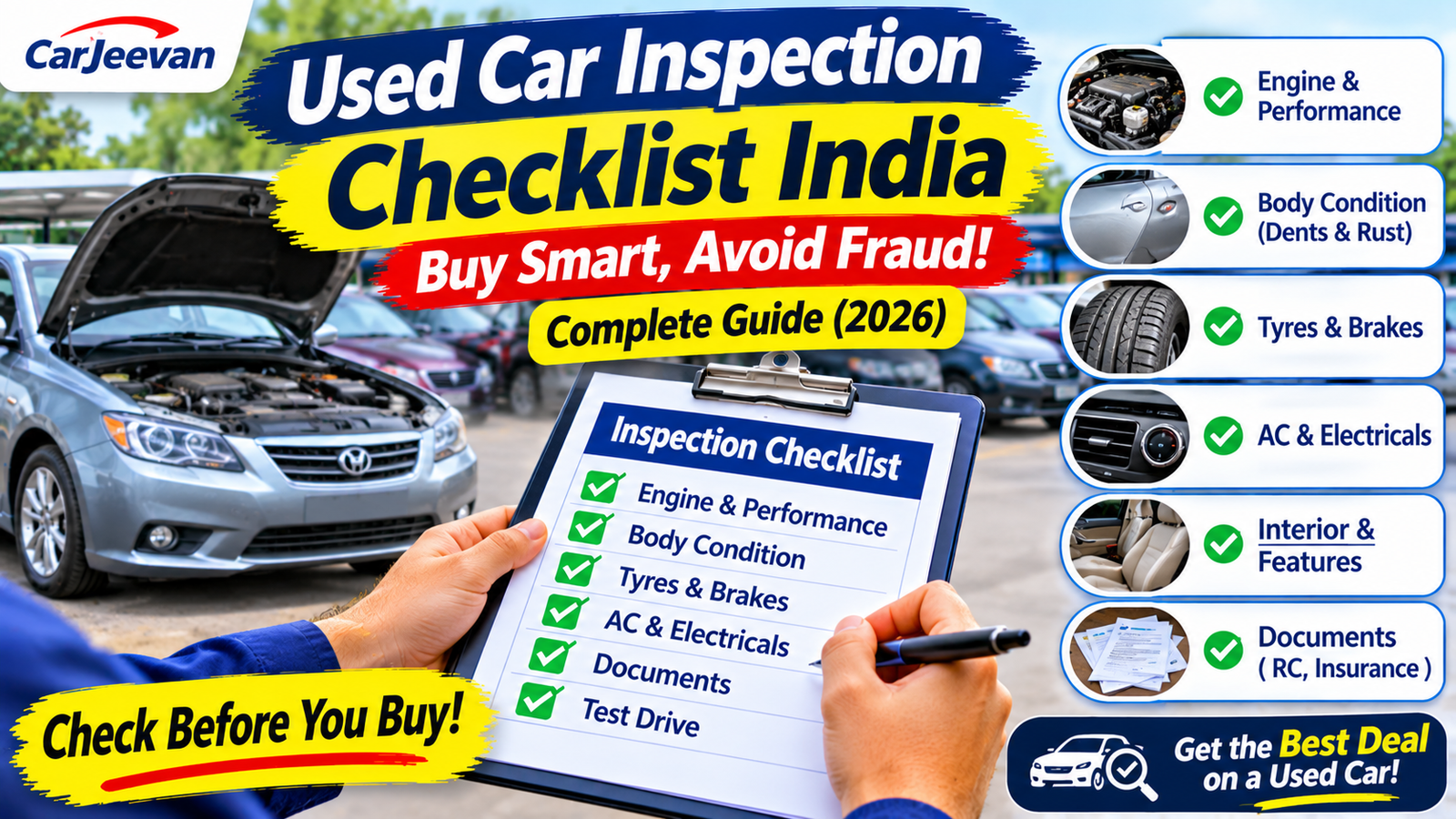
Used Car Inspection Checklist in India – Quick Overview
Use this table as a printable checklist. Each step is explained below.
| Stage | What to check | Red flags |
|---|---|---|
| 1. Papers | Original RC in the seller’s name; chassis and engine numbers match the car; loan or hypothecation status; valid insurance and PUC; service records; an NOC if the car came from another state | The seller is not the registered owner; the numbers do not match; a loan is not cleared; only copies are offered |
| 2. Body and glass | Panel gaps, paint shade and texture, overspray on rubber seals, sealant or weld marks, glass and lights | Uneven gaps, mismatched paint, fresh welds, which may point to accident repair |
| 3. Tyres and wheels | Date code, tread, wear pattern | Tyres about six years old or more; uneven wear, which may point to alignment or suspension problems |
| 4. Engine bay | Inspect cold; look for leaks, fluid level and colour, belts, battery, a cold start | Smoke on start; fresh oil or coolant leaks; warning lights that stay on |
| 5. Cabin and electricals | Wear against the odometer, AC, windows, lights, warning lights, smell | A musty smell, silt, fogged lamps or rusted seat rails, which may point to flood damage; wear that does not match the kilometres |
| 6. Test drive | 15–20 minutes on mixed roads: steering pull, brakes, clutch, gears, noises, AC | Pulling, vibration, grinding, a slipping clutch, clunks over bumps |
| 7. Professional inspection | An independent workshop that you choose | The seller insists on their own mechanic |
Indicative Used Car Inspection Prices in India
| Service | Published figure | Source (checked 5 Nov 2026) | What to know |
|---|---|---|---|
| Pre-delivery inspection by a marketplace (car bought elsewhere) | From ₹1,199 | CARS24: hidden costs article (dated 25 Aug 2025) | A “starting” price, with “300+ checkpoints” claimed by the seller. The page may be out of date. |
| Doorstep pre-purchase inspection | Starting ₹3,065 | Ride N Repair: inspection page | A seller’s starting price. |
| Aggregator ranges | ₹2,000–₹5,000 (Bengaluru); ₹3,000–₹7,000 (Mumbai) | Bino: Bengaluru and Mumbai pages | An aggregator’s ranges, with no method stated. |
| Your own mechanic | ₹500–₹1,500 | A blog’s suggestion: indiag.co | Not verified. |
| Authorised-workshop inspection fee | Not verified | – | No published fee found. |
How far to trust this table. Three limits apply. All of these figures are prices that sellers or aggregators published, and we saw them in search results without opening every page. Inspections differ in scope, so a ₹1,199 check and a ₹3,065 check are not the same product. And a report is a snapshot of the car on that day, not a guarantee.
Step 1: Check the Paperwork Before You See the Car
Start with the papers, because they decide whether you can legally own the car.
- Original RC. It should be in the seller’s name. Under Section 2(30) of the Motor Vehicles Act, the person in whose name the vehicle is registered is the owner, which is why a seller who is not on the RC cannot sign the transfer. Our guide to checking RC status online covers online lookups.
- Chassis and engine numbers. They should match the RC. Compare them on the car itself, not just in a photo.
- Loan status. If the car was financed, the RC should show the loan removed, or you should hold the bank’s NOC and the form to remove hypothecation (Form 35, per Autocar India). Otherwise the lender’s claim may remain.
- Interstate cars. A car from another state needs an NOC from the original RTO (Form 28).
- Insurance, PUC and service records. Check validity and dates. Ask for the claim history.
The transfer rules. Section 50 requires the seller to report the transfer within 14 days, for a car registered in the same state, and the buyer to report it within 30 days. For a car registered in another state, the seller has 45 days to forward the NOC. These figures come from the Act as quoted in a Supreme Court judgment, and some blogs give different numbers. Confirm the process with your RTO. The same judgment says that if the name on the RC is not changed, the registered owner remains liable. Complete the transfer promptly, and apply to your insurer to transfer the policy within 14 days of the transfer, as Section 157(2) of the Act provides, according to an insurer’s blog. Fees and forms can vary by state.
Step 2: Walk Around the Body, Glass and Tyres
Inspect the car in daylight. Look along each side for uneven gaps between panels and for paint that differs in shade or texture. Check for overspray on rubber seals and for sealant or welds in the engine bay and boot, since these can point to accident repair. Look inside headlamps for moisture. Press each panel gently to see if it feels loose.
Some guides suggest a magnet or a paint-thickness gauge to find filler. Treat this as a supplementary check only: a magnet may not stick to aluminium or plastic panels, and a gauge needs a reference reading for that model.
Tyres. Apollo says the date of manufacture is the last four digits of the DOT code: the first two give the week and the last two the year, and Apollo also says to change tyres at about six years. Check all four, and the spare. Uneven wear can point to alignment or suspension faults, so ask about them. See our guides on suspension repair cost and wheel alignment vs balancing for what repairs can cost.
Step 3: Look Under the Bonnet and Inside the Cabin
See the car cold. A warm engine can hide hard starting. Look for oil or coolant leaks, check fluid levels and colour, inspect belts and hoses, and note the battery’s age. Listen to the cold start, and watch for smoke. Ask for the car to idle while you look.
Inside, check that wear matches the odometer. A heavily worn steering wheel, pedals or seat on a car with low kilometres deserves questions. Test every window, light, switch and the AC. Watch for warning lights that stay on after start.
Flood damage. A musty smell, silt in crevices, fogged lights or rusted seat rails can point to water damage. If you see them, walk away or have an expert confirm before going further.
Odometer. Cross-check the reading against service records. Our valuation guide also advises calculating kilometres per year and checking that the odometer matches the records.
Step 4: Take a Proper Test Drive
Drive for at least 15–20 minutes on different roads, as one buyer’s guide advises. Listen and feel for the following:
- Steering. It should hold straight with light hands, and not pull to one side.
- Brakes. The car should stop straight, without vibration, squeal or grinding.
- Clutch and gears. Look for slipping, a high or late bite point, and rough shifts.
- Suspension. Clunks over bumps or noises while turning need a closer look.
- AC. Test it while driving, not just at idle.
Take notes or photos of anything you notice, so you can price it later. If the car makes you uneasy, say so and stop.
Step 5: Get an Independent Inspection
If you are serious, pay a workshop that you choose, not one the seller recommends, to inspect the engine, gearbox, brakes, suspension, steering, electricals, tyres, underbody and any signs of accident or flood damage. Published starting prices are in the table above, from ₹1,199 to ₹3,065 and more, depending on scope. Ask what the report covers, and whether it states measurements and defects in writing.
From Findings to Rupees: A Worked Example
Once you have a list of problems, get written quotes and turn them into a figure. The table below is a hypothetical list of findings for a 5-year-old hatchback, with ranges taken from published listings in our other guides. These are not quotes for your car, and not every item will apply. This is an illustration, not a market average.
| Finding | Published range | Amount used | Read more |
|---|---|---|---|
| Four tyres near the age limit, plus alignment and balancing | ₹2,832–₹4,161 per tyre; ₹799–₹1,500 for alignment and balancing | ₹17,000 (4 × ₹4,000 + ₹1,000) | Annual car maintenance cost |
| Weak battery | ₹4,500–₹8,000 fitted, small Maruti cars | ₹6,000 | Battery replacement cost |
| Front brake pads worn | From ₹1,299 to ₹3,200 | ₹2,300 | Brake pad replacement cost |
| AC cooling poorly, diagnosed as a service | ₹1,949–₹2,749 | ₹2,300 | AC repair cost |
| Clunk over bumps, front suspension pair | ₹3,500–₹6,000 | ₹4,500 | Suspension repair cost |
| Total | ₹32,100 |
The total is ₹17,000 + ₹6,000 + ₹2,300 + ₹2,300 + ₹4,500 = ₹32,100. One finding can swing it. If the AC problem turns out to be a compressor, the published listings in our AC guide start at ₹13,876 for replacement, so that line rises from ₹2,300 to ₹13,876 and the total becomes ₹43,676. That is why you want a written diagnosis and a quote, not a guess.
Do not subtract the whole total mechanically. Our valuation guide advises deducting only the repairs that go beyond what the asking price already assumes, to avoid counting the same wear twice, and treating safety-critical items such as brakes, tyres and steering with extra caution. Get a second quote for any large item.
Common Mistakes to Avoid
- Judging the car by its looks and the price alone.
- Viewing only copies of the RC, not the original.
- Letting the seller choose the inspector.
- Skipping the cold start or the test drive.
- Handing over money before the transfer papers are signed. Many guides advise settling payment terms in writing first, and you should confirm the arrangement for your case.
- Ignoring tyre age, because tread looks fine.
- Deducting the same wear twice when negotiating.
How CarJeevan Helps Compare Two Repair Quotes
CarJeevan’s Car Repair Estimate Calculator & Quote Comparator is a free tool for organising two garage quotations side by side. For each quotation you enter the repair items with quantity, parts cost per item and labour, plus other charges, discounts and tax or fees. You can also tick whether a quotation states the part brand or number, explains the warranty, lists labour separately and requires your approval for additional work. The tool then shows the totals and the differences between the two. Its privacy note says the calculations run in your browser.
It has limits. It has no live price database, does not inspect cars, cannot tell you whether a used car is a good buy or a repair is necessary, and does not guarantee savings. Its output is only as accurate as what you enter. Enter taxes exactly as the quotation shows them, and do not count them twice.
If your inspection finds problems, ask two workshops for written quotes and enter each finding as its own row. Our guide to how to compare two car repair estimates explains how to keep the scope and tax basis the same.
Have two garage quotations for the repairs on your list? Use the CarJeevan comparison tool to organise and compare the parts, labour and other charges entered in both estimates.
Questions to Ask the Seller
- Can I see the original RC, and is it in your name?
- Was the car ever financed, and can I see the loan closure papers?
- Has it been in an accident, a flood or a major repair? Do you have the invoices?
- Can I see the service records, and do they match the odometer?
- Can I take it for a long test drive and to a workshop of my choice?
- Who pays for the transfer fees and when will the transfer papers be signed?
Used Car Inspection Checklist – Frequently Asked Questions
What should I check first when buying a used car?
The papers. Confirm that the seller is the registered owner, that the chassis and engine numbers match the RC, and that any loan is cleared. Then inspect the body, tyres, engine bay, cabin and take a test drive.
How much does a used car inspection cost in India?
Published starting prices we saw ran from ₹1,199 at one marketplace to ₹3,065 for a doorstep service, with aggregator ranges of ₹2,000–₹7,000 in Bengaluru and Mumbai. Scope varies, so ask what the report covers.
Which documents should I check when buying a used car?
The original RC, insurance, PUC and service records, plus loan closure papers if the car was financed and an NOC if it came from another state. Check with your RTO for what applies in your state.
Can a checklist replace a professional inspection?
No. A checklist helps you spot obvious problems and ask better questions, but it cannot guarantee reliability or future repair costs. For a car you are serious about, pay for an independent inspection.
When should I complete the RC transfer?
The Act requires the seller to report within 14 days and the buyer within 30 days for a same-state sale, and the registered owner can remain liable until the name changes. Confirm the process and timing with your RTO.
Conclusion
A used car inspection is a sequence, not a single look. Check the papers first, then the body, tyres, engine bay and cabin, then drive the car for long enough to feel it. If you are serious, pay for an independent inspection, and turn what you find into figures from written quotes rather than guesses.
Keep your paperwork, notes and photos together, and complete the transfer on time. When you hold two quotes for the repairs you want done, the CarJeevan tool can line them up row by row, while the decision about whether the car is sound belongs with a qualified inspector.
This article is general information, not legal advice or a professional inspection. Prices are published listings and estimates checked on 5 November 2026 and may change. Procedures and fees can vary by state, so confirm with your RTO and consult a qualified mechanic before buying.

Through CarJeevan,prashant bobde aims to make confusing automotive information easier to understand. The website focuses on practical questions that car owners face, such as how to compare garage quotations, understand parts and labour charges, review additional fees, and identify the right questions to ask before approving a repair.
CarJeevan also provides a free Car Repair Estimate Calculator and Garage Quote Comparator that helps users organise and compare two repair quotations using the information provided by the user.
The editorial approach focuses on clear explanations, practical examples, and transparent limitations. Where appropriate, articles refer to official information, manufacturer guidance, policy documents, and other reliable sources. Illustrative examples are identified as examples rather than presented as actual market prices.
CarJeevan does not claim to diagnose vehicle faults or independently verify every garage's prices. Readers are encouraged to consult a qualified automotive professional for mechanical inspections and safety-related repair decisions.
The goal is simple: to help Indian car owners understand repair costs better, ask informed questions, and make decisions with greater clarity.
Website: https://carjeevan.com/