
Last reviewed and prices checked: 5 November 2026. This is general information, not a diagnosis. If you smell petrol, the engine cranks unusually fast, or the car has been in standing water, stop trying to start it and call for help.
Introduction
You turn the key or press the button, and the engine turns over with its usual rhythm, but never catches. You try again, and again. The dashboard lights are bright, so it does not look like a flat battery, but nothing fires.
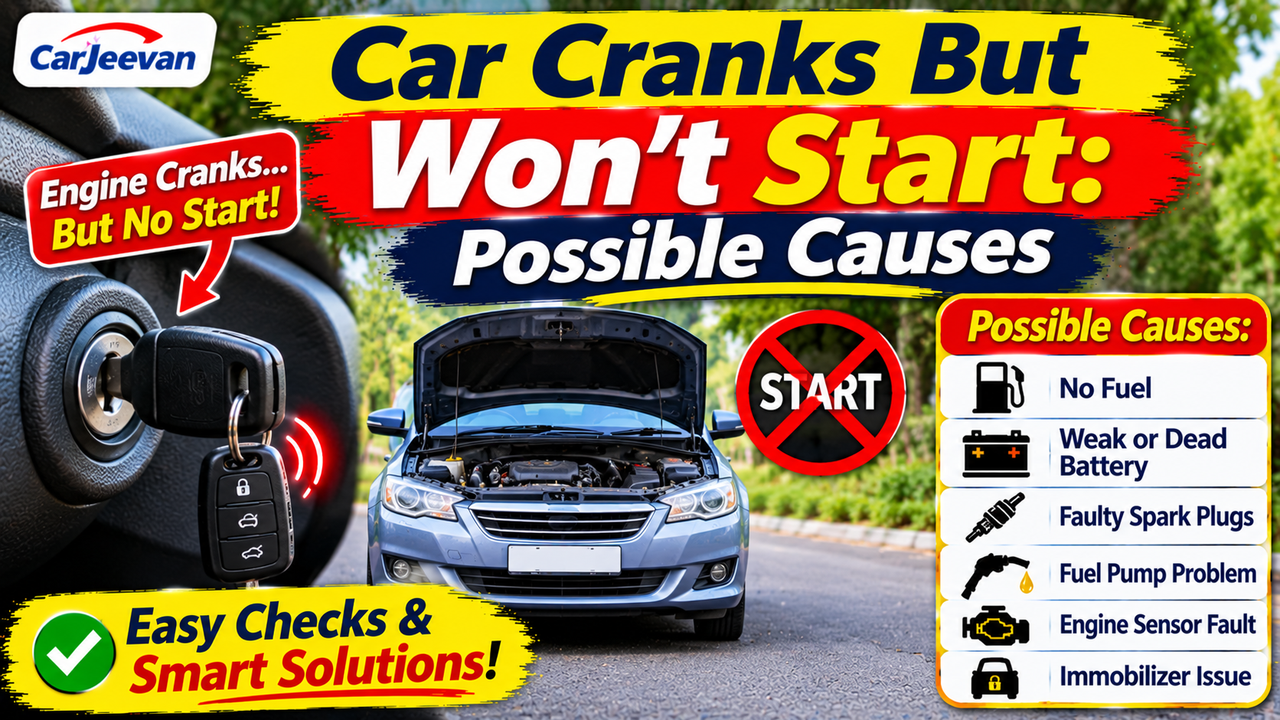
A car that cranks but does not start is usually missing one of the things an engine needs: fuel, a spark (or, in a diesel, enough heat and the right fuel pressure), air, and correct timing. It can also be refusing to start because the immobiliser does not recognise the key. The right next step depends on what you see and hear, and there are a few things you should not do, such as cranking for a long time, which can overheat the starter and, in a petrol car, flood the engine.
This guide explains what to do first and what to avoid, the likely causes grouped by system, when to stop and call for a tow, what a workshop should check, indicative costs, and how to compare two quotes. We did not test any car for this article. First steps come from India-market owner’s manuals, causes from workshop sources, prices from published ranges, and the worked example is hypothetical.
Car Cranks But Won’t Start – Quick Overview
| What you notice | What it may point to | Urgency |
|---|---|---|
| The fuel gauge is low or you ran short recently | No fuel, or a wrong gauge reading | Check first |
| A blinking key or immobiliser light | The key is not recognised | Try the spare key; a workshop if it persists |
| A strong smell of petrol | Possible flooding or a fuel leak | High: stop cranking and call for help |
| The engine cranks unusually fast or sounds free-spinning | A broken timing belt or chain | High: stop cranking |
| A check engine light that stays on | A sensor or ignition fault is stored | Get it scanned |
| A diesel with a water-in-fuel or glow plug light | Water in the fuel, glow plugs | Workshop |
| It started fine yesterday and nothing changed | A relay, fuse, sensor or fuel pump | Workshop |
| Slow cranking or only clicking | A weak battery or starter | See our battery guide; a different problem |
What to Do First, and What Not to Do
Maruti Suzuki’s owner’s manuals say not to use the starter for more than about 12 seconds at a time, to wait about 15 seconds between attempts, and, if the engine still fails to start after several attempts, to check the fuel and ignition systems or consult an authorised workshop. Mahindra’s manual for the XUV500 gives a similar limit of 15 seconds with a 10-second wait. Long cranking can overheat the starter and drain the battery, and in a petrol car it can flood the engine. So crank in short bursts, then stop.
Then check the simple things in the order the manuals suggest:
- Fuel. Honda Cars India’s manual says to check the fuel gauge. The gauge can be wrong, so if in doubt add some fuel.
- The key or immobiliser light. Honda’s manual says that if the immobiliser indicator is blinking, the engine will not start because the key is not recognised. Try the spare key and keep the key away from other keys.
- Warning lights. Note any check engine light or diesel indicators.
- Smells and sounds. A strong smell of petrol, or an engine that turns over much faster than usual, means stop.
Do not keep cranking, do not use starter spray or tap parts, and do not open the fuel system. If you have roadside assistance, from your carmaker or as an insurance add-on, this is the time to call it.
Fuel Causes
Missing fuel is the commonest cause. Beyond an empty tank or a wrong gauge, workshop sources list a failed fuel pump, a blown fuse or relay for the pump, a clogged fuel filter, and contaminated fuel. Tata’s Nano manual lists no fuel, a blown fuel pump fuse and a choked fuel filter among causes of cranking without starting. Spinny’s service tables for the Grand i10 NIOS show a fuel filter replacement at around 40,000 km, which is one maker’s schedule, so check your own manual.
Diesel cars. Mahindra’s XUV500 manual treats “engine is cranking, vehicle not starting” as a case for checking the fuel level, the water-in-fuel indicator and the glow plug light, and describes draining water from the fuel filter. Workshop sources add air in the fuel system and weak glow plugs as common diesel causes. These are workshop jobs for most owners.
Spark and Sensor Causes
Worn spark plugs or weak ignition coils can leave a petrol engine unable to fire, especially in damp conditions. A failed crankshaft position sensor can also stop a car starting, because the computer uses its signal to time the spark and fuel. Jalopnik’s explainer says a bad crankshaft sensor can cause hard starting or stalling, and that in most cars it triggers a P0335 code, and a bad camshaft sensor usually a P0340 code, although a mechanic should rule out wiring and connector faults first. Amaron’s check engine light guide lists plugs at ₹500–₹4,000 and ignition coils at ₹2,000–₹8,000 each.
The Key and the Immobiliser
A car’s immobiliser stops the engine starting if it does not recognise the key. A blinking security light, a worn key or a dead key battery can cause it. Try the spare key, and if the light keeps blinking, a dealer or locksmith may need to reprogram the key.
Timing, Compression and Flooding
If the timing belt or chain has broken, the engine will crank easily but cannot start, and in some engines the valves and pistons can be damaged. Workshop sources say that an engine that cranks much faster than usual may mean a broken timing belt or chain, so stop cranking and call for help. A petrol engine that has been cranked repeatedly can also become flooded with fuel, and the manual for your car may describe what to do. Do not keep trying.
When to Stop and Call for a Tow
Stop cranking and arrange a tow or roadside help if you smell petrol, the engine cranks unusually fast, there is smoke or a leak, you are in an unsafe spot, or the car has been in standing water (this is general advice, not from a manual). If the car cranks strongly and has done so for several short attempts without catching, there is little point in trying more.
What a Workshop Should Check
A workshop should test, not guess. A sensible order, based on the sources, is: confirm the basics (fuel, key, warning lights), scan for stored codes, check fuel pressure and delivery, check for spark, check the crankshaft and camshaft signals, check the immobiliser communication, and, if the engine cranks too fast, check the timing. A quote that names a pump, sensors and plugs with no test result deserves questions.
Indicative Costs in India
| Item | Published figure | Source (checked 5 Nov 2026) | What to know |
|---|---|---|---|
| OBD scan only | ₹0 (self) to ₹500 at a workshop | Amaron (27 June 2026) | Many providers scan for free, per Amaron. |
| Spark plugs | ₹500–₹4,000 | Amaron | Depends on the engine. |
| Ignition coil | ₹2,000–₹8,000 per coil | Amaron | Per coil. |
| Battery replacement | See our battery replacement cost guide | – | Relevant if the cranking is slow, not if it is brisk. |
| Fuel pump, fuel filter, crankshaft or camshaft sensor | Not verified | – | We found only dollar figures and anecdotes. |
| Immobiliser key reprogramming | Not verified | – | Ask the dealer. |
| Towing or roadside help | Not verified | – | Use roadside assistance from your carmaker or insurer if you have it. |
| Authorised-centre prices | Not verified | – | No published price list found. |
How far to trust this table. Three limits apply. Only the scan, plug and coil figures are verified, and they come from one source, a battery maker that sells a diagnostic service. We found no credible Indian price for the fuel pump, sensors or key. And prices vary by car, city and part, so ask for an itemised quote.
How to Compare Two Quotes for a No-Start
Two quotes are only comparable when they rest on the same findings. Check these in order:
- Tests done. Scan, fuel pressure, spark, sensor signals, immobiliser, and what each showed.
- Scope. Which parts are replaced, and why does each follow from a test result?
- Parts. Brand, part number, and new or reconditioned.
- Labour and towing. Hours, and any towing charge shown separately.
- Tax. Bring both quotes to the same basis, as in our guide on how to compare two car repair estimates.
- Warranty. On parts and on labour, and whether it is written.
Illustrative example: two quotes for the same no-start. These figures are invented to show the method. They are not market prices, and neither quote is recommended.
| Line | Quote A (hypothetical) | Quote B (hypothetical) |
|---|---|---|
| Scan and fuel pressure test | ₹700, no fuel pressure, pump relay suspected | None shown |
| Fuel pump relay | ₹450 | – |
| Fuel pump | – | ₹6,500 |
| Crankshaft sensor | – | ₹2,500 |
| Spark plugs | – | ₹1,600 |
| Labour | ₹300 | ₹3,000 |
| Total before tax | ₹1,450 | ₹13,600 |
| GST at 18% | ₹261 | ₹2,448 |
| Total as quoted | ₹1,711 | ₹16,048 |
Quote B is ₹14,337 higher, but the point is not the price. Quote A starts from a test and a finding, and Quote B names three parts with no test shown. Quote B could still be right if the tests support it, for example if the pump is confirmed failed. Ask which result supports each line.
How CarJeevan Helps Compare Two Repair Quotes
CarJeevan’s Car Repair Estimate Calculator & Quote Comparator is a free tool for organising two garage quotations side by side. For each quotation you enter the repair items with quantity, parts cost per item and labour, plus other charges, discounts and tax or fees. You can also tick whether a quotation states the part brand or number, explains the warranty, lists labour separately and requires your approval for additional work. The tool then shows the totals and the differences between the two. Its privacy note says the calculations run in your browser.
It has limits. It has no live price database, does not diagnose a no-start, cannot tell you which repair your car needs or whether a garage is overcharging, and does not guarantee savings. Its output is only as accurate as what you enter. Enter taxes exactly as the quotation shows them, and do not count them twice.
For a no-start, enter each test, part, labour and any towing as separate rows. A part that appears in one quote and not the other is then easy to spot, and it is a question to ask, not a verdict.
Have two garage quotations for your no-start? Use the CarJeevan comparison tool to organise and compare the parts, labour and other charges entered in both estimates.
Questions to Ask Before Approving the Repair
For general questions, see our list of questions to ask your mechanic before approving any repair. For a no-start, add these:
- What tests did you do (scan, fuel pressure, spark, sensor signal, immobiliser), and what did each show?
- Which finding supports each part on the quote?
- Is the fault a relay or fuse, or the part itself?
- If the engine cranked fast, did you check the timing?
- Is the key being recognised, and does the spare key work?
- Is towing quoted separately, and is it covered by my roadside assistance?
- Is the warranty written, on both parts and labour?
Prevention: Small Habits That Help
Do not run the tank down to the last drops, follow the service schedule in your owner’s manual for the fuel filter and spark plugs, keep a working spare key, and keep the battery healthy. Our annual car maintenance cost guide shows how routine servicing fits into a yearly budget.
Car Cranks But Won’t Start – Frequently Asked Questions
Why does my car crank but not start?
Usually because something the engine needs is missing: fuel, spark, a recognised key or correct timing. Check the fuel and the key light first, and get the car scanned if it still does not start.
How long should I crank the engine?
Maruti Suzuki’s manuals say no more than about 12 seconds at a time, with a wait of about 15 seconds between attempts, and Mahindra’s XUV500 manual gives 15 seconds and a 10-second wait. Stop after several attempts.
Is it the battery?
If the engine cranks briskly and the lights are bright, the battery is probably not the main problem. Slow cranking or only a click points to the battery or starter. See our battery replacement guide.
Could the key be the problem?
Yes. A blinking immobiliser light means the car does not recognise the key. Try the spare key.
Should I call a tow?
If you smell petrol, the engine cranks unusually fast, you are in an unsafe spot, or the car has been in standing water, yes. Also if several short attempts have failed.
Conclusion
A car that cranks but does not start is missing fuel, spark, a recognised key or correct timing, and the sounds, smells and lights narrow it down. Crank in short bursts, check the fuel and the key light, and stop for the urgent signs.
A good workshop tests first and ties each part to a result. When you hold two estimates, the CarJeevan tool can line them up row by row, while decisions about your engine belong with a qualified technician.
This article is general information, not a diagnosis or professional advice. Prices are estimates checked on 5 November 2026 and may change. If your car will not start, call roadside assistance or a qualified technician.

Through CarJeevan,prashant bobde aims to make confusing automotive information easier to understand. The website focuses on practical questions that car owners face, such as how to compare garage quotations, understand parts and labour charges, review additional fees, and identify the right questions to ask before approving a repair.
CarJeevan also provides a free Car Repair Estimate Calculator and Garage Quote Comparator that helps users organise and compare two repair quotations using the information provided by the user.
The editorial approach focuses on clear explanations, practical examples, and transparent limitations. Where appropriate, articles refer to official information, manufacturer guidance, policy documents, and other reliable sources. Illustrative examples are identified as examples rather than presented as actual market prices.
CarJeevan does not claim to diagnose vehicle faults or independently verify every garage's prices. Readers are encouraged to consult a qualified automotive professional for mechanical inspections and safety-related repair decisions.
The goal is simple: to help Indian car owners understand repair costs better, ask informed questions, and make decisions with greater clarity.
Website: https://carjeevan.com/