
Last reviewed and prices checked: 5 November 2026. This is general information, not a diagnosis. If the check engine light is flashing or the car runs roughly, stop driving as soon as it is safe and have it checked.
Introduction
Your car used to give about 16 km a litre. Lately you are filling up more often, and the numbers look closer to 12 or 13. You have not changed the route, and you are not sure whether it is the fuel, the weather, the tyres or something wrong with the engine.
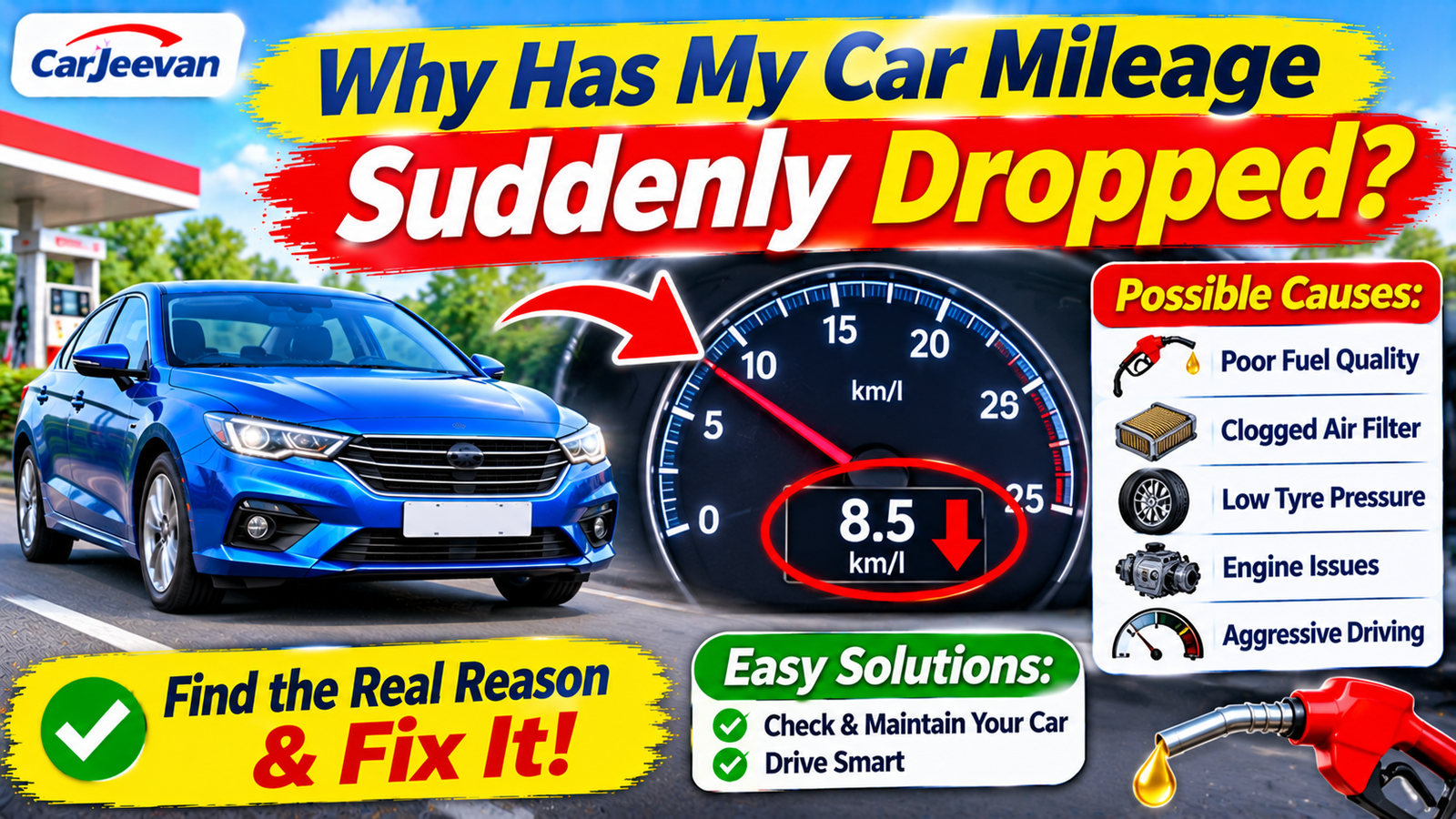
A sudden drop in mileage usually has an ordinary cause: low tyre pressure, extra weight, more AC, heavier traffic, a change in driving habits or a different fuel. Mechanical causes such as worn spark plugs, a faulty oxygen sensor or a dirty air intake come after those, and they often bring other signs, such as a warning light or rough idling. The sensible order is to check that the drop is real, rule out the easy things, and only then ask a workshop to scan the car.
This guide explains how to measure mileage properly, what the extra fuel costs, what usually changes, how ethanol-blended petrol fits in, indicative repair costs in India, and how to compare two quotes. We did not test any car for this article. Measurement methods come from Indian motoring sites, the E20 numbers from the Petroleum Ministry, the fuel-saving tips from a government agency’s guidance, costs from published ranges, and the worked examples are hypothetical.
Why Has My Car Mileage Suddenly Dropped? – Quick Overview
| What changed | What it may point to | Who checks it |
|---|---|---|
| You refuelled at a different pump or the petrol changed | Fuel quality, or ethanol blend (E20) | You: try a full tank elsewhere |
| New tyres, a puncture repair or a tyre pressure change | Wrong pressure, a different size or tyre type, alignment | You for pressure, a workshop for size and alignment |
| Hotter weather or more AC | AC load | You |
| Heavier traffic, a new route or a new driving style | Driving conditions | You |
| Extra weight, a roof carrier or accessories | Load and drag | You |
| A warning light, rough idle or loss of power | Ignition, sensor or air-fuel problem | A workshop, with a scan |
| A smell of fuel or a drip | A fuel leak | A workshop, now |
| The car feels sluggish, the clutch slips or the brakes feel heavy | Clutch or dragging brakes | A workshop |
| Only the trip computer changed | A measurement error | You: use the tank-to-tank method |
Step 1: Is the Drop Real?
The trip computer and fuel gauge can mislead. The standard check is the tank-to-tank method. Spinny’s guide gives the steps: fill the tank completely, reset the trip meter, drive normally for a few days, refill the tank completely again, note the litres, and divide the distance by the litres. CarDekho adds that you should fill to the brim, and that visiting the same filling station helps reduce error. Autocar India suggests using one trip meter for each fill-up and noting the litres each time.
Use the same pump and stop at the first click each time, and measure two or three tanks, not one, because a single tank can vary with traffic and with how full the tank really was.
A worked example (hypothetical). These figures are invented to show the method. Before the change, 480 km on 30 litres gave 16 km a litre. Now, 400 km on 32 litres gives 12.5 km a litre. That is a drop of (16 − 12.5) ÷ 16, or about 22%.
| Before | Now | |
|---|---|---|
| Distance and fuel (one tank) | 480 km on 30 litres | 400 km on 32 litres |
| Mileage | 16 km a litre | 12.5 km a litre |
| Litres for 12,000 km a year | 750 | 960 |
| Fuel cost at ₹102.12 a litre (Delhi petrol, 1 November 2026) | ₹76,590 | ₹98,035 |
The drop costs about ₹21,445 more a year at that price and distance. Our annual car maintenance cost guide shows the full formula, and that is why a persistent drop is worth chasing.
Step 2: Check the Easy Things First
- Tyre pressure. The Petroleum Conservation Research Association (PCRA), a government agency, says in its driving guidance that a 25% fall in tyre pressure can cost 5–10% more fuel, which is the agency’s claim. Check the pressure when the tyres are cold, against the figure in your owner’s manual or on the car’s placard.
- Load. Remove unneeded weight, roof carriers and accessories.
- AC. It adds load, so a hotter spell with more AC use lowers mileage. We found no reliable figure to quote.
- Driving style. PCRA lists sudden acceleration, jack-rabbit starts, violent braking, improper gear selection, riding the clutch and unnecessary idling as habits that waste fuel.
- Traffic and route. Stop-and-go traffic and short trips lower mileage compared with steady highway driving.
Did the Fuel Change?
India has moved to E20 petrol, which is petrol blended with 20% ethanol, and Spinny’s guide notes that E20 is now widely available. The Ministry of Petroleum and Natural Gas said in August 2025 that ethanol has a lower energy density than petrol, so the effect on fuel efficiency is marginal: a mileage drop of about 1–2% for vehicles designed for E10 and calibrated for E20, and around 3–6% for other vehicles. It also said the drop can be reduced with better engine tuning and E20-compatible parts, and that older vehicles may need minor rubber or gasket replacements after 20,000 to 30,000 km.
Those are the ministry’s figures, and you may judge them differently. But they give a yardstick. If your mileage has fallen by 15–20% overnight, a change of fuel alone is unlikely to explain it, which is our inference, not a ministry statement. Look at the other causes, and try a full tank from a different station to see what changes.
When It Is Mechanical
Amaron’s check engine light guide, quoted in our earlier work, lists causes with a bearing on fuel use. They are possibilities, not a diagnosis.
- Spark plugs or ignition coils. A weak spark causes misfires, rough idling and wasted fuel. A flashing check engine light with a misfire means stop driving as soon as it is safe.
- Oxygen sensor. It helps the computer set the fuel mixture, and a failing one can raise fuel use.
- Mass airflow (MAF) sensor. Dust can clog it, and it is sometimes cleaned instead of replaced.
- Thermostat. One that sticks open can keep the engine too cool, which the computer compensates for with more fuel. One that sticks closed causes overheating, which is urgent.
- EGR valve carbon build-up. More common in stop-go traffic, according to Amaron.
- Dragging brakes, a slipping clutch or misaligned wheels. Our guides to wheel alignment and clutch replacement cost cover two of these.
- A fuel leak. A smell of petrol or a drip needs immediate attention.
A car that runs fine with only a lower reading on the pump is less urgent than one with a warning light or rough running. Either way, ask for a scan before parts are replaced.
Indicative Costs in India
| Item | Published figure | Source (checked 5 Nov 2026) | What to know |
|---|---|---|---|
| OBD scan only | ₹0 (self) to ₹500 at a workshop | Amaron (27 June 2026) | Many providers scan for free, per Amaron. Reading codes is not diagnosis. |
| Spark plugs | ₹500–₹4,000 | Amaron | Depends on the engine. |
| Oxygen sensor | ₹2,000–₹8,000 | Amaron | Wide range. Ask for the part brand. |
| MAF sensor: cleaning; replacement | ₹200–₹500; ₹3,000–₹10,000 | Amaron | Cleaning is sometimes enough. |
| Thermostat | ₹800–₹3,000 | Amaron | See our overheating guide once live. |
| Wheel alignment | ₹499–₹900 flat (Bangalore tyre shop) | Tyre Torque, in our wheel alignment guide | Another page of the same shop gives ₹1,200–₹1,800. |
| Authorised-centre prices | Not verified | – | No published price list found. |
How far to trust this table. Four limits apply. Most figures come from one source, a battery maker that also sells a diagnostic service. Prices vary by car, city and part. Cleaning and replacement are priced separately. And we found no authorised-centre price list.
How to Compare Two Quotes for Low Mileage
Two quotes are only comparable when they rest on the same measurement and findings. Check these in order:
- The baseline. Did the workshop measure or ask for your before-and-after mileage?
- Codes and findings. Which codes were read, and what did the live data show?
- Scope. Which parts are replaced, and why does each follow from a finding?
- Cleaning or replacement. Which is quoted for sensors and valves?
- Parts. Brand, part number, and new or reconditioned.
- Tax. Bring both quotes to the same basis, as in our guide on how to compare two car repair estimates.
- A re-test. Will mileage be measured again after the repair?
Illustrative example: two quotes for a 22% drop. These figures are invented to show the method. They are not market prices, and neither quote is recommended.
| Line | Quote A (hypothetical) | Quote B (hypothetical) |
|---|---|---|
| Scan and check of tyre pressures | ₹300, a misfire code on one cylinder found | None shown |
| Spark plugs, set of 4 | ₹1,600 (4 × ₹400, brand stated) | – |
| Injector cleaning | – | ₹3,500 |
| Oxygen sensor | – | ₹5,000 |
| MAF sensor | – | ₹6,500 |
| Labour | ₹500 | ₹1,500 |
| Total before tax | ₹2,400 | ₹16,500 |
| GST at 18% | ₹432 | ₹2,970 |
| Total as quoted | ₹2,832 | ₹19,470 |
Quote B is ₹16,638 higher, but the point is not the price. Quote A starts from a scan and a finding, and Quote B lists three parts with no scan, code or measurement shown. Quote B could still be right if the codes support it. Ask which result supports each line, and ask to re-measure mileage afterwards.
How CarJeevan Helps Compare Two Repair Quotes
CarJeevan’s Car Repair Estimate Calculator & Quote Comparator is a free tool for organising two garage quotations side by side. For each quotation you enter the repair items with quantity, parts cost per item and labour, plus other charges, discounts and tax or fees. You can also tick whether a quotation states the part brand or number, explains the warranty, lists labour separately and requires your approval for additional work. The tool then shows the totals and the differences between the two. Its privacy note says the calculations run in your browser.
It has limits. It has no live price database, does not measure mileage or read fault codes, cannot tell you which repair your car needs or whether a garage is overcharging, and does not guarantee savings. Its output is only as accurate as what you enter. Enter taxes exactly as the quotation shows them, and do not count them twice.
For a mileage problem, enter the scan, each part and the labour as separate rows. A part that appears in one quote and not the other is then easy to spot, and it is a question to ask, not a verdict.
Have two garage quotations for your low mileage? Use the CarJeevan comparison tool to organise and compare the parts, labour and other charges entered in both estimates.
Questions to Ask Before Approving the Repair
For general questions, see our list of questions to ask your mechanic before approving any repair. For low mileage, add these:
- Did you scan the car, and which codes did you find?
- What did the live data and inspection show?
- Which finding supports each part on the quote?
- Have you checked tyre pressures, alignment and brakes first?
- Is cleaning an option before replacement, for the MAF sensor or injectors?
- Will you re-test the mileage after the repair, and how?
- Is the warranty written, on both parts and labour?
Prevention: Small Habits That Help
Keep a simple log of litres and kilometres at each fill-up so a drop shows up early. Check tyre pressures regularly, follow the service schedule in your owner’s manual, and avoid the driving habits PCRA lists. If a warning light appears, get the car scanned rather than waiting.
Why Has My Car Mileage Suddenly Dropped? – Frequently Asked Questions
How do I calculate my car’s mileage?
Fill the tank to the brim, reset the trip meter, drive normally, refill to the brim at the same pump, and divide the distance by the litres added. Do it for two or three tanks and average them.
Does E20 petrol reduce mileage?
The Petroleum Ministry says by about 1–2% for vehicles designed for E10 and calibrated for E20, and about 3–6% for other vehicles. A much bigger drop points to other causes.
Does the AC reduce mileage?
Yes, because it adds load on the engine, so heavy AC use lowers mileage. We found no reliable figure, so we do not quote one.
Can low tyre pressure reduce mileage?
Yes. PCRA says a 25% fall in tyre pressure can cost 5–10% more fuel. Check the pressure cold, against your manual.
When should I take the car to a workshop?
If the drop persists after you have checked tyres, load, AC use and fuel, or if there is a warning light, rough running, a fuel smell, a slipping clutch or heavy brakes.
Conclusion
A sudden drop in mileage is a prompt to measure, rule out the simple causes, and then diagnose. Start with the tank-to-tank method to confirm the drop and put a rupee figure on it, then check tyre pressure, load, AC, driving and fuel. If it persists, ask a workshop to scan the car before replacing parts.
A good workshop starts from a measurement and a finding. When you hold two quotes, the CarJeevan tool can line them up row by row, while decisions about your car belong with a qualified technician.
This article is general information, not a diagnosis or professional advice. Prices are estimates checked on 5 November 2026 and may change. Have a qualified technician inspect your car if a warning light is on or it runs roughly.

Through CarJeevan,prashant bobde aims to make confusing automotive information easier to understand. The website focuses on practical questions that car owners face, such as how to compare garage quotations, understand parts and labour charges, review additional fees, and identify the right questions to ask before approving a repair.
CarJeevan also provides a free Car Repair Estimate Calculator and Garage Quote Comparator that helps users organise and compare two repair quotations using the information provided by the user.
The editorial approach focuses on clear explanations, practical examples, and transparent limitations. Where appropriate, articles refer to official information, manufacturer guidance, policy documents, and other reliable sources. Illustrative examples are identified as examples rather than presented as actual market prices.
CarJeevan does not claim to diagnose vehicle faults or independently verify every garage's prices. Readers are encouraged to consult a qualified automotive professional for mechanical inspections and safety-related repair decisions.
The goal is simple: to help Indian car owners understand repair costs better, ask informed questions, and make decisions with greater clarity.
Website: https://carjeevan.com/