
Last reviewed and prices checked: 5 November 2026. This is general information, not a diagnosis. If the red oil pressure light comes on, stop the engine as soon as it is safe.
Introduction
There is a dark patch on the ground where you park. Last week the car smelled faintly of something burning after a long drive. A workshop says “gasket leak” but cannot say how serious it is, or what it should cost.
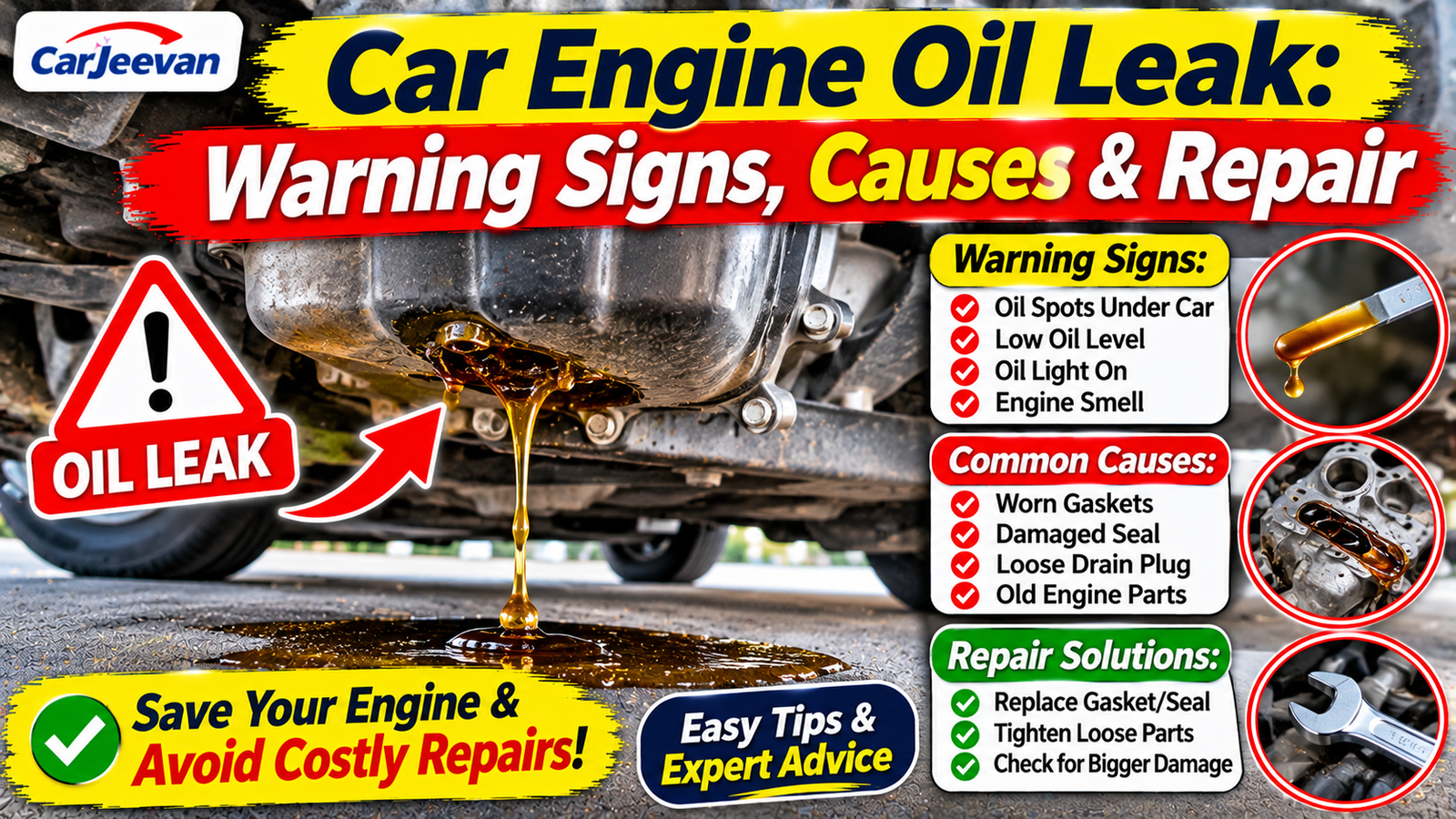
An engine oil leak is oil escaping from the engine through a worn gasket or seal, a loose drain plug or filter, or a damaged part. The usual signs are oil spots under the car, a burning smell, smoke from the engine bay, a dipstick reading that keeps falling, and, in a serious case, a red oil pressure light. Most leaks start as slow seeps from small, cheap parts such as a valve cover gasket. The danger is that oil can run low, which can damage the engine, or reach a hot exhaust, which can smell and may cause a fire risk. How fast the oil is going and which warning lights are on tell you how urgent it is.
This guide explains the warning signs, when to stop driving, the common causes and what the location of the oil tells you, what a repair involves, why parts are cheap but labour is not, and how to compare two quotes. We did not test any car for this article. Safety advice comes from carmakers’ owner’s manuals, causes from workshop sources, parts prices from Maruti Suzuki’s retail site, and the worked example is hypothetical.
Car Engine Oil Leak Symptoms – Quick Overview
| What you notice | What it may mean | Urgency |
|---|---|---|
| Dark, slippery spots or a puddle under the car | A leak from a gasket, seal, pan, drain plug or filter | Medium: get it checked soon; high if the puddle is growing |
| A burning smell after driving | Oil dripping onto a hot exhaust or engine part | Medium to high: check soon |
| Smoke from the engine bay | Oil on hot parts | High |
| Oil on or around the engine, belts or the underside | An active seep, often a valve cover or seal | Medium |
| The dipstick reading keeps falling | Oil is being lost by leaking or burning | Medium to high |
| A red oil pressure light | Oil pressure is too low | Very high: stop the engine as soon as it is safe |
| Knocking or ticking from the engine with low oil | Lubrication may already be inadequate | Very high: stop and get help |
| A drip that began right after an oil change | A loose filter, drain plug or washer | Medium to high: go back to the workshop |
First, Check What the Fluid Is
Fresh engine oil is light brown, and older oil looks darker and thicker, according to one workshop blog. Other fluids, such as coolant and transmission or brake fluid, look and smell different, and a leak of those can be serious too. If you are not sure what is under your car, ask a workshop to identify it before you decide what to do.
When to Stop Driving
Maruti Suzuki’s owner’s manual for the Ciaz says that if the oil pressure light comes on while driving, you should pull off the road as soon as you can and stop the engine, check the oil level and add oil if necessary, and, if there is enough oil, have the lubrication system inspected by an authorised workshop before driving again. It warns that operating the engine with the light on can cause severe engine damage, and that you should not rely on the light to tell you when to add oil, so check the level periodically. Hyundai’s manuals for models sold in India, such as the Eon, i10 and i30, say the same and add that if the engine is not stopped immediately after the light comes on, severe damage could result. Honda Cars India’s WR-V manual says to stop the engine, wait about three minutes, check the oil level, and contact a dealer for repairs immediately if the indicator does not go off within 10 seconds of restarting.
In short: stop, switch off, check the oil, and do not keep driving if the light stays on. Also stop if you see smoke, hear knocking, or find the oil level dangerously low. A small seep with no warning light and a normal dipstick reading is less urgent, but do not ignore it.
Common Causes
A loose or damaged drain plug or oil filter
If the drip began soon after an oil change, the drain plug, its washer or the filter seal is a prime suspect. Workshop sources say a bad filter seal or plug can lose oil much faster than a slow gasket seep, so go back to the workshop promptly.
The valve cover gasket
This gasket seals the cover on top of the engine. Workshop sources describe it as one of the most common leak sources, with oil seeping along the cover’s edge and dripping onto the hot exhaust, which produces a burning smell.
The oil pan or sump gasket, or a damaged pan
The pan sits under the engine. Leaks from the pan gasket or drain plug area show as wet oil around the pan’s seam. A cracked or dented pan, for example from hitting a speed breaker, can leak quickly and drop the oil level during a short drive, according to one parts retailer’s guide.
The oil filter housing, oil cooler or oil pressure sensor
These sit around the engine block. Leaks here can run down the engine and mimic other leaks. One workshop source notes that a leaking oil pressure sensor can also cause confusing warnings.
Front and rear crankshaft seals
The rear main seal sits where the engine meets the gearbox, and workshop sources say a leak there is labour-intensive to fix because the gearbox has to be separated. Our guide to car clutch plate replacement cost explains why the clutch is often looked at at the same time.
The timing cover, PCV system and turbo lines
Some engines leak from the timing cover. A clogged PCV (crankcase ventilation) system can build pressure and push oil out of seals, according to workshop sources, and turbocharged engines have oil feed and drain lines that can leak.
Oil burning, not leaking
Oil that burns inside the engine shows as blue-grey exhaust smoke, especially at start-up, without spots under the car. That is a different problem, and a workshop should check it too.
Where the Oil Is Found Tells You Where to Look
Workshop sources give these rough links. They are clues, not proof, because oil runs downward and the lowest wet part is not always the source.
| Where the oil appears | Likely sources |
|---|---|
| High on the engine, around the top cover | Valve cover gasket, oil filler cap, PCV system |
| At the front of the engine | Oil filter housing, timing cover, front crankshaft seal, oil cooler, pressure switch |
| Between the engine and the gearbox | Rear main seal, or a leak from above running down, the oil pan, or gearbox fluid |
| Underneath the pan, after parking overnight | Oil pan, drain plug, or oil draining from above |
| On the drive belt | A front seal, filter housing, valve cover or timing cover above the belt |
| Right after an oil change | Filter, drain plug or washer, or a spill |
What You Can Safely Check
Look under the car after it has been parked overnight, and note where and how much. Check the oil level when the engine is cold and the car is on level ground, as your owner’s manual describes, and do so periodically, since Maruti Suzuki says not to rely on the oil light. Look at the engine bay for wet or oily areas. Tell the workshop when it began, whether it followed a service, and any smell or smoke. Do not climb under a car on a jack. Leave tracing and repair to a workshop.
What a Workshop Should Do
A workshop should find the source before replacing parts. That means cleaning the area, running the engine or driving briefly, and tracing the wet oil upward to its highest point, because a valve cover leak can run down and make the pan look guilty, as one source puts it. A quote that goes straight to a large part without showing how the source was found deserves questions.
Repair and Cost: Cheap Parts, Costly Access
The gaskets and seals themselves are inexpensive. Maruti Suzuki’s retail site lists these MRPs, including taxes, for specific part numbers and models:
| Part (parts only) | MRP, including taxes | What to know |
|---|---|---|
| Cylinder head cover (valve cover) gasket | ₹101–₹175 for the part numbers we saw (one small gasket listed at ₹11) | Per piece. Model-specific. |
| Oil filter housing gasket | ₹156.50 | Per piece. |
| Oil cooler gasket | ₹64 | Per piece. |
| Rear crankshaft oil seal | ₹308.50 and ₹912.50 for two part numbers | Per piece. Model-specific. |
| Oil seal housing gasket | ₹175 | Per piece. |
| Cylinder head gasket (for comparison, a different repair) | ₹430–₹3,356 across part numbers | Not an oil leak part, but shows how costs vary by engine. |
| Oil pan gasket; drain plug washer | Not verified | We could not match these to a price. |
| Repair totals in India | Not verified | We found no credible Indian source for oil leak repair totals. |
Source: Maruti Suzuki Genuine Parts listings (see the source list). These are parts-only retail MRPs seen as search-result text.
How far to trust this. Four limits apply. The MRPs are for specific parts on specific models, and they exclude labour. We found no verified Indian labour rates or totals. Workshop sources say the bill depends on access: a valve cover gasket on top of the engine is usually a simpler job, an oil pan gasket needs more access, and a rear main seal needs the gearbox separated, which is why it costs more. So ask for the labour hours and an itemised quote, and see our guide to how car labour charges are calculated.
How to Compare Two Quotes for an Oil Leak
Two quotes are only comparable when they rest on the same findings. Check these in order:
- The trace. How was the source found, and can you see it?
- Scope. Which gasket or seal, and why does it follow from the trace?
- Parts. Brand, part number, and new or reconditioned.
- Labour. Hours, and itemised or lump sum.
- Extras. Oil, filter or other items “while we are there”, and why.
- Tax. Bring both quotes to the same basis, as in our guide on how to compare two car repair estimates.
- Warranty. On parts and on labour, and whether it is written.
Illustrative example: two quotes for an oil leak. These figures are invented to show the method. They are not market prices, and neither quote is recommended.
| Line | Quote A (hypothetical) | Quote B (hypothetical) |
|---|---|---|
| Clean and trace the leak | ₹800, oil found along the valve cover edge | None shown |
| Valve cover gasket | ₹350 (brand and part number stated) | – |
| Rear main seal | – | ₹950 |
| Clutch kit “while the gearbox is out” | – | ₹5,200 |
| Labour | ₹1,900 | ₹8,500 |
| Total before tax | ₹3,050 | ₹14,650 |
| GST at 18% | ₹549 | ₹2,637 |
| Total as quoted | ₹3,599 | ₹17,287 |
Quote B is ₹13,688 higher, but the point is not the price. Quote A is tied to a trace, and Quote B names a rear main seal and a clutch with no trace and no clutch finding shown. Replacing the clutch while the gearbox is out is sensible when the clutch is worn, but that should be a finding, not an assumption. Ask which result supports each line.
How CarJeevan Helps Compare Two Repair Quotes
CarJeevan’s Car Repair Estimate Calculator & Quote Comparator is a free tool for organising two garage quotations side by side. For each quotation you enter the repair items with quantity, parts cost per item and labour, plus other charges, discounts and tax or fees. You can also tick whether a quotation states the part brand or number, explains the warranty, lists labour separately and requires your approval for additional work. The tool then shows the totals and the differences between the two. Its privacy note says the calculations run in your browser.
It has limits. It has no live price database, does not find leaks or diagnose engines, cannot tell you which repair your car needs or whether a garage is overcharging, and does not guarantee savings. Its output is only as accurate as what you enter. Enter taxes exactly as the quotation shows them, and do not count them twice.
For an oil leak, enter the trace, each part and the labour as separate rows. A line that appears in one quote and not the other is then easy to spot, and it is a question to ask, not a verdict.
Have two garage quotations for your oil leak? Use the CarJeevan comparison tool to organise and compare the parts, labour and other charges entered in both estimates.
Questions to Ask Before Approving the Repair
For general questions, see our list of questions to ask your mechanic before approving any repair. For an oil leak, add these:
- Where exactly is the oil coming from, and can you show me?
- Was the leak cleaned and traced, or is the part a guess?
- Is it a gasket, a seal, a loose plug or a damaged part?
- How many hours of labour are quoted, and why?
- Are other parts recommended “while we are there”, and which finding supports them?
- Will you check for leaks after the repair, and is the warranty written?
- Is the oil grade the one in my owner’s manual?
Prevention: Small Habits That Help
Check the oil level periodically, as Maruti Suzuki advises, and look at the engine bay and the ground after parking. Follow the service schedule in your owner’s manual, use the recommended oil grade, and avoid overfilling, which one source lists as a cause of leaks. After an oil change, check for drips. Our annual car maintenance cost guide shows how servicing fits into a yearly budget.
Car Engine Oil Leak – Frequently Asked Questions
Is it safe to drive with an oil leak?
A small seep with a normal dipstick reading and no warning light may be safe for a short drive to a workshop, but do not ignore it. If the oil pressure light comes on, you see smoke, or the engine knocks, stop the engine as soon as it is safe.
What should I do if the oil pressure light comes on?
Pull over safely, switch off the engine, check the oil level, and add oil if it is low, following your owner’s manual. If the light stays on, do not keep driving, and have the car inspected. Maruti Suzuki’s manual warns that running the engine with the light on can cause severe damage.
What are the most common causes of an oil leak?
Workshop sources point to the valve cover gasket, the oil pan gasket, the oil filter and drain plug, and the crankshaft seals. A leak right after an oil change usually points to the filter or drain plug.
How much does it cost to fix an oil leak?
We could not verify Indian repair totals. Maruti Suzuki lists some gaskets and seals at under ₹1,000 MRP for specific part numbers, but labour and access decide the bill, and a rear main seal costs far more than a valve cover gasket because the gearbox must be separated. Get an itemised quote with labour hours.
Can the oil smell burning without a leak?
Yes. Oil burning inside the engine can cause blue-grey smoke at start-up, and spilled oil on a hot exhaust can smell after a service. A workshop should check either way.
Conclusion
An engine oil leak is a warning that something is worn or loose, and how serious it is depends on how fast the oil is going and what the dashboard says. Treat the red oil pressure light, smoke and knocking as reasons to stop. Treat a slow seep as something to diagnose soon.
The parts are often cheap, but access and labour decide the bill, so ask how the source was found and how many hours the job takes. When you hold two estimates, the CarJeevan tool can line them up row by row, while decisions about your engine belong with a qualified technician.
This article is general information, not a diagnosis or professional advice. Prices are estimates checked on 5 November 2026 and may change. Oil leaks can damage an engine quickly, so have a qualified technician inspect your car.

Through CarJeevan,prashant bobde aims to make confusing automotive information easier to understand. The website focuses on practical questions that car owners face, such as how to compare garage quotations, understand parts and labour charges, review additional fees, and identify the right questions to ask before approving a repair.
CarJeevan also provides a free Car Repair Estimate Calculator and Garage Quote Comparator that helps users organise and compare two repair quotations using the information provided by the user.
The editorial approach focuses on clear explanations, practical examples, and transparent limitations. Where appropriate, articles refer to official information, manufacturer guidance, policy documents, and other reliable sources. Illustrative examples are identified as examples rather than presented as actual market prices.
CarJeevan does not claim to diagnose vehicle faults or independently verify every garage's prices. Readers are encouraged to consult a qualified automotive professional for mechanical inspections and safety-related repair decisions.
The goal is simple: to help Indian car owners understand repair costs better, ask informed questions, and make decisions with greater clarity.
Website: https://carjeevan.com/