
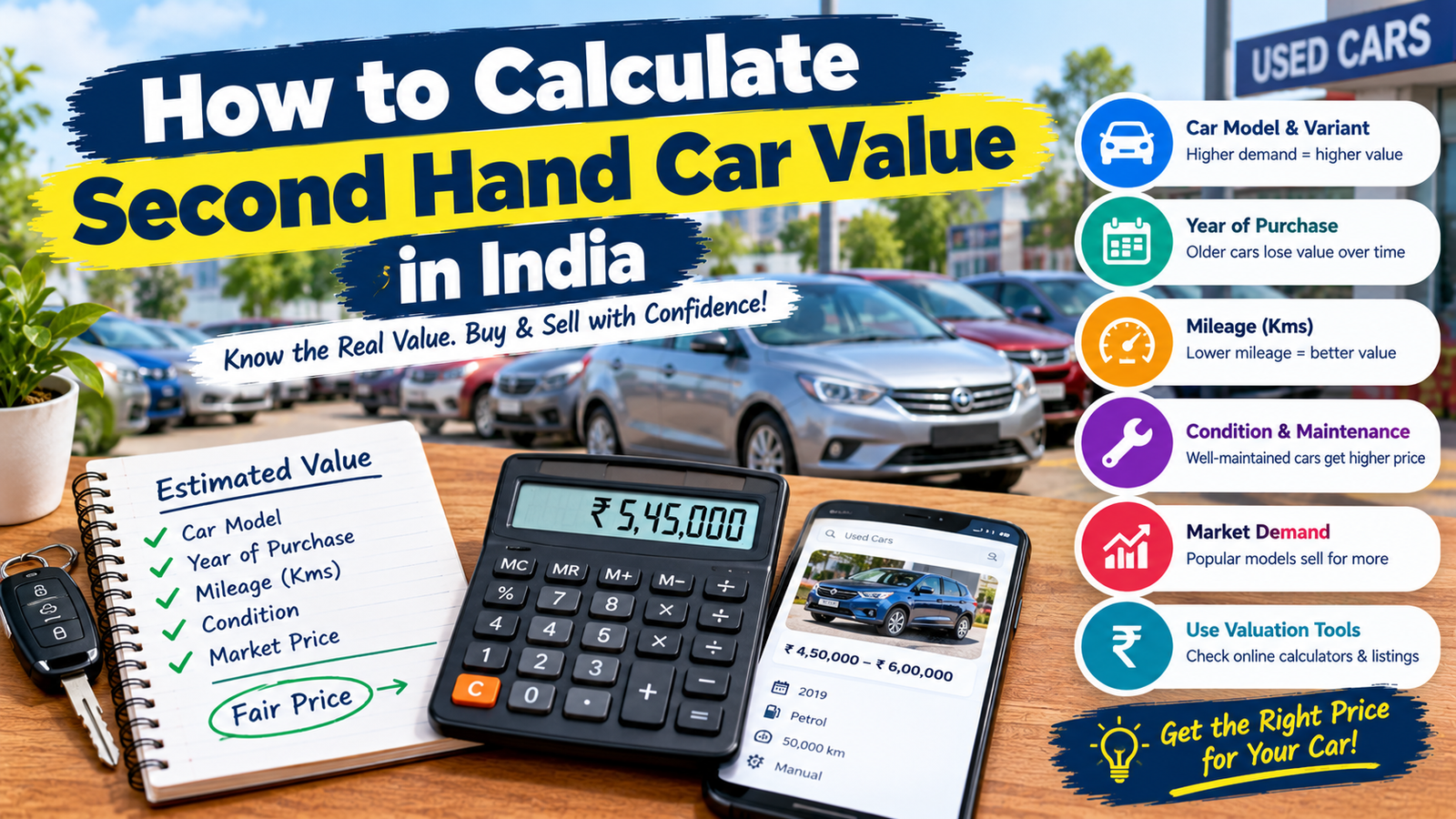
You want to sell your five-year-old hatchback. One website says ₹5.2 lakh, a dealer offers ₹4.3 lakh and a neighbour says it should fetch ₹5.8 lakh. Who is right?
Usually, all of them are partly right, because a used car doesn’t have one “true” price. It has a range, and where you land in that range depends on age, kilometres, owners, condition, demand and who is buying. Once you understand how that range is built, you can value your car yourself, spot a lowball offer and negotiate with confidence.
In this guide, we answer six questions that sellers and buyers ask most about second hand car value in India, with a worked example you can copy.
This guide gives general information. Every figure and percentage below is illustrative, because published rates vary from source to source, and real prices depend on your car, city and the market at that moment.
1. How Is the Resale Value of a Used Car Calculated?
Most valuation methods work in two steps: start with a depreciated base value, then adjust it for the real-world details of your car.
Step 1: Base value from depreciation. Depreciation is the value a car loses with time. A common way to model it is:
Car value = Original price × (1 − depreciation rate) ^ number of years
Online tools use different rates, which is why their answers differ. For example, one illustrative calculator assumes 15% depreciation in the first year and 10% of the remaining value in each year after that. As a very rough guide, one valuation site says a five-year-old car in India typically keeps about 45 to 55 percent of its original ex-showroom price, depending on brand, model, condition and city. Treat that as a ballpark, not a rule.
Step 2: Adjustments. Valuation guides list factors such as age, verified mileage, mechanical and body condition, brand demand, fuel and transmission type, number of owners, service history, accident record and city-level demand. Each can push the base value up or down.
Don’t confuse this with insurance IDV. Insurers use an age-based schedule to set a car’s Insured Declared Value. That schedule is a standard baseline for insurance, and actual resale also depends on mileage, accident history, owners, brand, fuel type and local demand. Use IDV as a rough reference at best, not as your selling price.
2. How Much Does Mileage Affect a Car’s Value?
Mileage matters because it is a quick signal of wear on the engine, clutch, suspension and brakes. But what matters most is kilometres per year, not the total alone.
Online guides use different benchmarks, but a pattern appears. One estimator treats about 10,000 km a year as pristine usage and around 20,000 km a year as high usage, with a deduction of roughly 5 to 8 percent for the high-usage car. Another claim in the same guide is that cars driven beyond 12,000 to 15,000 km a year tend to see a steeper fall in value. These are not official standards, so use them to understand the logic.
How to think about it:
| Situation | Likely effect on value |
|---|---|
| Well below average yearly running, with service records | Supports a higher price |
| Around average running | Neutral |
| Well above average, or ex-taxi or commercial use | Lowers the price |
| Odometer gaps or doubts about the reading | Serious red flag |
Two practical tips. First, calculate km per year: total kilometres divided by the car’s age. A 4-year-old car at 60,000 km averages 15,000 km a year. Second, check that the odometer matches service records, because a tampered reading is one of the biggest risks in the used-car market.
3. Does the Number of Previous Owners Affect Resale Value?
Yes, though the size of the effect varies. Ownership count appears in the standard lists of valuation factors, and buyers tend to read it as a clue to how the car was cared for.
- First owner: Usually preferred, especially with full service history.
- Second owner: Common and widely accepted, with a modest discount.
- Third owner or more: Buyers often worry about maintenance, so discounts tend to be larger.
But an owner count is not a verdict. A second-owner car with complete service records can be a better buy than a first-owner car that was neglected. Frequent ownership changes in a short time, a former commercial registration or unclear paperwork deserve more questions. Remember that the number of owners is shown on the RC, so buyers can verify it.
4. Why Is the Online Car Valuation Different from the Dealer’s Offer?
This is the question behind most seller frustration. There are several reasons the two numbers don’t match.
An online valuation is an estimate, not an offer. An online estimate is not a confirmed purchase offer. It is built from your inputs and the tool’s assumptions, and it usually can’t see the dents, tyre wear or accident history of your actual car. One valuation guide notes that the last portion of a used car’s price is driven by condition, city, ownership count, accident history and season, things that only an inspection can price.
A dealer is buying to resell. Dealer offers tend to be lower because they build in the cost of repairs, showroom expenses and profit margin before reselling. The same source describes three tiers: dealer trade-in as the lowest, then private-party sale and fair market value higher up. The difference is the price of convenience: a dealer gives you quick payment and handles paperwork, while a private sale can earn more but takes time and effort.
Other reasons for the gap:
- The tool’s data may be outdated or based on a different city’s demand.
- Your variant, colour or fuel type may be in lower demand locally.
- The inspection may find issues the tool couldn’t know about.
- Platforms vary in how they price risk and how quickly they want to resell.
A sensible approach is to get two or three offers, from a dealer, a used-car platform and a private-buyer route, and compare them against your own calculation.
5. How Does Car Condition Affect Its Price?
Condition is where your own effort can change the price most. Evaluators generally look at:
- Exterior: dents, scratches, repainted panels, rust and panel gaps
- Interior: seat wear, dashboard cracks, odours, electronics and AC
- Engine and gearbox: noises, leaks, smoke, clutch feel, gear shifts
- Suspension and brakes: clunks, uneven tyre wear, brake condition
- Tyres and battery: remaining life, age and brand
- Accident and flood history: structural repair, airbag deployment, water damage
- Service records: regular servicing, genuine parts and invoices
Condition changes value in two ways. It changes what a buyer will pay, and it changes how fast the car sells. A clean car with a bound folder of service invoices builds trust, which is worth real money. Our guide on how to read a car service bill helps you organise those records properly, and a clear paper trail also helps a buyer feel safe.
6. Should Repair Costs Be Deducted from a Used Car’s Price?
Often yes, but with a few rules so that you neither overpay nor undersell.
Deduct what is necessary and realistic. If a car needs new tyres, a clutch replacement or an AC repair now, the buyer will have to spend that money, so it is fair to reflect it in the price. Don’t deduct for every cosmetic imperfection or for normal wear that is already assumed in an “average condition” valuation.
Avoid double counting. If the valuation tool already assumed average condition, deducting again for ordinary wear counts the same problem twice. Only deduct for issues that are beyond what the valuation assumed.
Use written quotes, not guesses. Get a repair estimate from a garage and compare it with a second one before making a deduction. Our guides on how to compare two car repair estimates in India and car labour charges in India show how to do this properly. You can also enter the lines into our Car Repair Calculator to total parts, labour and GST for each quotation and compare them side by side. It checks arithmetic, but it doesn’t use a live price database, so treat the totals as only as reliable as the quotes you enter.
As a seller: Fixing small things like a dead bulb, a loose trim or a dirty interior is usually worthwhile. Big mechanical or cosmetic repairs may not return their full cost in the sale price, so compare the repair cost with the likely price increase before spending.
As a buyer: Ask for an inspection and get a written estimate for any problem you find, then negotiate using that figure. Safety-critical items such as brakes, tyres and steering should be fixed or priced in with extra caution.
Worked Example: Valuing a 4-Year-Old Hatchback
These numbers are illustrative only. Suppose a hatchback has an ex-showroom price of ₹8,00,000, is 4 years old, and has done 60,000 km.
Step 1: Base value (15% first year, 10% yearly after that)
| Year | Calculation | Value (₹) |
|---|---|---|
| 1 | 8,00,000 × 0.85 | 6,80,000 |
| 2 | 6,80,000 × 0.90 | 6,12,000 |
| 3 | 6,12,000 × 0.90 | 5,50,800 |
| 4 | 5,50,800 × 0.90 | 4,95,720 |
Step 2: Adjustments (assumed)
| Factor | Adjustment (₹) |
|---|---|
| Mileage: 15,000 km a year, above typical | −10,000 |
| Second owner | −15,000 |
| Minor dents and scratches | −8,000 |
| Tyres worn, replacement needed soon | −12,000 |
| Complete service history | +5,000 |
| Net adjustments | −40,000 |
Estimated private-market value: ₹4,95,720 − ₹40,000 = about ₹4,55,000.
Step 3: Think about the buyer
| Route | Illustrative outcome |
|---|---|
| Private sale | ₹4,50,000 to ₹4,60,000, but takes time |
| Dealer or platform | Perhaps ₹4,00,000 to ₹4,25,000, after refurbishment cost and margin |
The aim isn’t a perfect number. It is an informed range, so a dealer’s lower offer doesn’t surprise you and a private buyer’s unrealistic offer doesn’t tempt you.
Common Mistakes When Valuing a Used Car
- Treating one online estimate as the final price
- Comparing your car’s asking price with cars in a different city or condition
- Ignoring kilometres per year and looking only at the total
- Forgetting that fuel type, transmission and variant affect demand
- Deducting repair costs twice
- Over-spending on repairs before selling
- Not checking loans, hypothecation, pending challans or paperwork
- Not completing the ownership transfer after the sale
Quick Checklist
- Note the car’s age, kilometres and km per year.
- Calculate a base value using an illustrative depreciation curve.
- Adjust for owners, condition, service history and accident record.
- Check at least two or three online valuations.
- Get one or two offers from different routes.
- Get written repair estimates before deducting repair costs.
- Keep the RC, insurance, service records and loan clearance papers ready.
- After the sale, make sure the transfer is completed and tracked.
FAQs
Is there an official formula for second hand car value in India?
No single official formula exists. Insurers use a standard IDV schedule, but resale prices come from market demand, condition and negotiation.
Is IDV the same as the resale price?
No. IDV is an insurance baseline, and real resale prices can be higher or lower.
How much value does a car lose each year?
It depends on the brand, model and condition. Many sources describe a steeper fall in the first year and a gentler decline afterwards, but the exact percentages differ, so treat any figure as a rough guide.
Does a first-owner car always sell for more?
Usually it is preferred, but condition, mileage and service history can outweigh the owner count.
Why did the dealer inspect and then reduce the offer?
The online figure was probably an estimate. After inspection, the dealer prices in actual condition, repair needs and resale margin.
Should I repair my car before selling it?
Fix inexpensive, visible issues and make sure the car is clean. For big repairs, compare the cost with the likely increase in price before you decide.
What documents do I need to sell a car?
Typically the RC, insurance, PUC, service records, ID proof and, if the car had a loan, the loan closure papers. Requirements can differ by state, so check with your RTO.
Final Thoughts
A used car’s value isn’t a single number you look up. It is a range you build from depreciation, then adjust for kilometres, owners and condition, then test against real offers. Use online tools as a starting point, get a few offers, deduct only realistic repair costs backed by written quotes, and keep your paperwork in order. Do that, and you will know what your car is worth, whether you are selling it or buying one.

Through CarJeevan,prashant bobde aims to make confusing automotive information easier to understand. The website focuses on practical questions that car owners face, such as how to compare garage quotations, understand parts and labour charges, review additional fees, and identify the right questions to ask before approving a repair.
CarJeevan also provides a free Car Repair Estimate Calculator and Garage Quote Comparator that helps users organise and compare two repair quotations using the information provided by the user.
The editorial approach focuses on clear explanations, practical examples, and transparent limitations. Where appropriate, articles refer to official information, manufacturer guidance, policy documents, and other reliable sources. Illustrative examples are identified as examples rather than presented as actual market prices.
CarJeevan does not claim to diagnose vehicle faults or independently verify every garage's prices. Readers are encouraged to consult a qualified automotive professional for mechanical inspections and safety-related repair decisions.
The goal is simple: to help Indian car owners understand repair costs better, ask informed questions, and make decisions with greater clarity.
Website: https://carjeevan.com/